Quranic Answer
“Is man responsible for his own destiny?” This question is one of the deepest and most fundamental inquiries that has occupied the human mind since ancient times, with various answers offered across different philosophies and religions. From the perspective of the Holy Quran, the answer to this question is unequivocally positive, with a strong emphasis on humanity's role and responsibility in shaping their own destiny, both in this world and the hereafter. While acknowledging divine decree (Qada wa Qadar) and God's eternal knowledge, the Quran in no way negates human free will and volition. Instead, it makes human choice the very basis for accountability, reward, and punishment. These two concepts (divine decree and free will) are not contradictory in the Quranic view; rather, they are complementary. God is the All-Knowing, aware of everything that has been, is, and will be, but this divine knowledge does not impose compulsion on human will. This divine knowledge is like a roadmap where God is aware of all choices and their outcomes, but this awareness does not mean forcing humans to choose a particular path. Humans possess the power of choice and the ability to distinguish good from evil, and this capacity forms the cornerstone of their responsibility. The Quran, in numerous verses, emphasizes human capacity for choice and free will. For instance, in Surah Al-Kahf (18:29), it states: “And say, 'The truth is from your Lord, so whoever wills - let him believe; and whoever wills - let him disbelieve.'” This verse explicitly declares that the path of truth and falsehood has been made clear, and the choice between them rests solely with the individual. This is the responsibility that has been placed upon humanity. If humans had no free will, the concepts of obligation, command and prohibition, reward and punishment, and Paradise and Hell would become meaningless. Divine justice necessitates that reward and punishment are based only on actions that originate from free will and volition. God has granted humanity intellect, innate disposition (fitra), and sent prophets to show the right path, completing the argument against any excuse. Ultimately, it is the human being who decides whether to accept or reject this guidance. This choice is what directs one's path towards eternal felicity or perpetual misery. One of the most beautiful Quranic expressions that clearly illustrates human responsibility in changing one's destiny is found in Surah Ar-Ra'd (13:11): “Indeed, Allah will not change the condition of a people until they change what is in themselves.” This verse clearly indicates that change and transformation in the destiny of an individual or a society originate from within, through their own decisions, thoughts, beliefs, and actions. Felicity or misfortune, progress or decline, honor or disgrace, all stem from human choices and efforts. This means that humans are not only responsible for their actions but also for changing their own life circumstances. This verse is a clear invitation to self-improvement, effort, and inner transformation, emphasizing that no external compulsion, without internal will, can alter human destiny. This Quranic principle is both hopeful and empowering, as it grants humans the ability to guide their lives towards their desired direction through will and effort, freeing them from the dead ends of pure fatalism. The Quran also emphasizes that every action, whether good or bad, will have consequences for its doer. In Surah Az-Zalzalah (99:7-8), we read: “So whoever does an atom's weight of good will see it, And whoever does an atom's weight of evil will see it.” These verses point to the utmost precision and justice in the divine system of reward and punishment, holding each individual directly responsible for even the smallest of their deeds. This responsibility includes intentions, thoughts, and actions performed throughout one's life. The concept of “kashb” (earning/acquisition) in the Quran also signifies this; whatever a person gains, whether good or bad, is the result of their efforts and choices. This perspective moves humans away from a passive state, transforming them into active and dynamic beings who can shape the course of their lives through conscious decisions. This responsibility is not limited to individual actions but also encompasses social responsibility. Humans are accountable for society, family, and even their environment. The Holy Quran refers to humans as “Khalifatullah” (vicegerents of God) on Earth (Surah Al-Baqarah, 2:30), a position that entails a significant responsibility for cultivating the earth and establishing justice and equity. Choosing the right path in life requires utilizing divine guidance sent through prophets and holy scriptures. God has shown the way and guided humanity towards truth through intellect and innate disposition, but taking steps on this path or deviating from it is entirely within human choice. If humans do not take responsibility for this choice and instead blame it on destiny or external factors, they have, in essence, neglected their noble human status. Ultimately, every individual's eternal destiny is entirely dependent on their worldly choices and actions. Paradise and Hell are the natural and logical outcomes of the paths one chooses throughout their life. The Quran explicitly states that no soul will bear the burden of another, and everyone will receive the recompense for their own deeds. “And that there is not for man except that for which he strives” (Surah An-Najm, 53:39). This verse expresses the ultimate human responsibility and the direct link between effort and its results. Even when humans face hardships and afflictions, the Quran in Surah An-Nisa (4:79) states: “Whatever good comes to you, [O man], it is from Allah; but whatever evil befalls you, it is from yourself.” This verse further confirms human responsibility for the misfortunes and problems that befall them due to their poor choices or actions. This means that Allah, the Most High, is the source of all good and blessings, but any evil or harm that afflicts a person is the direct result of their own wrong choices and decisions. This perspective empowers humans to prevent many problems and forge a better destiny for themselves through thoughtful and correct choices. This Quranic explanation of human responsibility for one's destiny does not negate reliance on God and divine assistance. On the contrary, trust in God (Tawakkul) and prayer are complementary to effort and striving. Humans should exert their utmost effort and, alongside that, seek help from God and rely on Him. This is the “synthesis of free will and predestination” alluded to in Islamic teachings: effort and striving in the path of free will, coupled with reliance and trust in God's absolute knowledge and power. In summary, the Holy Quran emphatically declares that humans are beings endowed with free will, responsibility, and consciousness, and their worldly and eternal destiny rests upon their own choices and actions. This responsibility is not a mere burden; rather, it is a sign of humanity's dignity and elevated status in the sight of God, enabling them to consciously and responsibly shape their life's path with firm will and determination. This profound understanding forms the basis for all human progress and perfection.
Related Verses
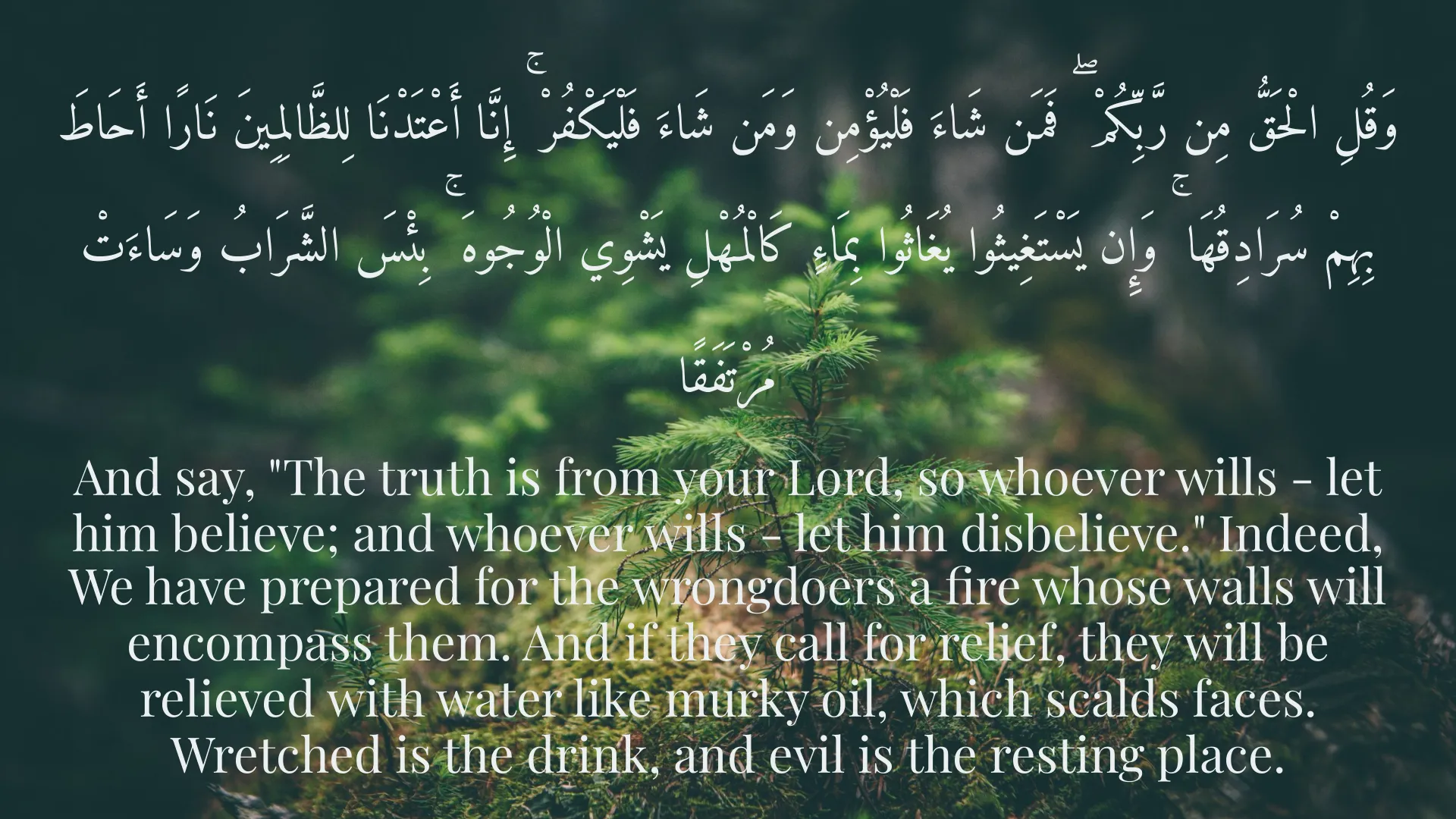
وَقُلِ الْحَقُّ مِن رَّبِّكُمْ ۖ فَمَن شَاءَ فَلْيُؤْمِن وَمَن شَاءَ فَلْيَكْفُرْ ۚ إِنَّا أَعْتَدْنَا لِلظَّالِمِينَ نَارًا أَحَاطَ بِهِمْ سُرَادِقُهَا ۚ وَإِن يَسْتَغِيثُوا يُغَاثُوا بِمَاءٍ كَالْمُهْلِ يَشْوِي الْوُجُوهَ ۚ بِئْسَ الشَّرَابُ وَسَاءَتْ مُرْتَفَقًا
And say, "The truth is from your Lord, so whoever wills - let him believe; and whoever wills - let him disbelieve." Indeed, We have prepared for the wrongdoers a fire whose walls will encompass them. And if they call for relief, they will be relieved with water like murky oil, which scalds faces. Wretched is the drink, and evil is the resting place.
Al-Kahf : 29
لَهُ مُعَقِّبَاتٌ مِّن بَيْنِ يَدَيْهِ وَمِنْ خَلْفِهِ يَحْفَظُونَهُ مِنْ أَمْرِ اللَّهِ ۗ إِنَّ اللَّهَ لَا يُغَيِّرُ مَا بِقَوْمٍ حَتَّىٰ يُغَيِّرُوا مَا بِأَنفُسِهِمْ ۗ وَإِذَا أَرَادَ اللَّهُ بِقَوْمٍ سُوءًا فَلَا مَرَدَّ لَهُ ۚ وَمَا لَهُم مِّن دُونِهِ مِن وَالٍ
For each one are successive [angels] before him and behind him who protect him by command of Allah. Indeed, Allah will not change the condition of a people until they change what is in themselves. And when Allah intends for a people ill, there is no repelling it. And there is not for them besides Him any patron.
Ar-Ra'd : 11
فَمَن يَعْمَلْ مِثْقَالَ ذَرَّةٍ خَيْرًا يَرَهُ ﴿٧﴾ وَمَن يَعْمَلْ مِثْقَالَ ذَرَّةٍ شَرًّا يَرَهُ ﴿٨﴾
So whoever does an atom's weight of good will see it, And whoever does an atom's weight of evil will see it.
Az-Zalzalah : 7
Short Story
One day, a poor and weary dervish sat at the doorstep of a house, sighing and lamenting, "What a destiny has befallen me! It seems divine fate has decreed that I shall always be poor and helpless." At that moment, a wise old man, a man of insight and knowledge, happened to pass by and heard his words. The elder approached the man and, with a welcoming face, said, "Young man, what words are these that you utter? Do you imagine that divine decree is without wisdom?" The dervish replied, "Yes, destiny has written it thus for us." The elder smiled kindly and said, "Have you not heard what Sa'di of Shiraz said: 'A man of good name never dies,' and also that 'effort and striving' yield good fruit? My friend, God is the Provider, but He opens the door to provision only for those who take a step and do not neglect their inner treasures. Have you ever made an effort to change your own condition? Cease your complaints and instead, take a step towards earning a livelihood. Your destiny is in your hands, not in the compulsion of time." The man pondered these words. From that day forward, he abandoned his idleness, and through effort and striving, he transformed his life, freeing himself from the bonds of poverty and despair. He understood that human will plays a significant role in shaping one's own destiny.