Quranic Answer
In the Holy Quran, one of the most profound and simultaneously challenging concepts is the topic of divine decree, or 'Qadar,' in conjunction with human free will and choice. A careful examination of the Quranic verses reveals that these two concepts are not contradictory; rather, they are intertwined in a wise and logical manner that portrays both the majesty and infinite knowledge of God, and affirms human responsibility and free will. The definitive answer is that, from the Quranic perspective, divine decree and human free will are entirely compatible and each plays a distinct and crucial role. Let us first delve into the concept of 'Divine Decree' (Qadar). Linguistically, Qadar means to measure, determine, or predestine. In Islamic terminology, Qadar refers to God's absolute and pre-existent knowledge of all events, destinies, and details of existence, from eternity to eternity. Allah, by virtue of His infinite knowledge, is aware of everything that has been, is, and will be. This awareness does not imply that events are forced upon humans; rather, through His boundless knowledge, God knows which paths His servants will choose and what actions they will undertake with their free will. In essence, God's knowledge of human actions is simply His knowledge of their choices, not His compulsion of those choices. This divine knowledge encompasses all the laws governing the universe, the divine traditions in creation and guidance, and also the consequences and outcomes of human actions. This is referred to as the 'Clear Book' or 'Preserved Tablet' (Al-Lawh Al-Mahfuz) in the Quran, where all matters are recorded. However, this recording does not mean that free will is taken away from the creation; rather, it records what will happen by their own choice. For example, in Surah Ar-Ra'd, verse 39, we read: "Allah erases what He wills or confirms [what He wills], and with Him is the Mother of the Book." This verse indicates that while certain matters are decreed, there is also the possibility of change and divine will, which itself can be connected to human actions. Conversely, we have the concept of 'Human Free Will' (Ikhtiyar). The Quran explicitly emphasizes that humans are endowed with choice and have the power to decide. Allah the Almighty created humanity with intellect, the ability to discern right from wrong, and the capacity to choose good or evil. It is this free will that makes humans accountable for their actions and forms the basis for reckoning, reward, and punishment on the Day of Judgment. If humans were not free, divine commands and prohibitions, the sending of prophets, and the promise of Paradise and warning of Hell would be meaningless. Numerous verses in the Quran explicitly attest to human free will. For instance, in Surah Al-Kahf, verse 29, we read: "So whoever wills – let him believe; and whoever wills – let him disbelieve." This verse clearly shows that humans are free to choose their path of belief or disbelief. Furthermore, in Surah Al-Insan, verse 3, it states: "Indeed, We guided him to the way, whether grateful or ungrateful." This verse also emphasizes that God has shown humanity the way of guidance, but the choice of path, whether gratitude or ingratitude, rests with them. Now, how do these two concepts coexist? The compatibility of divine decree and human free will in the Quran is based on a correct understanding of divine knowledge and will. God's knowledge is pre-existent and encompasses all choices that humans will make through their free will. This knowledge, in no way, removes free will from humans, because knowing something is different from compelling it. Imagine a teacher who knows which student will succeed through hard work and which will fail due to laziness. The teacher's knowledge does not compel the students to succeed or fail. They still choose to work hard or neglect their studies. Similarly, God, with His infinite knowledge, is aware of our choices, but this awareness does not alter the voluntary nature of our actions. Another crucial point is that human will operates within the framework of divine decree. This means that God has created a universe in which the possibility of choice and will exists for humans. All talents, abilities, and environmental conditions that humans find themselves in are part of divine decree. However, how these talents are utilized and how these conditions are reacted to, is within human control. In their life journey, humans encounter obstacles and opportunities that are part of their destiny, but how they confront them, decide, and act is the result of their will and choice. This perspective does not lead to fatalism; instead, it motivates humans towards effort, striving, and responsibility. A correct belief in Qadar does not negate effort; rather, it means reliance on God after exerting all possible effort and striving. In summary, the Quran offers a balanced philosophy that encompasses the majesty of the Creator while preserving the value and responsibility of the created being. Humans are free agents, but they live in a system managed by a wise and knowing Creator. This balance strengthens human motivation for righteous deeds and avoidance of sin, as they know that their destiny, to a large extent, is the outcome of their own choices and actions, which are, of course, recorded in God's eternal knowledge. This perspective prevents humans from despair in the face of difficulties and arrogance in the face of successes, guiding them towards humility and reliance on God, while simultaneously taking responsibility for their actions. Therefore, the concept of divine decree in the Quran is not only compatible with human free will but forms the foundation of the system of divine recompense and guidance.
Related Verses
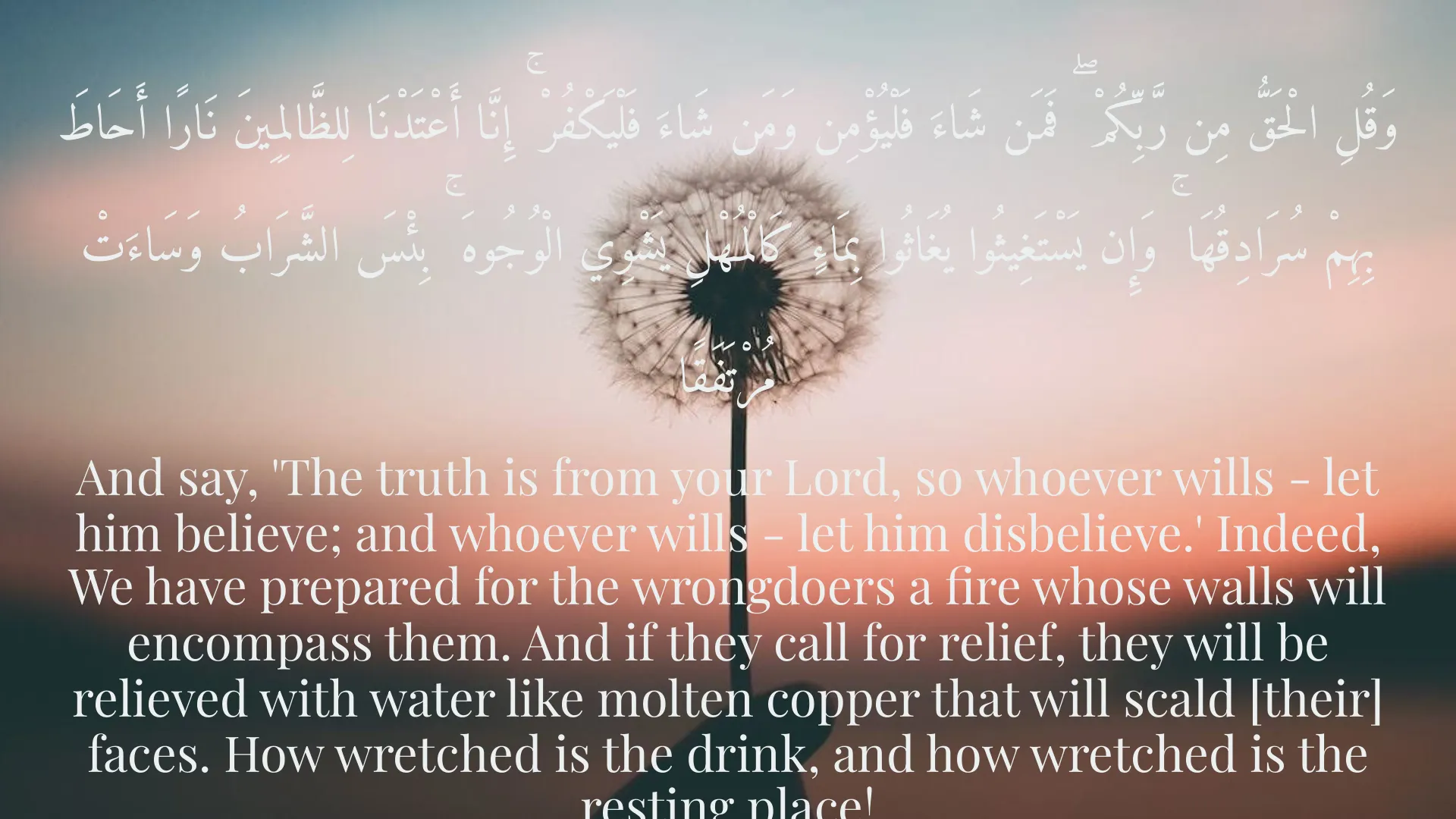
وَقُلِ الْحَقُّ مِن رَّبِّكُمْ ۖ فَمَن شَاءَ فَلْيُؤْمِن وَمَن شَاءَ فَلْيَكْفُرْ ۚ إِنَّا أَعْتَدْنَا لِلظَّالِمِينَ نَارًا أَحَاطَ بِهِمْ سُرَادِقُهَا ۚ وَإِن يَسْتَغِيثُوا يُغَاثُوا بِمَاءٍ كَالْمُهْلِ يَشْوِي الْوُجُوهَ ۚ بِئْسَ الشَّرَابُ وَسَاءَتْ مُرْتَفَقًا
And say, 'The truth is from your Lord, so whoever wills - let him believe; and whoever wills - let him disbelieve.' Indeed, We have prepared for the wrongdoers a fire whose walls will encompass them. And if they call for relief, they will be relieved with water like molten copper that will scald [their] faces. How wretched is the drink, and how wretched is the resting place!
Al-Kahf : 29
إِنَّا هَدَيْنَاهُ السَّبِيلَ إِمَّا شَاكِرًا وَإِمَّا كَفُورًا
Indeed, We guided him to the way, whether grateful or ungrateful.
Al-Insan : 3
يَمْحُو اللَّهُ مَا يَشَاءُ وَيُثْبِتُ ۖ وَعِندَهُ أُمُّ الْكِتَابِ
Allah erases what He wills or confirms [what He wills], and with Him is the Mother of the Book.
Ar-Ra'd : 39
Short Story
It is narrated that in ancient times, a pious man, who placed his trust in God, saw a dervish lamenting his poverty and hardship, saying, 'O unfortunate me, destiny has decreed that I shall always be in suffering.' The pious man kindly told him: 'My friend, God is Generous and the Provider, but He has never closed the door of effort and striving upon His servant. As Sa'di says: 'If the rain of mercy does not fall on the lazy, the seed of hope will not sprout on the ground.' (This line embodies Sa'di's teaching about the importance of effort alongside reliance on God.) Arise and seek your sustenance. For sustenance is decreed, but this does not mean you should sit idle. It may be that your destiny guides you towards your provision, but your steps must tread the path to reach it.' The dervish took heed of this advice, and with pure intention and increased effort, he began to work and strive. After some time, he found that his sustenance increased, and he was freed from hardship. Then he understood that divine decree is nothing but wisdom and justice, and it never negates human free will, but rather paves the way for success for those who strive.