Quranic Answer
While the Holy Quran does not use the exact phrase 'the fall of man as freedom,' the profound concept underlying this question is extensively and clearly elucidated in numerous verses. The Quran repeatedly emphasizes that humanity is endowed with free will and is an autonomous being. This freedom and choice offer both the potential for ascension and perfection and concurrently provide the ground for a 'fall' in the sense of sin, error, and deviation from the straight path. Indeed, this 'fall' is not due to a deprivation of freedom, but rather it is a direct consequence and outcome of the exercise of that very freedom and choice. The central narrative that illuminates this concept is the story of Adam and Eve in Paradise. Allah commanded them not to approach a specific tree, but Satan tempted them. Here, despite their awareness of the divine command, Adam and Eve, by their own will and choice, decided to eat from that tree. This choice, which led to their 'descent' (hubut) and expulsion from Paradise to Earth, is a clear example of the exercise of human freedom. Their descent to Earth was not merely a forced demotion but a part of the divine plan for the commencement of human life on Earth and for testing humanity in the crucible of free will. From this perspective, Adam's initial 'fall' symbolizes that human beings, possessing free will, can choose a path that carries consequences, even if those consequences appear to be a 'descent.' Many verses in the Holy Quran refer to human accountability for their actions and emphasize that each individual freely chooses their path. Allah has shown the path of truth and falsehood and has left humanity free to choose. "By the soul and by Him Who proportioned it and inspired it [with discernment of] its wickedness and its righteousness, He has succeeded who purifies it, and he has failed who corrupts it." (Surah Ash-Shams, verses 7-10). These verses clearly indicate that humans possess two internal forces (wickedness and righteousness), and the choice between them rests with them. Choosing wickedness (sin and error) can be a form of 'fall' that human freedom makes possible. The purpose of granting this freedom is for trial and testing (ibtila'). Earthly life is a field for testing human beings to determine who among them is best in deeds. This test is meaningful only in the light of freedom and choice. If humans were compelled to obey, the concept of trial, reward, and punishment would cease to exist. Therefore, the possibility of a 'fall' or error is an indispensable part of this freedom, and without it, neither freedom nor divine trial would have meaning. The Quran explicitly states: "Say, 'The truth is from your Lord, so whoever wills - let him believe; and whoever wills - let him disbelieve.'" (Surah Al-Kahf, verse 29). This verse clearly articulates humanity's absolute freedom to choose between belief and disbelief. Choosing disbelief is an instance of a 'fall' that occurs through the exercise of free will. However, the Quran never considers this 'fall' as the end of humanity's journey. Instead, it always keeps open the door of repentance, return, and rectification. After every slip or error, a person can, through repentance and supplication to Allah, return to the right path and even attain higher degrees of perfection. This capacity for return is another sign of divine mercy and an emphasis on the positive aspect of freedom, which can lead to salvation. "Except for those who repent, believe and do righteous deeds. For them Allah will change their evil deeds into good ones. And Allah is Oft-Forgiving, Most Merciful." (Surah Al-Furqan, verse 70). This verse shows that even after a 'fall' (sin), the path to transforming it into good deeds is open. In summary, the Quran indicates that the possibility of a 'fall' (meaning deviation, sin, or disobedience) is an inherent necessity for a being endowed with the gift of will and choice. This 'fall' is, in fact, the result of exercising freedom, not its deprivation. With their freedom, humans can ascend to the heights of perfection or descend to the depths of degradation, and this choice places a great responsibility upon them. Understanding this helps us to perceive freedom not just as a right, but as a great divine responsibility that shapes our path to happiness or misery.
Related Verses
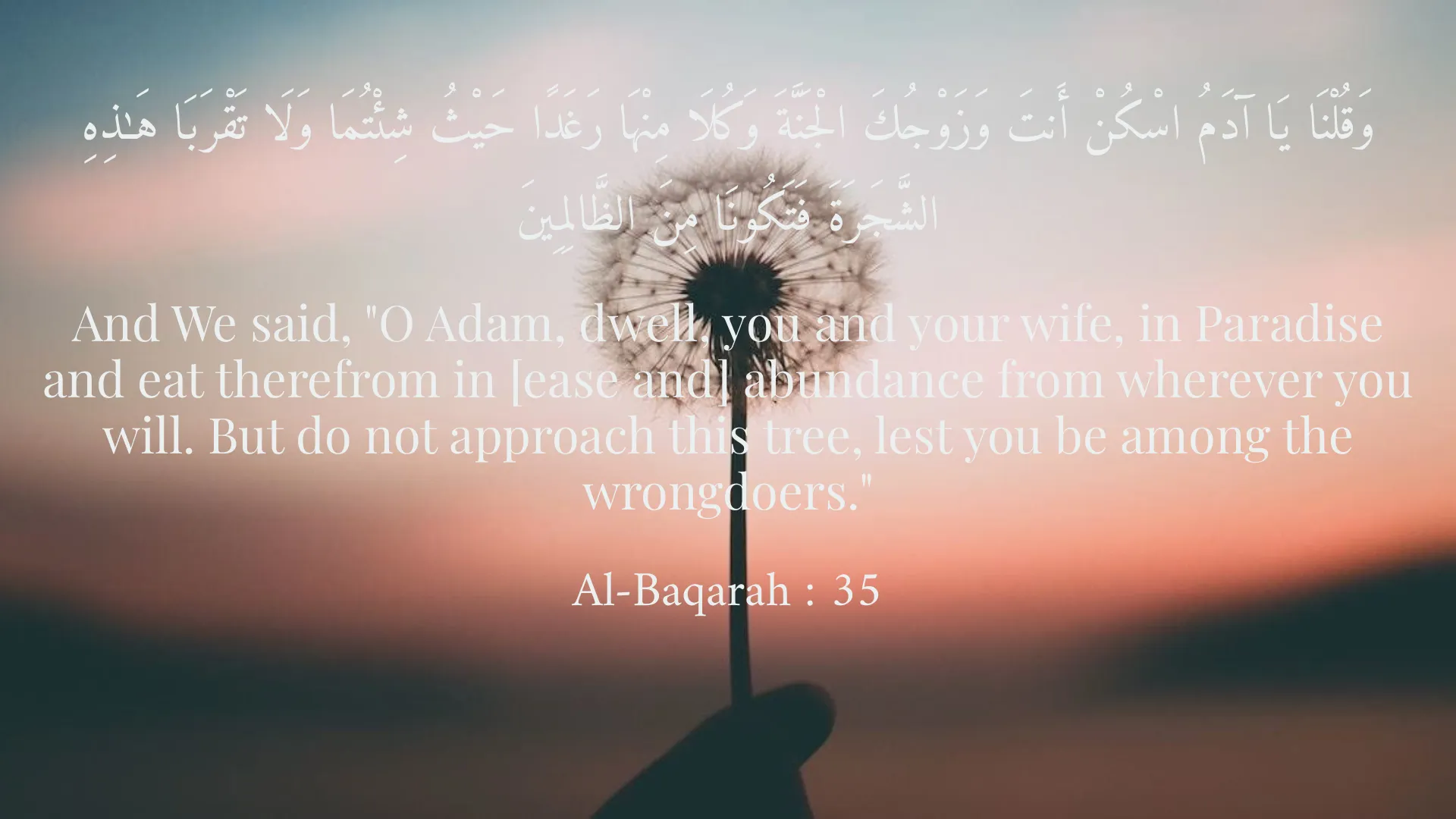
وَقُلْنَا يَا آدَمُ اسْكُنْ أَنتَ وَزَوْجُكَ الْجَنَّةَ وَكُلَا مِنْهَا رَغَدًا حَيْثُ شِئْتُمَا وَلَا تَقْرَبَا هَٰذِهِ الشَّجَرَةَ فَتَكُونَا مِنَ الظَّالِمِينَ
And We said, "O Adam, dwell, you and your wife, in Paradise and eat therefrom in [ease and] abundance from wherever you will. But do not approach this tree, lest you be among the wrongdoers."
Al-Baqarah : 35
فَأَزَلَّهُمَا الشَّيْطَانُ عَنۡهَا فَأَخۡرَجَهُمَا مِمَّا كَانَا فِيهِۖ وَقُلۡنَا اهۡبِطُواْ بَعۡضُكُمۡ لِبَعۡضٍ عَدُوٌّۖ وَلَكُمۡ فِي ٱلۡأَرۡضِ مُسۡتَقَرٌّ وَمَتَٰعٌ إِلَىٰ حِينٍ
But Satan caused them to slip out of it and removed them from that [state] in which they had been. And We said, "Descend, being to one another enemies. And for you on earth will be a [temporary] settlement and enjoyment for a time."
Al-Baqarah : 36
وَقُلِ الْحَقُّ مِن رَّبِّكُمْ ۖ فَمَن شَاءَ فَلْيُؤْمِن وَمَن شَاءَ فَلْيَكْفُرْ ۚ إِنَّا أَعْتَدْنَا لِلظَّالِمِينَ نَارًا أَحَاطَ بِهِمْ سُرَادِقُهَا ۚ وَإِن يَسْتَغِيثُوا يُغَاثُوا بِمَاءٍ كَالْمُهْلِ يَشْوِي الْوُجُوهَ ۚ بِئْسَ الشَّرَابُ وَسَاءَتْ مُرْتَفَقًا
And say, 'The truth is from your Lord, so whoever wills - let him believe; and whoever wills - let him disbelieve.' Indeed, We have prepared for the wrongdoers a fire whose walls will encompass them. And if they call for relief, they will be relieved with water like molten copper that scalds faces. Wretched is the drink, and bad is the resting place.
Al-Kahf : 29
وَنَفْسٍ وَمَا سَوَّاهَا
And [by] the soul and [by] He who proportioned it
Ash-Shams : 7
فَأَلْهَمَهَا فُجُورَهَا وَتَقْوَاهَا
And inspired it [with discernment of] its wickedness and its righteousness,
Ash-Shams : 8
قَدْ أَفْلَحَ مَن زَكَّاهَا
He has succeeded who purifies it,
Ash-Shams : 9
وَقَدْ خَابَ مَن دَسَّاهَا
And he has failed who corrupts it.
Ash-Shams : 10
Short Story
It is narrated that in ancient times, there was a renowned wrestler, famous far and wide for his prowess. His master had taught him all the techniques, save for one hidden move which he kept to himself. The student, puffed up with pride and conceit, feeling the power within himself, one day challenged his master to a duel in the town square. The master gently dissuaded him, but the student refused, arrogantly declaring: "I am now peerless, and I have learned all techniques from you!" Seeing no other way but to reveal the truth, the master sternly told him: "Though you may think you have reached the peak, the sin of your arrogance will pull you into a deep abyss." In the heat of battle, the master used that unspoken technique to bring the proud student to the ground, bringing him to his knees. The student, ashamed and remorseful from that 'fall,' learned a great lesson: that freedom in choosing one's path can either lead to the peak or to a downfall, and only humility and self-awareness can truly protect a person from a real fall. From that day on, despite his strength, the wrestler remained humble, knowing that every misstep was a result of a choice he had made with his freedom.