Quranic Answer
In the teachings of the Holy Quran, knowledge ('ilm) and faith (iman) are not merely separate concepts; rather, they are like two wings enabling humanity to soar towards truth and perfection. The Quran explicitly emphasizes the importance of knowledge and reflection, presenting them as pathways to deepen faith and understand God. Indeed, many Quranic verses invite humanity to ponder and contemplate the creation of the heavens and the earth, natural phenomena, and even their own selves, thereby recognizing the Creator's grandeur and strengthening their belief. This call to acquire knowledge is not merely about accumulating information but about gaining a profound understanding of the divine order and wisdom pervading the universe. The Quran repeatedly uses terms such as 'ta'qilun' (you reason), 'tatafakkarun' (you reflect), 'tatadabbarun' (you ponder deeply), and 'ulu al-albab' (people of understanding/intellect) to indicate that comprehension and deep thinking are integral to faith. These verses teach us that every phenomenon in existence, from the smallest particle to the most expansive galaxies, is a 'sign' (ayah) of God's boundless power, knowledge, and wisdom. The more one contemplates these signs and gains understanding through knowledge, the more their recognition of God increases, consequently making their faith stronger and more profound. For instance, the discovery of laws in physics, chemistry, biology, and astronomy does not contradict faith; rather, each new discovery can reveal an aspect of the creation's grandeur and order, leading humanity to praise and glorify the Lord. Conversely, faith also serves as a framework and guide for knowledge. Faith, as derived from the Quran, imbues knowledge with purpose and meaning. Knowledge without faith can become a mere tool for material gain or even destructive ends. However, when knowledge is accompanied by faith, it is directed towards serving humanity, promoting ethics, and gaining a deeper understanding of absolute truth. Belief in Allah and accountability before Him prevents the scholar from arrogance and self-aggrandizement, calling them instead to humility before divine, boundless knowledge. In the Quranic worldview, the ultimate goal of knowledge is to achieve reverence and piety towards God. As stated in Surah Fatir, verse 28: 'Indeed, those who fear Allah among His servants are only those who have knowledge.' This verse indicates that true knowledge is not only compatible with faith but leads to an increase in reverence and piety towards God, for the more one knows, the more one realizes the Creator's grandeur and power. The Quran repeatedly elevates those with knowledge above the ignorant, referring to them as those capable of understanding truths. Surah Az-Zumar, verse 9, asks: 'Say, 'Are those who know equal to those who do not know?'' This rhetorical question underscores the high status of knowledge in Islam. Knowledge, in this perspective, is not just about accumulating data but signifies deep understanding, insight, and wisdom that leads to righteous action and a meaningful life. Belief in God serves as a powerful motivator for seeking knowledge, as a Muslim believes that every form of knowledge, even seemingly worldly, ultimately contributes to understanding the Creator and the sublime purposes of creation. Therefore, the relationship between knowledge and faith in the Quran is synergistic and complementary. Knowledge is a tool for better understanding divine signs and deepening faith. Faith, in turn, is a light that illuminates the path of knowledge, directing it towards truth and service to creation. The Quran invites us on a journey where intellect and heart, knowledge and belief, walk hand-in-hand, guiding humanity towards perfection and comprehending the reality of existence. This perspective motivates Muslims to be pioneers in all scientific fields, for every discovery and every new understanding is a step towards knowing God better and appreciating the majesty of His creation. Ultimately, knowledge and faith in the Quran are two sides of the same coin; without each other, they lose their full meaning, but together, they pave the way for success in this world and the hereafter.
Related Verses
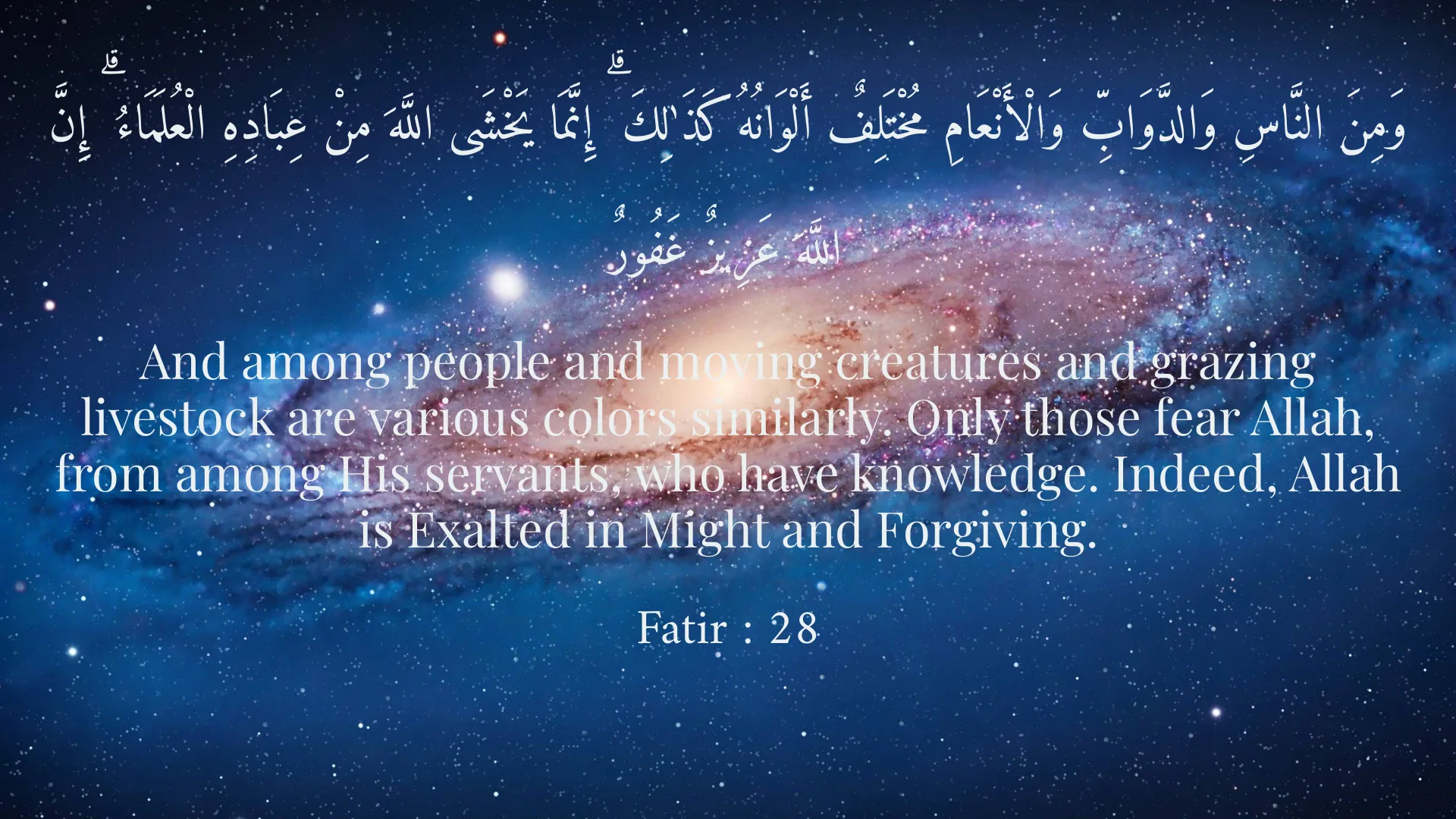
وَمِنَ النَّاسِ وَالدَّوَابِّ وَالْأَنْعَامِ مُخْتَلِفٌ أَلْوَانُهُ كَذَٰلِكَ ۗ إِنَّمَا يَخْشَى اللَّهَ مِنْ عِبَادِهِ الْعُلَمَاءُ ۗ إِنَّ اللَّهَ عَزِيزٌ غَفُورٌ
And among people and moving creatures and grazing livestock are various colors similarly. Only those fear Allah, from among His servants, who have knowledge. Indeed, Allah is Exalted in Might and Forgiving.
Fatir : 28
إِنَّ فِي خَلْقِ السَّمَاوَاتِ وَالْأَرْضِ وَاخْتِلَافِ اللَّيْلِ وَالنَّهَارِ لَآيَاتٍ لِّأُولِي الْأَلْبَابِ
Indeed, in the creation of the heavens and the earth and the alternation of the night and the day are signs for those of understanding.
Al-Imran : 190
الَّذِينَ يَذْكُرُونَ اللَّهَ قِيَامًا وَقُعُودًا وَعَلَىٰ جُنُوبِهِمْ وَيَتَفَكَّرُونَ فِي خَلْقِ السَّمَاوَاتِ وَالْأَرْضِ رَبَّنَا مَا خَلَقْتَ هَٰذَا بَاطِلًا سُبْحَانَكَ فَقِنَا عَذَابَ النَّارِ
Who remember Allah while standing or sitting or [lying] on their sides and reflect upon the creation of the heavens and the earth, [saying], 'Our Lord, You have not created this in vain; exalted are You [above such a thing]; then protect us from the punishment of the Fire.'
Al-Imran : 191
Short Story
One day, in ancient times, a wise man named Luqman was walking with his son. The son asked, 'Father, why do some people, despite witnessing so many wonders in the world, still not believe in God?' Luqman smiled and said, 'My son, it's like someone who is illiterate holding a book full of wisdom; they only see the letters but do not grasp their profound meaning. But a scholar reads every letter and word and comprehends its deep concepts. Similarly, a seeing eye is not enough to behold the signs of God; rather, an aware heart and an active intellect are necessary to contemplate the order and beauty of creation and derive from it the existence of the Wise Creator. Knowledge is a light that illuminates the path of the heart so that faith may flourish.' Upon hearing these words, the son understood the importance of knowledge and reflection alongside faith, realizing that these two, hand in hand, are the keys to truth.