Quranic Answer
The Holy Quran, regarded as the paramount religious text of Islam, serves not only as a divine guide but also as a profound source of wisdom that illuminates various aspects of human existence. Among its many teachings, the Quran distinctly articulates the reasons why some individuals find themselves devoid of guidance, as well as the conditions requisite for those who seek to be led on the righteous path. Understanding these concepts requires delving deeper into its verses and grasping the intricate relationship between divine guidance and human free will. At the heart of the Quran's narrative lies the recognition that guidance is a divine gift from Allah, dependent upon His wisdom and will. One of the primary reasons outlined in the Quran for the lack of guidance among certain individuals is their own willful rejection of faith. In Surah Al-Baqarah, verses 6 and 7, it is unequivocally stated: 'Indeed, those who disbelieve - it is all the same for them whether you warn them or do not warn them; they will not believe.' This profound verse highlights the stubbornness and resistance that some individuals exhibit towards the faith, rendering any attempts at persuasion or warning ineffective. This unyielding nature of disbelief raises significant questions about the interplay between external guidance and internal belief. Moreover, the concept of free will plays a crucial role in this dynamic. Allah, in His divine wisdom, permits individuals to exercise their free will in matters of faith. In Surah Al-Imran, verse 86, it is further emphasized with the words: 'So, you are among those who disbelieve.' Here, Allah reminds us that the responsibility of faith lies ultimately within the individual. This acknowledgment accentuates the significance of one's personal effort and intention in achieving belief and sincerity. It suggests that Allah has endowed humans with the capacity to choose, thus making faith a matter of personal endeavor rather than mere compulsion. Another poignant revelation can be found in Surah An-Naml, verse 46, where it is stated: 'Indeed, you do not guide those whom you love, but Allah guides whom He wills.' This verse underscores a critical paradigm: guidance is not a function of mere affection or desire; instead, it hinges upon Allah's divine will, which operates beyond human comprehension. This idea can be particularly humbling for those dedicated to encouraging others towards faith. Despite one's genuine intentions and love for others, it is ultimately Allah who leads individuals to the truth. This affirmation provides solace to those who may feel disheartened by the apparent indifference exhibited by some of their loved ones toward the message of faith. What becomes apparent from these verses is the intricate interplay between human disposition and divine decree. One must understand that while Allah controls the distribution of guidance, individuals play a pivotal role in seeking it. Self-surrender and an earnest desire for faith can pave the way for enlightenment. Thus, the lack of desire or will to believe can effectively render a heart impervious to divine guidance. The Quran places significant emphasis on the intentions that dwell within the heart. Sincerity in seeking the truth is indispensable for any individual on the path to guidance. A heart that harbors doubts, animosity, or insincerity is bound to remain shrouded in spiritual darkness, far removed from the enlightening rays of divine guidance. Consequently, it is paramount for individuals to engage in self-reflection and earnest prayer, humbling themselves before their Creator, and expressing their desire for truth and guidance. Only through such sincere endeavors can one hope to transcend the veils that obscure their hearts. Furthermore, the Quran intricately warns that guidance does not simply entail knowledge; rather, it demands practice and action in accordance with that knowledge. An individual may be well-versed in the teachings of Islam, yet without the proper internal disposition steeped in faith and sincerity, they may find themselves devoid of genuine belief. Thus, Islam encourages believers to engage actively with their faith, not only through ritual practice but also through a profound understanding of the teachings of the Quran that call for transformation of the heart and intention. It challenges believers to move beyond superficial observance and to cultivate authentic connections with their faith grounded in understanding and sincerity. In conclusion, the Quran elucidates distinctly on the reasons why some individuals are not granted guidance. The cornerstone of this lack of guidance lies in the dispositions of their hearts, influenced by their desire or rejection of faith. Through verses in Surah Al-Baqarah, Surah Al-Imran, and Surah An-Naml, the divine message emphasizes that guidance rests in the hands of Allah, and it is only bestowed upon those who genuinely seek it with sincerity. Thus, the journey toward faith requires immense personal effort and a profound yearning for the truth, allowing individuals to seek divine guidance earnestly. Without embracing these principles, hearts shall remain ensnared in darkness, distanced from Allah’s illuminating guidance. The Qur'an, therefore, serves as a timeless guide, urging humanity to engage in introspection and to nurture the desire for belief and divine guidance for a fulfilling spiritual journey.
Related Verses
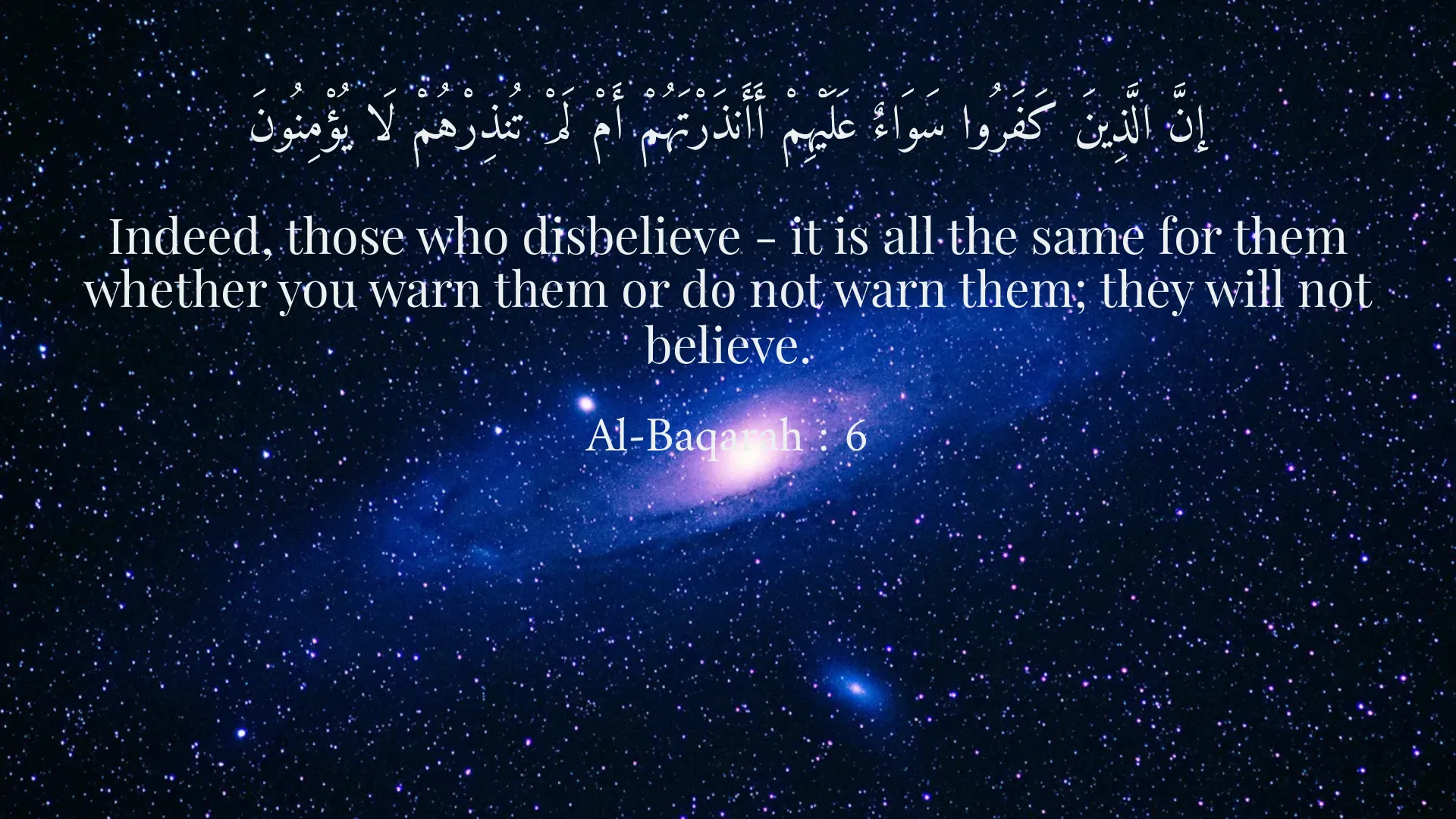
إنَّ الَّذِينَ كَفَرُوا سَوَاءٌ عَلَيْهِمْ أَأَنذَرْتَهُمْ أَمْ لَمْ تُنذِرْهُمْ لَا يُؤْمِنُونَ
Indeed, those who disbelieve - it is all the same for them whether you warn them or do not warn them; they will not believe.
Al-Baqarah : 6
فَأَنْتَ أَحَدٌ مِّنَ الَّذِينَ كَفَرُوا
So, you are among those who disbelieve.
Al-Imran : 86
إِنَّكَ لا تَهْدِي مَنْ أَحْبَبْتَ وَلَكِنَّ اللَّهَ يَهْدِي مَن يَشَاءُ
Indeed, you do not guide those whom you love, but Allah guides whom He wills.
An-Naml : 46
Short Story
One day, a man was returning home when he encountered a young man who looked disheartened. He asked the young man, 'Why are you so troubled?' The young man replied, 'I am searching for the right path, but I am always confused.' The man kindly said, 'Guidance is in the hands of Allah, but you must have a pure and open heart to be guided. Whenever you can call upon God, do not turn away from Him and wait for the doors of His mercy to open.' The young man, reflecting on these words, returned home with a newfound hope.