Quranic Answer
In the Holy Quran, the issue of faith and disbelief is one of the most critical themes explored throughout its verses. The text not only illumines the principles of belief but also presents insights into why certain individuals turn away from faith. This phenomenon can be understood through various exegetical lenses, each illustrating the complexity of faith as a concept intertwined with personal, societal, and cultural factors. In Surah Al-Baqarah, verses 6 and 7, Allah states: 'Indeed, those who disbelieve, it is all the same for them whether you warn them or do not warn them, they will not believe (6). Allah has set a seal upon their hearts and upon their hearing, and there is a veil over their eyes, and for them is a great punishment (7).' These verses convey a stark message: a group of individuals is intrinsically sealed off from understanding, which makes it exceedingly difficult for them to accept faith. The seal metaphor is particularly evocative, suggesting that disbelief isn't a mere absence of faith but a profound disconnection from spiritual truths. This condition isn’t simply attributable to a lack of information but often stems from deeper, more profound influences that shape an individual’s disposition. One crucial factor is personal disposition: an individual's character, emotions, and psychological state heavily influence their openness to accepting or rejecting faith. Some people may have inherent skepticism or a questioning nature that compels them to challenge the very essence of religious belief. First and foremost, personal factors can significantly hinder one's acceptance of faith. For instance, past experiences of trauma, betrayal, or loss can lead individuals to develop a protective skepticism toward faith traditions. If someone has faced considerable hardship or experienced tremendous loss, they may find it challenging to trust in a higher power or divine plan. Moreover, complacency may prevent others from seeking faith actively. They may be satisfied with their current worldview, rendering them oblivious to spiritual truths that could enhance their lives. Secondly, we must consider the role of societal environment. The era and community in which a person is raised play a defining role in shaping their perspective towards faith. If an individual grows up in an environment where religious beliefs are marginalized or ridiculed, this can create an overwhelming sense of fear and confusion regarding spirituality. Rapid globalization and the interconnectedness of diverse cultures often generate a societal milieu that challenges traditional beliefs, making it easy for individuals to succumb to doubt. In such contexts, individuals may struggle to reconcile their upbringing with the modern ideologies presented to them, leading to a crisis of faith. The societal perception of religion can also lead to a paradox where certain individuals feel compelled to outwardly profess their beliefs while internally opposing them. This is echoed in Surah Al-Ma'idah, verse 41, where Allah conveys to His Messenger not to be saddened by those who hasten toward disbelief among those who say, 'We believe,' but their hearts are devoid of true faith. This highlights a troubling reality: some individuals wear the façade of belief, influenced by social pressures and expectations, while their hearts remain unyielding. It's essential to realize that while such factors can block faith, they don’t represent an irreversible condition. The Quran suggests the potential for change, advocating that individuals often require a nurturing environment to rediscover and embrace faith genuinely. A stable and secure environment can help those who have turned away from belief to feel safe enough to explore their spiritual questions and concerns. Such an environment could involve family support, community acceptance, and access to wisdom shared by those who have traversed the journey of faith themselves. Positive spiritual experiences, such as community gatherings or personal encounters that inspire faith, can initiate or rekindle the belief process. Moreover, education plays a pivotal role in reducing skepticism and fostering understanding. Establishing a foundation of knowledge about faith, its significance, and its connection to morality and ethics can create a more conducive environment for belief. By approaching faith with curiosity rather than a judgmental lens, individuals can gradually dismantle their barriers to faith. The discourse surrounding faith must be characterized by empathy, understanding, and respect for each person's journey, as the process of belief is often not linear. As believers and advocates of faith, there is a great responsibility to nurture those around us who may be struggling with their beliefs. Whether through open dialogue, sharing personal stories of faith, or demonstrating love and compassion, we can create spaces where individuals feel welcomed to explore their spirituality without fear of prejudice or misunderstanding. We must be the kind of supporters who provide love and understanding, emphasizing that the journey to faith is often fraught with questions, doubts, and even objections. In essence, understanding why some may turn away from faith requires a multifaceted approach. We must consider the internal dynamics of the individual, the external societal influences, and the broader cultural narratives that shape one's worldview. The Quran reminds us that faith can be a journey filled with challenges, and those who temporarily flee from faith may find their way back through compassion, understanding, and nurturing environments. In this light, communities have the sacred duty to cultivate spaces of growth and understanding, allowing the light of faith to shine brightly upon those who struggle in darkness.
Related Verses
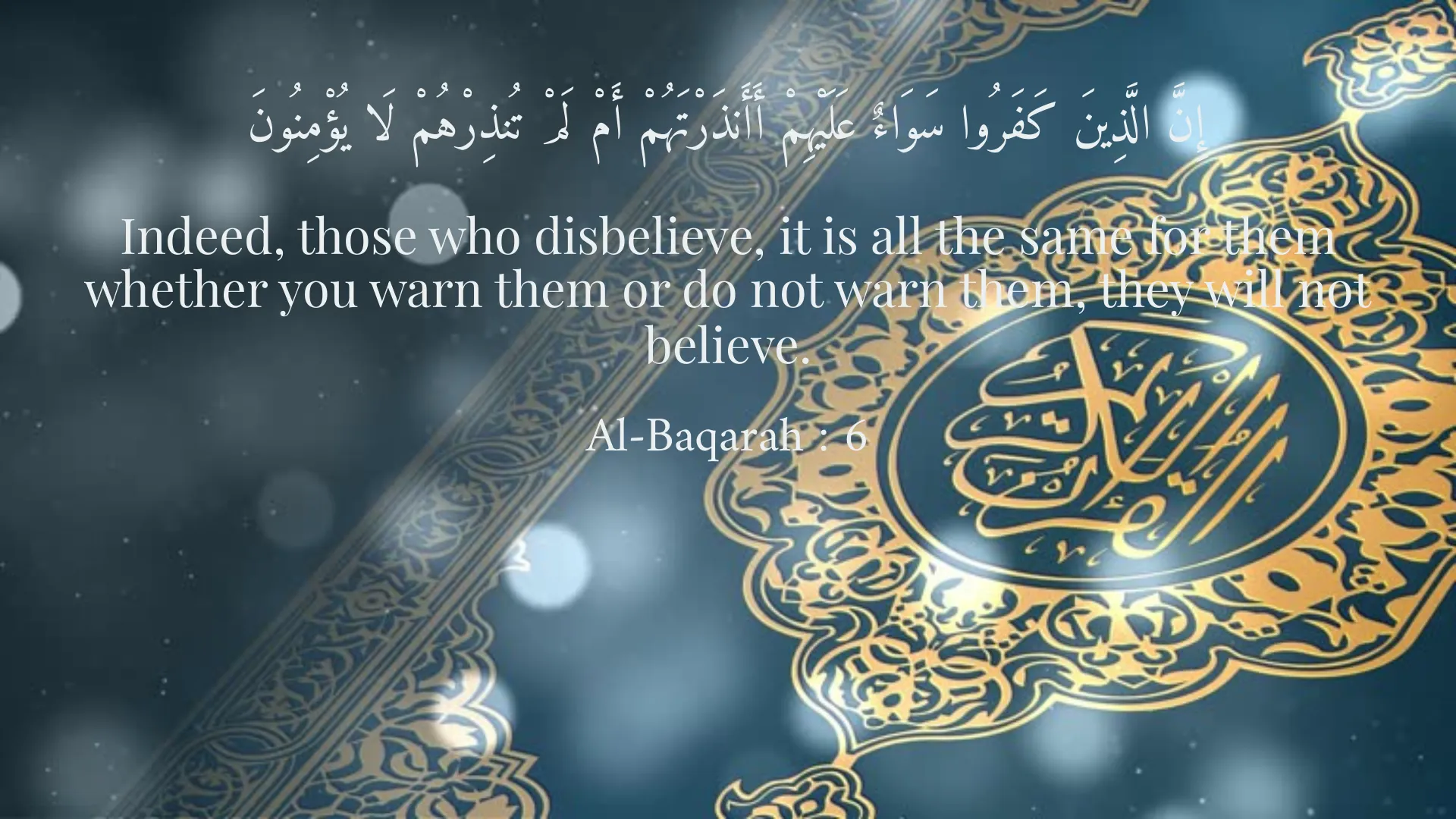
إِنَّ الَّذِينَ كَفَرُوا سَوَاءٌ عَلَيْهِمْ أَأَنذَرْتَهُمْ أَمْ لَمْ تُنذِرْهُمْ لَا يُؤْمِنُونَ
Indeed, those who disbelieve, it is all the same for them whether you warn them or do not warn them, they will not believe.
Al-Baqarah : 6
خَتَمَ اللّهُ عَلَى قُلُوبِهِمْ وَعَلَى سَمْعِهِمْ وَعَلَى أَبْصَارِهِمْ غِشَاوَةٌ ۖ وَلَهُمْ عَذَابٌ عَظِيمٌ
Allah has set a seal upon their hearts and upon their hearing, and there is a veil over their eyes, and for them is a great punishment.
Al-Baqarah : 7
يَا أَيُّهَا الرَّسُولُ لَا يَحْزُنكَ الَّذِينَ يُسَارِعُونَ فِي الْكُفْرِ من الذين قالوا آمنا بأفواههم ولم تؤمن قلوبهم
O Messenger, let not the people who hasten to disbelief sadden you among those who say, 'We have believed,' with their mouths while their hearts do not believe.
Al-Ma'idah : 41
Short Story
Once upon a time, a man named Ali was filled with doubts and in search of truth. Ever since he entered the wondrous world of faith, he felt that no one understood him. One day he attended a charitable gathering and met a group of believers. With kindness, they clarified the meaning of faith for him, and he no longer distanced himself from it. With a smile and a heart full of faith, Ali decided to seek truth every day and no longer feared taking steps toward faith.