Quranic Answer
In the Holy Quran, Allah reveals profound insights about the purpose of creation and the wisdom behind it. The verses contained within this sacred text serve as a spiritual guide, illuminating the path for humanity and jinn alike. One of the most compelling declarations is found in Surah Adh-Dhariyat, verse 56: 'And I did not create the jinn and mankind except to worship Me.' This fundamental statement emphasizes that the primary purpose of God's creation is worship and servitude to Him. The term 'worship' encompasses a wide array of actions and intentions, transcending mere rituals. It signifies a life lived in acknowledgment of God’s presence, shaping one's thoughts, actions, and interactions with others. The idea presented in this verse is not merely to perform acts of worship but to embed the essence of servitude to God into the very fabric of one’s life. Hence, the pursuit of God’s pleasure becomes the central narrative guiding a believer’s journey. Moreover, this notion of humanity's primary purpose is further elaborated in Surah Al-Baqarah, verse 30: 'And when your Lord said to the angels, ‘Indeed, I will make upon the earth a successive authority.’' This verse highlights a pivotal aspect of creation: the appointment of humans as His representatives on Earth. This designation implies a profound responsibility. As God's Khalifah (representative), humans are called to cultivate the Earth with righteousness and engage in virtuous deeds, reflecting the divine attributes and principles set forth by God. By recognizing that we are not solitary beings but rather part of a divine order, we gain essential insights into the responsibility we bear. As successive authorities, our mission extends beyond mere survival; it encompasses stewardship of the Earth, encouraging us to engage in acts that foster peace, justice, and compassion. Furthermore, the Quranic guidance implies that through our actions, we can manifest God’s will on Earth, leading humanity to realize its potential. An intrinsic element emphasized in both of these verses is the concept of free will. God created humans as beings endowed with the ability to choose. This gift of free will allows us to resolve to walk the path of worship and to serve both creation and the Creator. The significance of this freedom cannot be understated; it is through our choices that we sculpt our destinies, navigate moral complexities, and strive to align ourselves with God's purpose. Understanding this divine purpose enriches our lives and promotes spiritual growth. As we cultivate our connection to God and engage in worship, we simultaneously nurture our character and ethical standing. The Quran encourages believers to reflect on their existence, challenging us to contemplate our actions and intentions to ensure they align with the essence of servitude. Delving deeper into the nature of worship, it becomes evident that it is not confined to traditional acts such as prayer and fasting. Rather, every moment of our lives can be an opportunity for worship, whether through acts of kindness, justice, and compassion towards others, or even through simple everyday tasks done with the right intention. Therefore, living with accountability to God transforms mundane actions into acts of worship, enhancing our experience of life with a sense of purpose and direction. In addition, the understanding of our purpose encourages individual and communal responsibility. If we perceive ourselves as representatives tasked with upholding divine virtues, our interactions with one another must be anchored in mutual respect, love, and empathy. This acknowledgment creates an environment that fosters collaboration and unity, vital for addressing societal issues and striving towards a greater good for all. Communities rooted in the idea of servitude to God are bound to reflect positive social change, championing values that benefit all, irrespective of differences. The awareness of our purpose also presents a pathway toward perfection and deeper spirituality. As we strive to fulfill our divine mission, we nurture an inner longing to attain higher states of consciousness and moral integrity. This journey towards perfection is not an individual endeavor; rather, it is interwoven with our connections to others, as we encourage and uplift one another in pursuit of collective improvement. Furthermore, reflecting on our nature as worshippers invokes a sense of humility. Acknowledging that we have a Creator guides us to appreciate the intricate balance and harmony in creation. From the magnificent expanse of the cosmos to the seemingly insignificant details of life, every aspect reveals the presence and greatness of God. A deep sense of gratitude arises as we recognize our role within this magnificent tapestry of existence. In conclusion, the Quran eloquently articulates the purpose of human creation and the divine wisdom underpinning our existence. The clear directive given in Surah Adh-Dhariyat and Surah Al-Baqarah serves as an enduring reminder of our responsibilities as worshippers and stewards on Earth. Embracing this purpose not only guides us on a spiritual path but also invites us to contribute positively to our communities. With the gift of free will, we hold the power to choose a life grounded in worship, service, and the pursuit of righteousness, ultimately drawing closer to our Creator and cultivating a life of fulfillment and purpose. In the quest for understanding the essence of our existence, we are encouraged to embody the principles outlined in the Quran, forging a legacy of worship, compassion, and stewardship centered around our divine mission.
Related Verses
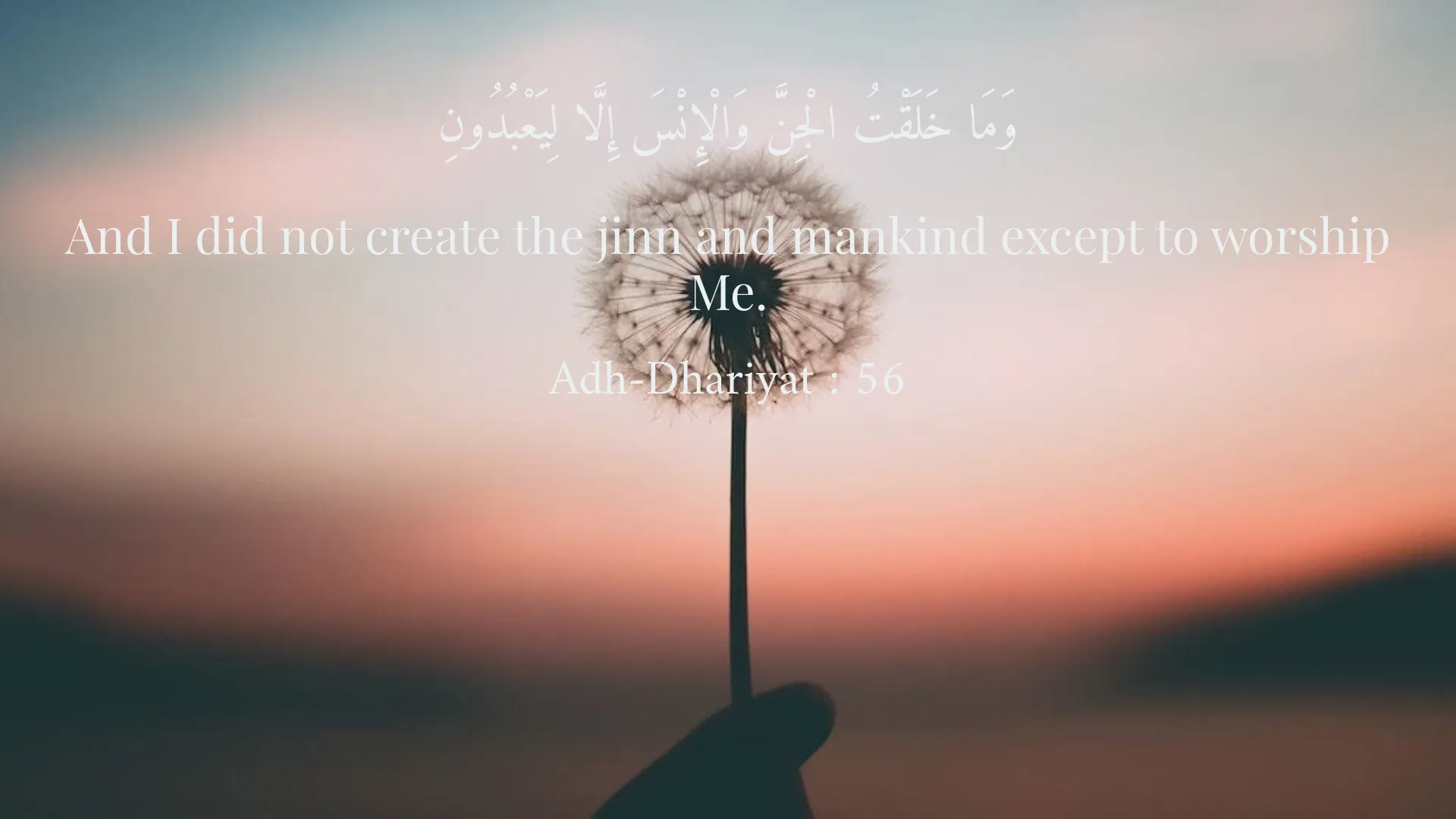
وَمَا خَلَقْتُ الْجِنَّ وَالْإِنْسَ إِلَّا لِيَعْبُدُونِ
And I did not create the jinn and mankind except to worship Me.
Adh-Dhariyat : 56
وَإِذْ قَالَ رَبُّكَ لِلْمَلَائِكَةِ إِنِّي جَاعِلٌ فِي الْأَرْضِ خَلِيفَةً
And when your Lord said to the angels, 'Indeed, I will make upon the earth a successive authority.'
Al-Baqarah : 30
Short Story
One day, a young man named Ali was deeply pondering about his life and questioning the reasons of his existence. He went to a garden near his village and looked at the green trees and beautiful blossoms. Suddenly, he remembered the verses of the Quran that explain the purpose of creation. He decided to fill his life with worship and service to others, striving every day to walk in the way of God. Ali realized that the more he walked on this path, the greater peace and happiness he would experience.