Quranic Answer
### Trials and Tribulations: A Spiritual Quest in the Holy Quran The Holy Quran serves as a profound guide for millions of believers across the globe, imparting wisdom, dictating principles of morality, and shaping the spiritual life of individuals. One of the cornerstones of Islamic belief highlighted in the Quran is the concept of ‘trial.’ This concept is not only significant but is intricately woven into the divine scheme of human existence. In Surah Al-Baqarah, verse 155, Allah states, “And We will surely test you with something of fear and hunger and a loss of wealth and lives and fruits, but give good tidings to the patient.” The depth and breadth of this verse invite introspection concerning the nature of trials in our lives, their purposes, and the resilience expected from us. #### The Nature of Trials and Their Purpose Faith, according to Islamic teachings, is intrinsically linked to trials. The Quran reflects that adversity is inevitable in the human experience. Tests manifest through various forms such as fear, hunger, loss, and even profound grief. It can be said that these adversities serve not only as obstacles but also as opportunities for spiritual elevation. Much like how gold is subjected to fire to separate impurities and achieve purity, humans too face challenges that bring forth their true selves, allowing them to reflect upon their beliefs. This process serves to purify the soul, rearranging priorities in line with divine guidance and ultimately bringing individuals closer to their Creator. In this context, the tribulations become not just challenges but pivotal elements of personal growth and spiritual refinement. Surah Al-Anfal, verse 28 further encapsulates this idea, asserting, “And know that your properties and your children are but a trial, and that Allah has with Him a great reward.” This perspective transforms the outlook toward worldly possessions and relationships, inviting believers to ponder on the transient nature of life and the eternal rewards promised by Allah. #### Understanding the Role of Patience Central to navigating through trials is the virtue of patience (“Sabr” in Arabic). Patience is an act of faith; it is about surrendering to Allah's will while actively participating in the journey of life. The Quran not only encourages patience but associates it with a multitude of virtues, including courage, resilience, and the ability to communicate comprehensively with oneself and with Allah. In various verses, believers are provided reminders that the trials they face are designed to be bearable; in Surah Al-Baqarah, verse 286, it is stated: “Allah does not burden a soul beyond that it can bear.” This affirmation is fundamental to Islamic belief, as it reinforces the idea that trials serve a purpose known best to Allah, while simultaneously fostering strength in the believer. When individuals face adversities with patience, they are promised profound treasures—spiritual and otherwise—that await them. #### The Impact of Divine Destiny Another layer to the understanding of trials is the concept of divine destiny (Qadar). Believers hold the view that Allah’s wisdom encompasses everything; thus, nothing happens to a person without divine decree. This notion can be both comfort and a challenge as individuals grapple with feelings of helplessness in the face of suffering. For instance, when a loved one passes away or financial hardships arise, it is easy to succumb to despair. However, through the lens of divine destiny, trials are seen as part of a greater plan, designed to evoke growth and transformation. Believers are encouraged to view such situations as tests of faith rather than mere misfortunes. This perception encourages surrender and acknowledgment of a higher knowledge that surpasses human understanding. In facing these tests, the narrative in the Quran also suggests that it is essential for believers to actively engage in self-reflection, asking profound questions about their relationship with Allah amid adversities. What lessons can be gleaned? How can one emerge stronger? Growth in faith during these times is the ultimate goal; trials become catalysts for spiritual enlightenment and fostering a deeper relationship with Allah. #### Coping Mechanisms Provided through Faith The Quran provides numerous examples and narratives, illustrating how notable figures in Islamic tradition navigated trials, helping believers find solace in their struggles. The stories of the Prophets—be it Prophet Job (Ayyub) enduring suffering patiently or Prophet Muhammad (peace be upon him) facing opposition and adversity in Mecca—serve as reminders that trials are integral to the spiritual journey. Moreover, to cope with trials, believers are encouraged to engage in regular prayers (Salah), supplications (Dua), and the remembrance of Allah (Dhikr). These acts serve as both a refuge and a source of strength. They allow the faithful to maintain a connection to their spirituality, reinforcing the understanding that while the world around them may feel tumultuous, there is a sanctuary to be found in faith. ### Conclusion Ultimately, the Quran emphasizes that life’s challenges, as burdensome as they may feel, are purposeful and necessary for spiritual and moral development. The essence of life lies not in the absence of trials, but in how we confront and respond to them. Each hardship is an opportunity for growth, guiding believers towards pivotal realizations that reveal the deeper realities of faith. With robust faith in Allah, through perseverance amid difficulties, individuals can navigate the complex terrains of life. Indeed, strong faith acts as a beacon of hope, elevating a person to higher spiritual states and inner peace. The Quran thus serves not merely as a text of spiritual law but as a perpetual source of guidance, illuminating the path through life’s inevitable trials and tribulations.
Related Verses
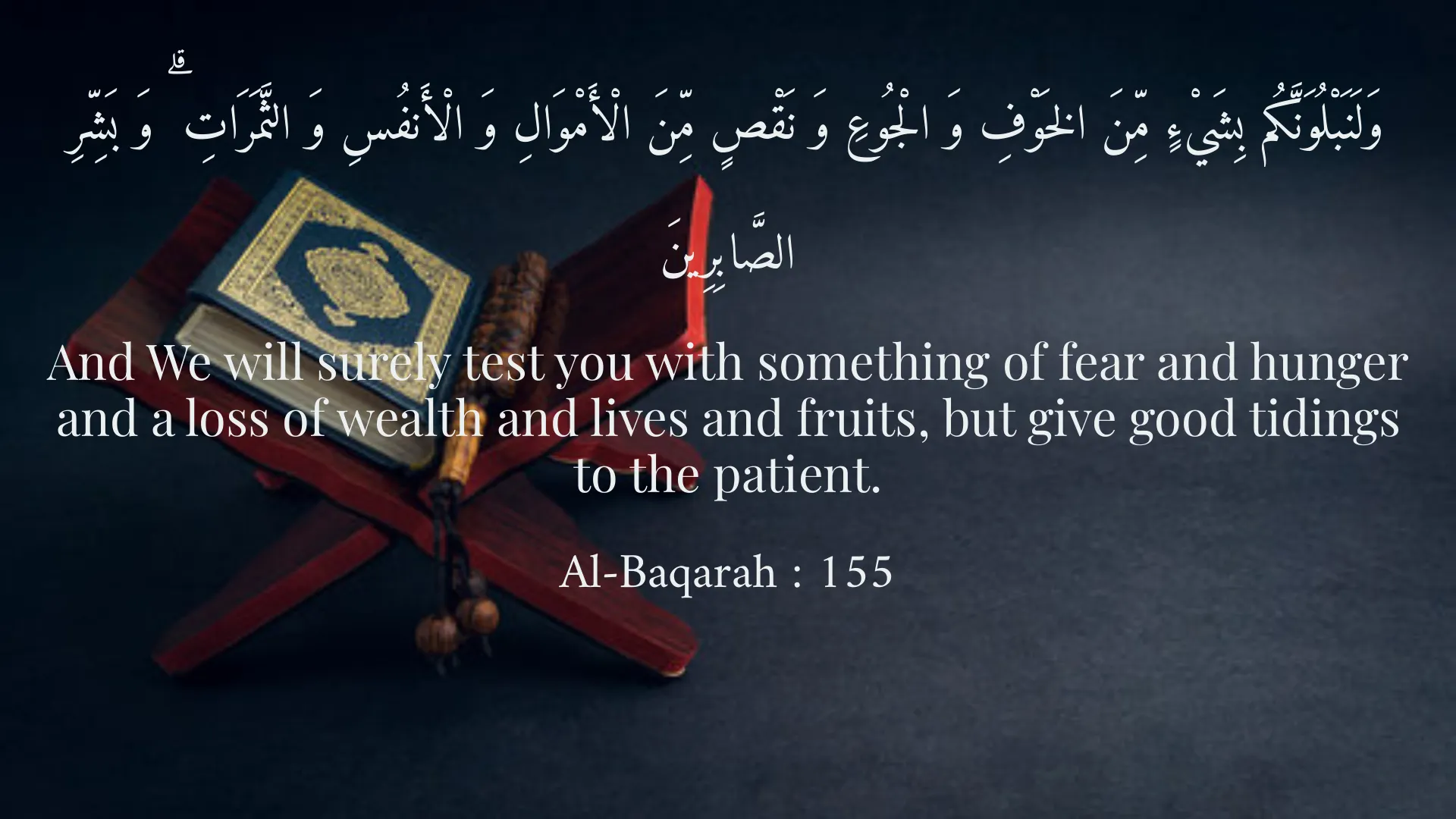
وَلَنَبْلُوَنَّكُم بِشَيْءٍ مِّنَ الخَوْفِ وَ الْجُوعِ وَ نَقْصٍ مِّنَ الْأَمْوَالِ وَ الْأَنفُسِ وَ الثَّمَرَاتِ ۗ وَ بَشِّرِ الصَّابِرِينَ
And We will surely test you with something of fear and hunger and a loss of wealth and lives and fruits, but give good tidings to the patient.
Al-Baqarah : 155
وَ اعْلَمُوا أَنَّمَا أَمْوَالُكُمْ وَ أَولَادُكُمْ فِتْنَةٌ ۖ وَ أَنَّ اللَّهَ عِندَهُ أَجْرٌ عَظِيمٌ
And know that your properties and your children are but a trial, and that Allah has with Him a great reward.
Al-Anfal : 28
Short Story
Once upon a time, there was a righteous man named Hasan who always sought to do good and help others. However, one day he was struck by a serious illness that disrupted his life. Nevertheless, Hasan remained patient and placed his trust in God. He prayed and sought peace from God. After some time, he recovered, and he realized that this experience had taught him invaluable lessons. Hasan had become closer to God than ever and had gained a better understanding of life.