Quranic Answer
Prayer, or Salah, is one of the five pillars of Islam, serving as a fundamental act of worship and devotion for Muslims worldwide. It is more than a mere ritual; it is an obligatory act enshrined in multiple verses of the Holy Quran and reinforced by the teachings of the Prophet Muhammad. The significance of prayer transcends ritualistic practice, as it fosters a profound relationship between the believer and God, provides a framework for spiritual discipline, and promotes a sense of community among Muslims. The Holy Quran lays down the foundation of the importance of prayer in various surahs. One of the clearest commandments is found in Surah Al-Baqarah, verse 43, where Allah commands: 'And establish prayer and give zakah.' This directive highlights not only the importance of prayer but also its role as a vehicle for charity, thereby establishing a connection between worship and social responsibility. The establishment of prayer is fundamental, as it serves to strengthen the individual's faith and relationship with the divine. Prayer acts as a bridge between a believer and their Creator, reinforcing the idea that worship is both an individual and communal responsibility. The emphasis on establishing prayer heralds the notion that faith is actively practiced rather than passively held. It requires commitment, discipline, and sincerity, signifying that prayer is not merely an obligation but a means to cultivate a genuine bond with Allah. In Surah Al-Ma'idah, verse 55, Allah states: 'Your ally is none but Allah and His Messenger and those who have believed - those who establish prayer and give zakah.' This verse underlines that the establishment of prayer is an essential characteristic of a true believer. It suggests that those who establish prayer are securely anchored in their faith, and their connection to Allah and His Messenger shapes their community and relationships with others. The collective act of prayer, especially in communal settings such as mosques, instills a deep sense of unity and belonging among the Muslim community (Ummah). Moreover, prayer serves a crucial role as an intercessor for individuals on the Day of Judgment. The Prophet Muhammad is reported to have said, 'Prayer is light,' emphasizing the need to use it as a guiding force in one's spiritual journey. This metaphor illustrates that prayer illuminates the path towards righteousness and moral fortitude, providing clarity amid the trials and tribulations of life. Additionally, in Surah Al-Isra, verse 78, Allah instructs: 'And establish prayer at the two ends of the day and at the approach of night.' This command indicates the importance of timeliness and discipline in performing prayers. The five daily prayers, distributed throughout the day, serve as checkpoints for individuals to realign themselves spiritually, seek forgiveness, and express gratitude. The insistence on establishing prayer at specific times emphasizes the significance of ritual continuity and the necessity of integrating spiritual practice into daily life. These prescribed times instill a sense of structure and discipline into a believer's daily routine, guiding them to always remain mindful of their responsibilities towards Allah. Furthermore, the benefits of prayer extend beyond the personal realm into the collective spiritual fabric of society. When Muslims gather for congregational prayers, whether during the daily prayers or the Friday sermon (Jummah), they engage in an act that transcends individual worship to embody a collective submission to Allah. This shared experience strengthens ties within the community, fosters mutual support, and encourages a spirit of cooperation among individuals from diverse backgrounds. In addition to fostering individual and communal bonds, regular prayer is associated with numerous psychological and emotional benefits. Many studies have shown that individuals who engage in regular prayer experience lower levels of stress and anxiety. The act of praying provides a moment of reflection, peace, and tranquility amidst a rapidly changing and often chaotic world. It serves as a form of meditation, allowing individuals to clear their minds, focus on the divine, and find solace in their faith during periods of hardship. The spiritual peace achieved through prayer also connects individuals to a legacy of faith that spans generations. In Islam, prayer is a practice passed down through the ages, linking contemporary believers with the experiences and teachings of past prophets and saints. This sense of continuity enriches one's spiritual journey, instilling a deeper appreciation for the rituals and practices that have been maintained through centuries. In conclusion, the significance of prayer in Islam cannot be overstated. It is a multifaceted practice that nurtures an individual's relationship with Allah, instills discipline through prescribed prayers at specified times, and fosters a sense of community within the Muslim Ummah. The thematic emphasis in the Holy Quran and Hadith surrounding the establishment of prayer elucidates its vital role as a means of spiritual enlightenment. The obligation to engage in prayer is not merely a duty; it is a golden opportunity for believers to draw nearer to God, achieve guidance, and attain inner peace. Therefore, prayer remains an essential aspect of a Muslim's life, underlining the value of faith, community, and personal growth through the worship of the Almighty.
Related Verses
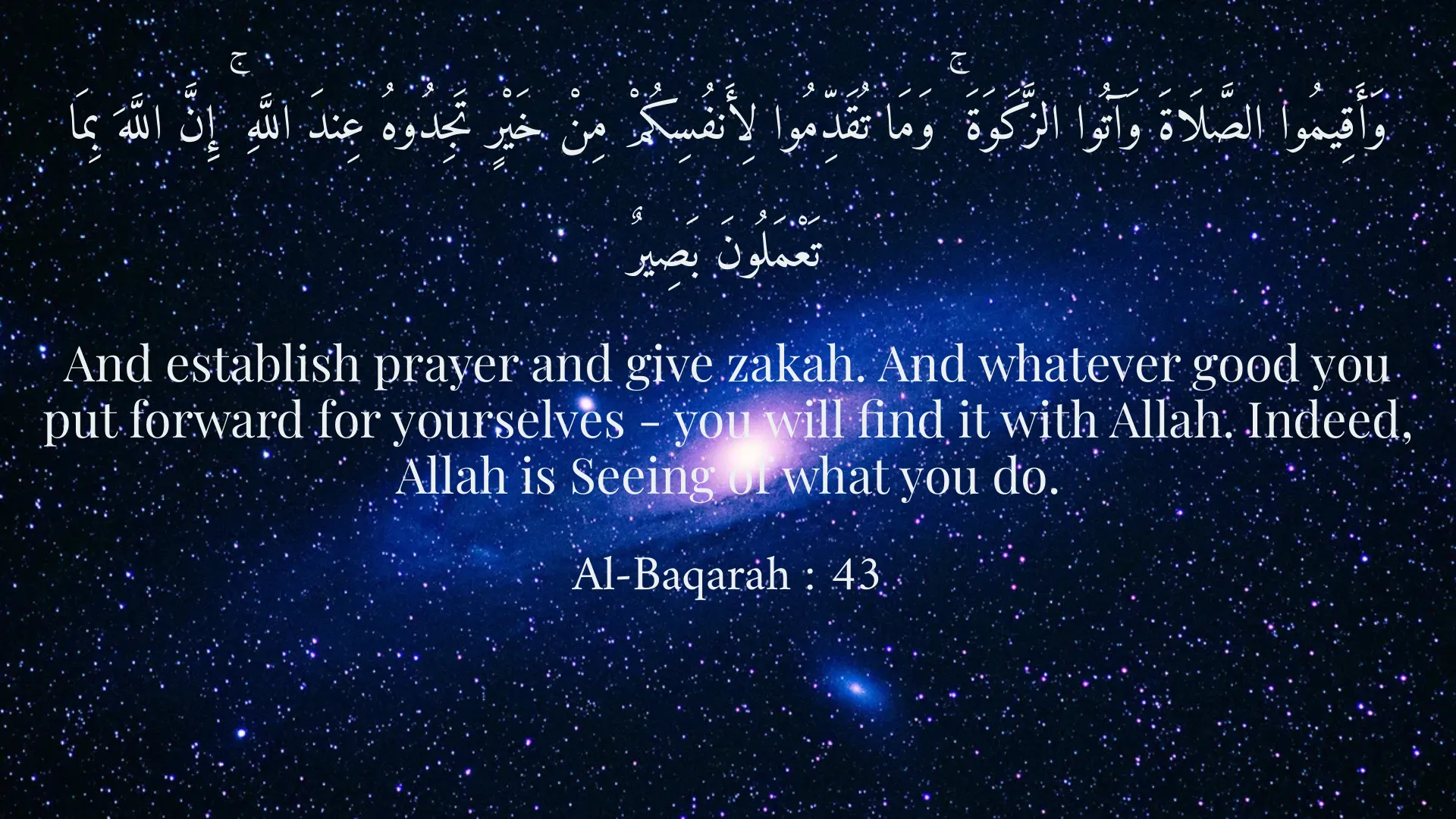
وَأَقِيمُوا الصَّلَاةَ وَآتُوا الزَّكَوَةَ ۚ وَمَا تُقَدِّمُوا لِأَنفُسِكُمْ مِنْ خَيْرٍ تَجِدُوهُ عِندَ اللَّهِ ۚ إِنَّ اللَّهَ بِمَا تَعْمَلُونَ بَصِيرٌ
And establish prayer and give zakah. And whatever good you put forward for yourselves - you will find it with Allah. Indeed, Allah is Seeing of what you do.
Al-Baqarah : 43
إنما وليكم الله ورسوله والذين آمنوا الذين يقيمون الصلاة ويقيمون الزكاة وهم راكعون
Your ally is none but Allah and His Messenger and those who have believed - those who establish prayer and give zakah while they bow.
Al-Ma'idah : 55
وَأَقِمِ الصَّلَاةَ طَرَفَيِ النَّهَارِ وَزُلَفًا مِّنَ اللَّيْلِ ۚ إِنَّ الْحَسَنَاتِ يُذْهِبْنَ السَّيِّئَاتِ ۚ ذَٰلِكَ ذِكْرًۭى لِلذَّاكِرِينَ
And establish prayer at the two ends of the day and at the approach of night. Indeed, good deeds erase bad deeds. This is a message for those who remember.
Al-Isra : 78
Short Story
Once upon a time, there was a young man named Ahmad who often faced crossroads in his life. One day, he decided to visit a mosque and inquire about the secrets and importance of prayer. After the prayer, he met a scholar and asked him why prayer is so significant. The scholar replied, 'Prayer is a bridge between you and your Creator. That is why it is obligatory for you to stand before Allah at those specified times.' Upon hearing these words, Ahmad resolved to perform his prayers with attention and love, transforming his life.