Quranic Answer
### The People of the Book in the Holy Quran: A Historical and Contemporary Perspective The Holy Quran, regarded by Muslims as the ultimate guidance, provides profound insights into the relationships among diverse religious communities. One prominent reference within its verses is the 'People of the Book,' a term primarily encompassing Jews and Christians. This essay delves deeper into the meaning of this term, the portrayal of the People of the Book in the Quran, and the historical interactions between Muslims and these communities, which can serve as a model for contemporary religious coexistence. #### Understanding the Term 'People of the Book' The phrase 'People of the Book' refers to those who possess a divine scripture or text that has been revealed by God. In Islamic theology, the most notable among these texts are the Torah, which was revealed to Moses, and the Gospel, given to Jesus. These texts form the basis for the beliefs held by Jews and Christians, respectively. Importantly, the Quran addresses these communities with respect, acknowledging their scriptures and their rightful place within the broader spectrum of revealed religions. In Surah Al-Imran, verse 199, it is asserted: 'Indeed, among the People of the Book are those who believe in Allah and what has been revealed to you and what has been revealed to them, humbly submitting to Him.' This verse offers a powerful acknowledgment that some among the People of the Book have indeed embraced faith in Allah and recognize the prophethood of Muhammad (PBUH). The Quran’s recognition of individuals with a shared appreciation of faith underscores the fundamental unity that exists among the Abrahamic faiths, paving the path for mutual respect and understanding. #### Affirmation of Faith and Respect Divine scripture serves as a meeting point for different faith communities. The Quran not only acknowledges the existence of the People of the Book but also encourages Muslims to treat them with kindness and respect. In Surah Al-Ma'idah, verse 82, Muslims are reminded: 'You will find the closest among them in affection to the believers are those who say, 'We are Christians.'' This verse emphasizes a kinship based on shared values, moral principles, and the essence of belief in one God. By fostering an environment which encourages understanding and camaraderie, the Quran sets a precedent for Muslims to engage positively with their Christian counterparts. ### Historical Interactions Between Muslims and the People of the Book Throughout history, the relationship between Muslims and the People of the Book has been marked by instances of both conflict and cooperation. In the era following the life of the Prophet Muhammad (PBUH), Muslims often found themselves in multi-faith societies where Jews and Christians coexisted alongside them. The early Islamic state in Medina serves as a remarkable example of cooperation and interfaith dialogue. In Medina, alliances were formed based on the Constitution of Medina, a pioneering document that recognized the rights of various religious groups, including Jews and Christians. This constitution advocated for mutual defense and ensured religious freedom for all adherents. Such cooperation enabled significant cultural and intellectual exchanges that enriched Islamic civilization, influencing various fields including science, philosophy, and the arts. One of the notable figures during this period was Caliph Umar ibn al-Khattab, who is remembered for his policies that favored religious tolerance. Upon entering Jerusalem, he offered protection to Christian communities and promised religious freedoms, establishing a legacy of dignified coexistence. In fact, churches continued to function without restriction under Islamic rule, symbolizing a period where diverse faiths could thrive side by side. ### Lessons for Contemporary Religious Coexistence The interactions between Muslims and the People of the Book during the time of the Prophet Muhammad (PBUH) and the early caliphates serve as an inspiring model for present-day coexistence. In our modern world, rife with divisions and intolerance, the teachings of the Quran demand that Muslims engage with individuals of other faiths in a spirit of respect, empathy, and cooperation. In many societies today, interfaith dialogue is crucial for the promotion of peace and understanding. Drawing from lessons in the Quran and early Islamic history, initiatives that encourage shared community services, religious dialogues, and cultural exchanges can help unify diverse groups. These efforts remind us that despite differences in beliefs, there exists a commonality in values such as compassion, justice, and the pursuit of truth. Furthermore, humanity as a whole thrives when people from different backgrounds come together to identify shared goals and aspirations. By fostering environments where dialogue is encouraged, misunderstandings can be resolved, and relationships can flourish. The Quran serves as a reminder that common ground can be found within the tenets of faith that promote dignity and respect for all individuals. ### Conclusion In summary, the Holy Quran's references to the People of the Book highlight the importance of interfaith relations and mutual respect between different religious communities. The acknowledgment of Jews and Christians as integral parts of the religious tapestry is a significant theme that runs throughout the Quran. The historical interactions between Muslims and the People of the Book exhibit a legacy of cooperation and understanding that can inspire today's efforts toward greater unity. As we navigate our complex and rapidly changing world, the Quran’s teachings can guide us in fostering environments of kindness and respect, reminding us that our differences should be embraced rather than feared. The legacy of interfaith dialogue and the strong relationships between Muslims and the People of the Book are examples we can draw from as we strive to build a harmonious world for future generations.
Related Verses
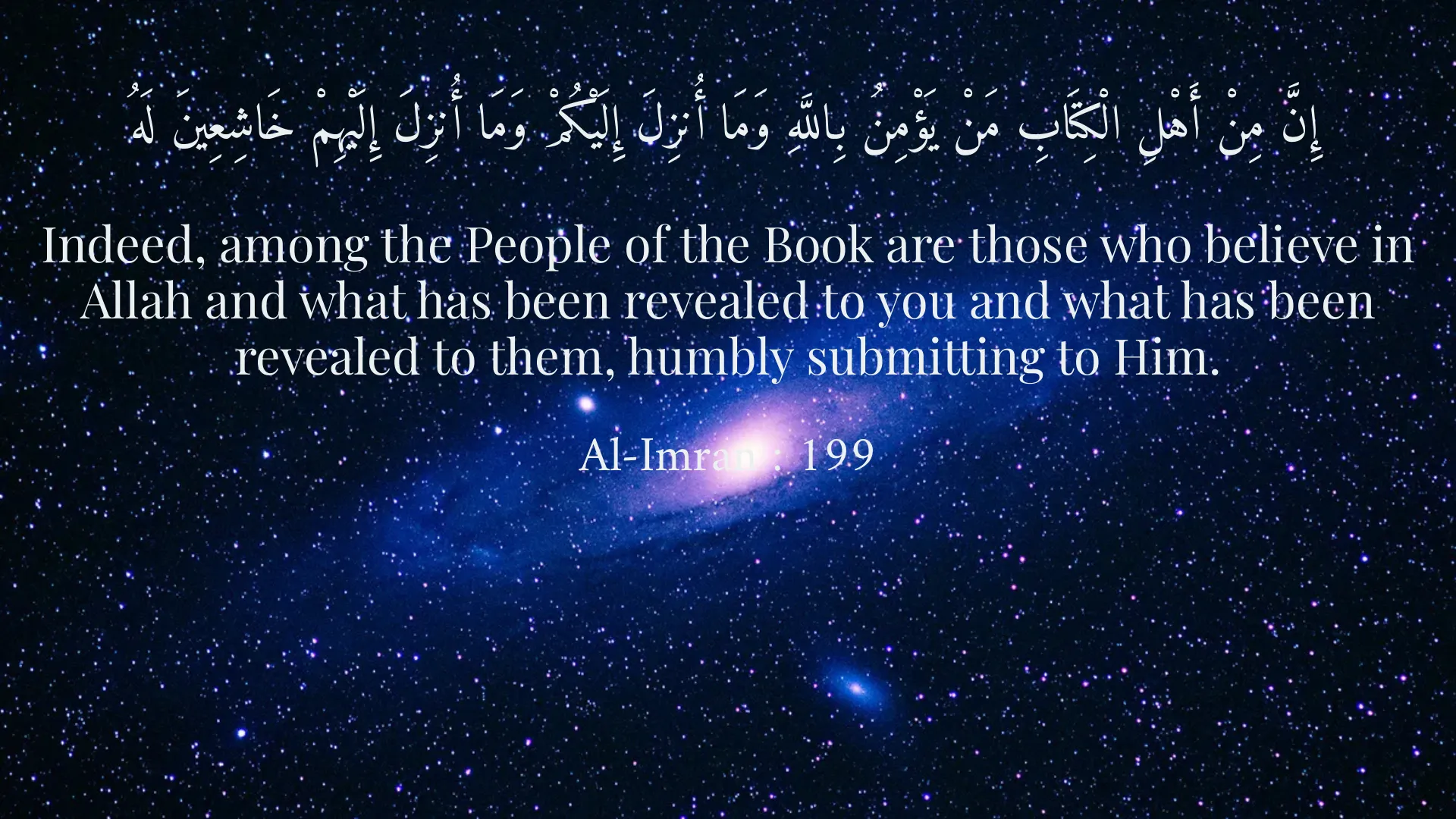
إِنَّ مِنْ أَهْلِ الْكِتَابِ مَنْ يَؤْمِنُ بِاللَّهِ وَمَا أُنزِلَ إِلَيْكُمْ وَمَا أُنزِلَ إِلَيْهِمْ خَاشِعِينَ لَهُ
Indeed, among the People of the Book are those who believe in Allah and what has been revealed to you and what has been revealed to them, humbly submitting to Him.
Al-Imran : 199
تَجِدَنَّ أَقْرَبَهُمْ مَوَدَّةً لِلَّذِينَ آمَنُوا الَّذِينَ قَالُوا إِنَّا نَصَارَىٰ
You will find the closest among them in affection to the believers are those who say, 'We are Christians.'
Al-Ma'idah : 82
Short Story
One day, a young man named Ali was studying the Quran and came across verses related to the People of the Book. He realized that the Quran mentions Jews and Christians and encourages Muslims to treat them with kindness and respect. Ali decided to follow these teachings in his life and interact more friendlily with the Christians in his neighborhood. From that day on, Ali established a closer friendship with them and enjoyed cultural exchanges and getting to know each other.