Quranic Answer
The Holy Quran, the sacred text of Islam, serves as a comprehensive guide for personal and communal conduct, emphasizing various ethical and moral principles. Among these principles, the significance of helping the needy and the poor is profoundly emphasized, marking it as a fundamental aspect of Islamic teachings. This article aims to delve deeper into the Quranic verses that articulate the importance of charity, the obligation of zakah, and the collective responsibility towards the less fortunate in society, reinforcing the understanding that aiding those in need is not merely an act of kindness but a critical component of faith itself. The Importance of Helping the Needy The Quran explicitly addresses the significance of aiding the underprivileged and destitute. In Surah Al-Baqarah, verses 177 and 273, Allah clearly instructs believers to utilize their wealth to support the poor and those in need. Verse 177 states, 'Establish prayer and give zakah and help those who are incapacitated and are facing financial difficulties.' This directive illustrates that the true essence of faith in God and the Day of Judgment is intertwined with righteous deeds; thus, charity and support for others are fundamental components of Islamic belief. By establishing prayer (Salah) and giving zakah (obligatory almsgiving), individuals are reminded that worship extends beyond mere rituals. True servitude to Allah entails active participation in uplifting the community, particularly those suffering from poverty and adverse circumstances. Helping the needy is portrayed not just as a charitable action but as an essential obligation expected of all Muslims. Zakah: An Obligation In verse 273 of Surah Al-Baqarah, zakah is classified as an obligation for Muslims, thereby reinforcing its fundamental role in Islamic society. Zakah acts as a mechanism for wealth redistribution that ensures that the more fortunate aid their less fortunate counterparts. In this context, zakah serves as a spiritual purifying act for those who give while simultaneously fulfilling the economic needs of the disadvantaged. This requirement for charitable giving creates a safety net within society. As the wealthier assist the poor, it reduces the gaps that exist between socioeconomic classes. This alleviation of poverty is further emphasized in Islamic teachings, which promote the idea that societal harmony and cooperation are achieved when wealth circulates and sustains all members of the community. Spiritual Rewards for Charitable Acts Furthermore, the Holy Quran provides reassurance and motivation for believers who engage in acts of charity and support for those in need. In Surah Al-Mu’minun, verse 60, Allah proclaims: 'And those who spend their wealth for orphans, the poor, and in the way of Allah are the ones who will be in Paradise.' This verse elucidates that participating in charitable acts confers divine blessings and rewards, thus offering a powerful incentive for Muslims to engage in philanthropy. The mention of orphans and the poor speaks to the inherent vulnerability within those groups, emphasizing that safeguarding their welfare is not only a moral obligation but also a pathway to spiritual elevation. Helping orphans holds a particular significance in Islam, as they symbolize the most vulnerable members of society, and actively contributing to their well-being carries ample virtue. Social Responsibility and Community Building The verses from the Quran collectively convey vital lessons about compassion, empathy, and the social responsibilities that Muslims hold towards one another. By promoting the practice of charity, Islam encourages the establishment of a cohesive, compassionate society where individuals prioritize the needs of others. Helping the needy is a way to build community resilience and solidarity, allowing the disadvantaged to regain their footing while fostering an environment where every member can thrive. This community-oriented mindset creates a culture of mutual support, where those in need are not merely seen as 'the other' but are integrated into the social fabric of society. It helps foster a sense of belonging and dignity among all members, irrespective of their socioeconomic status. By recognizing the profound interconnectedness of all individuals, Muslims are pushed toward engendering a community that mirrors the divine attributes of mercy, generosity, and justice. Conclusion In conclusion, the Quran’s explicit emphasis on helping the needy and the poor underscores the integral role that charity and support for others play in the Islamic faith. Verses from Surah Al-Baqarah and Surah Al-Mu’minun serve as reminders that true faith is demonstrated through action, particularly when it comes to aiding the less fortunate. Zakah functions not only as a religious obligation but as a tool for social equity and poverty alleviation, reinforcing the idea that every believer has a part to play in building a fairer and more compassionate society. Ultimately, the spiritual rewards associated with charitable acts serve to deepen one’s connection with Allah while simultaneously strengthening community ties. As Muslims strive to fulfill their obligations towards the needy, they contribute to a legacy of empathy and social responsibility that reflects the core values of Islam. The teachings of the Quran serve as a timeless guide, urging believers to extend their hands and hearts to those who are less fortunate, thereby creating a world that embodies mercy and compassion.
Related Verses
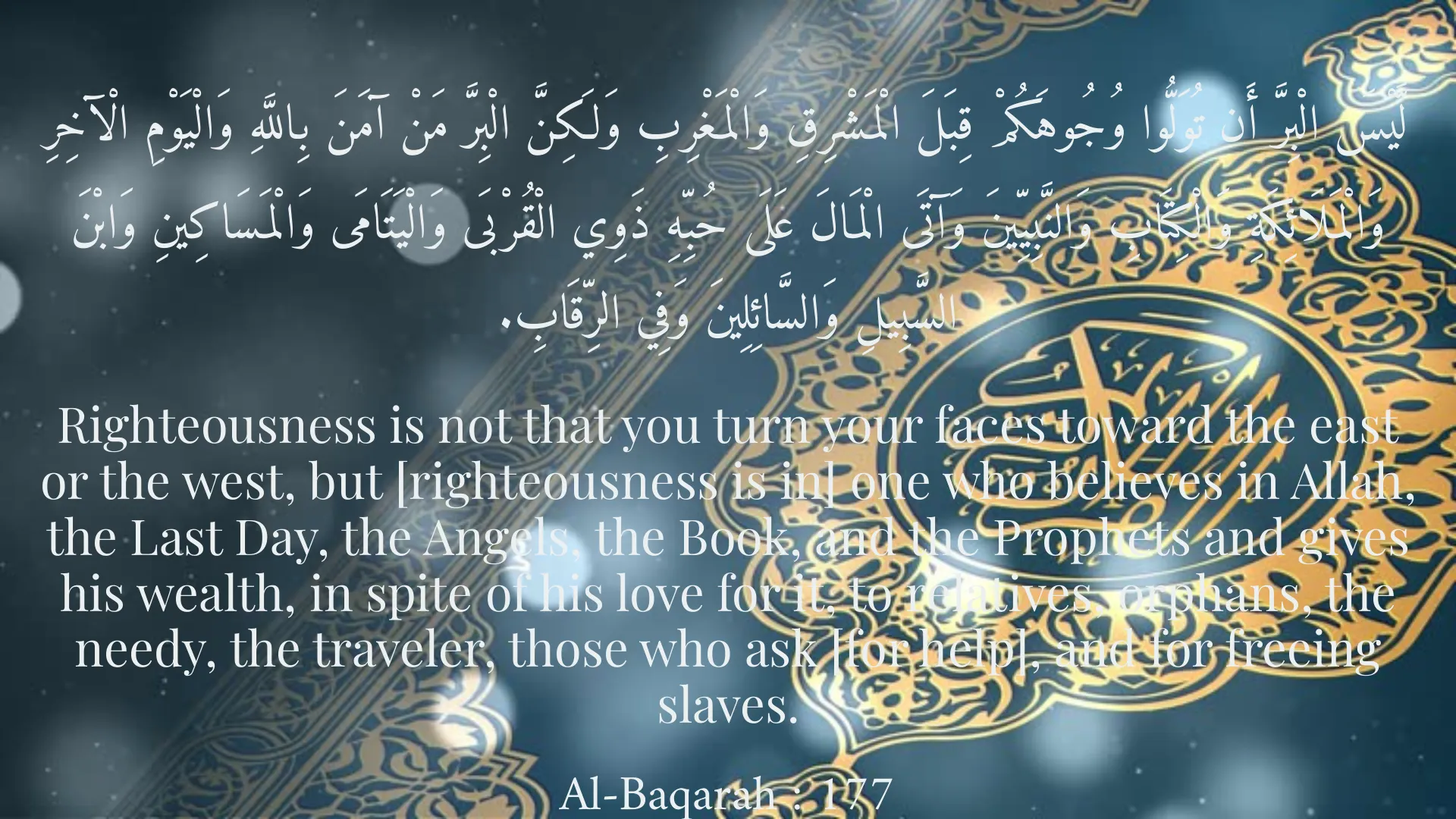
لَّيْسَ الْبِرَّ أَن تُوَلُّوا وُجُوهَكُمْ قِبَلَ الْمَشْرِقِ وَالْمَغْرِبِ وَلَكِنَّ الْبِرَّ مَنْ آمَنَ بِاللَّهِ وَالْيَوْمِ الْآخِرِ وَالْمَلَائِكَةِ وَالْكِتَابِ وَالنَّبِيِّينَ وَآتَى الْمَالَ عَلَى حُبِّهِ ذَوِي الْقُرْبَى وَالْيَتَامَى وَالْمَسَاكِينِ وَابْنَ السَّبِيلِ وَالسَّائِلِينَ وَفِي الرِّقَابِ.
Righteousness is not that you turn your faces toward the east or the west, but [righteousness is in] one who believes in Allah, the Last Day, the Angels, the Book, and the Prophets and gives his wealth, in spite of his love for it, to relatives, orphans, the needy, the traveler, those who ask [for help], and for freeing slaves.
Al-Baqarah : 177
لِلْفُقَرَاءِ الَّذِينَ أُحْصِرُوا فِي سَبِيلِ اللَّهِ لَا يَسْتَطِيعُونَ ضَرْبًا فِي الْأَرْضِ ۚ يَحْسَبُهُمُ الْجَاهِلُ أَغْنِيَاءَ مِنَ التَّعَفُّفِ ۚ تَعْرِيفٌ وَأَحْسَنُ أَشْكُرُوا لَهُمُ.
Charity is for the poor who have been restricted in the cause of Allah and are unable to travel in the land, whom the ignorant person would think are self-sufficient because of their restraint. You will recognize them by their non-requesting attitude.
Al-Baqarah : 273
وَالَّذِينَ يُؤْتُونَ مَا آتَوْا وَقُلُوبُهُمْ وَجِلَةٌ أَنَّهُمْ إِلَى رَبِّهِمْ رَاجِعُونَ.
And those who give what they give while their hearts are fearful because they will be returning to their Lord.
Al-Mu'minun : 60
Short Story
Once upon a time in a city street, a poor man sat beside a stream. He looked at the passersby with hopeful eyes. A kind-hearted man approached and noticed the man's dire needs. He decided to help him. When he gave the poor man some money and food, the man's eyes filled with tears. He said, 'You are not just helping me, but also giving me hope and peace. May God support you in this life and the hereafter.' This story serves as a reminder of our responsibility towards the needy and shows that helping others can change lives.