Quranic Answer
The Holy Quran, regarded by Muslims as the literal word of God, serves as a profound guide for mankind. Among the myriad teachings contained within its verses, one of the most salient themes is the encouragement of knowledge and the pursuit of education. This aspect is especially emphasized in Surah Al-‘Alaq, where Allah commands the Prophet Muhammad (PBUH) to read in His name. The first five verses of this surah hold significant importance, as they not only mark the first revelation but also encapsulate the essence of seeking knowledge. In these verses, Allah instructs, "Read in the name of your Lord who created, Created man from a clot (a piece of thick coagulated blood). Read, and your Lord is the most Generous—Who taught by the pen—Taught man that which he knew not." This powerful call to action highlights several core ideas: the act of reading, the significance of creation, and the divine endorsement of knowledge acquisition. From the outset of the Quran's revelation, the theme of knowledge emerges as a fundamental principle. The command to read indicates the importance of literacy and comprehension as pivotal tools for understanding the world and engaging with faith. This act of reading is not merely about acquiring skills; it symbolizes a deeper exploration of knowledge that encompasses both the physical universe and the divine wisdom embedded within it. The encouragement extends beyond surface-level understanding, inviting humanity to delve into the mysteries of life that Allah has created, thus fostering a continuous quest for personal and spiritual growth. Knowledge in Islam is not solely an intellectual pursuit; it is inherently connected to one’s faith and spirituality. The Quran establishes that gaining knowledge is a duty for every Muslim. This call for inquiry and reflection is echoed in the sayings of the Prophet Muhammad (PBUH), who is reported to have stated, "Seeking knowledge is an obligation for every Muslim." This obligation reinforces the idea that education is not only a personal ambition but also a communal responsibility that benefits society as a whole. Moreover, the Quran places knowledge on a high pedestal, considering it a means to draw closer to Allah. The pursuit of knowledge is seen as a form of worship. As Muslims engage in learning about the universe, human existence, and the signs of Allah, they deepen their understanding of their faith and the Creator. This exploration can lead to a more profound sense of awe and reverence for God's creation, enabling worshippers to appreciate the complexity and beauty of their surroundings. Furthermore, knowledge is regarded as a light that guides individuals through the darkness of ignorance. It equips believers with the understanding necessary to navigate ethical dilemmas and social challenges, allowing them to make informed decisions aligned with Islamic teachings. Consequently, education transforms individuals, instilling in them the virtues of compassion, justice, and equity, while also empowering them to contribute positively to their communities. Islamic scholars throughout history have exemplified the pursuit of knowledge, making substantial advancements in various fields such as mathematics, astronomy, medicine, philosophy, and literature. The Golden Age of Islam is a testament to the flourishing of intellectual thought and innovation, largely driven by the culture of learning that the Quran advocates. These scholars distinguished themselves by synthesizing Islamic principles with rational inquiry, illustrating that faith and reason are not antagonistic but rather complementary. The traditions of the infallible Imams further underline the esteem associated with knowledge. They conveyed the message that wisdom, understanding, and knowledge are the foundation upon which a healthy society is built. The teachings of these revered figures consistently highlight that those who seek knowledge should remain humble and committed to sharing their insights with others, aligning with the Islamic principle of community service and solidarity. Additionally, the Quran encourages an inquisitive mind that does not fear questioning. This aspect is crucial, as it reflects the dynamic nature of faith in Islam. Believers are encouraged to engage critically with their beliefs, to ask difficult questions, and to seek clarification about their doubts and concerns. This process helps to reinforce one’s faith through understanding, rather than blind adherence, promoting an active rather than passive approach to spirituality. Importantly, the Quran’s view on knowledge encompasses both spiritual understanding and practical skills. While religious education is crucial, the Quran also encourages the pursuit of worldly knowledge, enabling Muslims to thrive in various aspects of life. The diversification of knowledge pursuits fosters a well-rounded individual capable of contributing to society in numerous ways. In fact, the ability to balance spiritual and worldly knowledge is a hallmark of a successful Muslim, as it reflects the holistic nature of Islam. In contemporary society, the Quran's message about education remains more relevant than ever. With rapid advancements in technology, science, and socio-political dynamics, the call to seek knowledge resonates with the challenges faced today. This aligns with the global emphasis on education as a means to combat ignorance, poverty, and social injustice. Muslims are encouraged to engage actively with these issues, using their knowledge not only for personal growth but also as a force for positive change within the community. In conclusion, the Holy Quran explicitly invites humanity to seek knowledge and study, establishing it as a fundamental duty for Muslims. Through the revelations in Surah Al-‘Alaq, the emphasis on reading and understanding lays the foundation for a belief system that prioritizes education and enlightenment. The pursuit of knowledge, rooted in divine instruction, is a moral and religious obligation that enables individuals to grow closer to Allah while contributing meaningfully to society. As believers engage in this lifelong journey of learning, they embody the values of Islam, Illuminate the path for others, and perpetuate the transformative power of knowledge throughout generations.
Related Verses
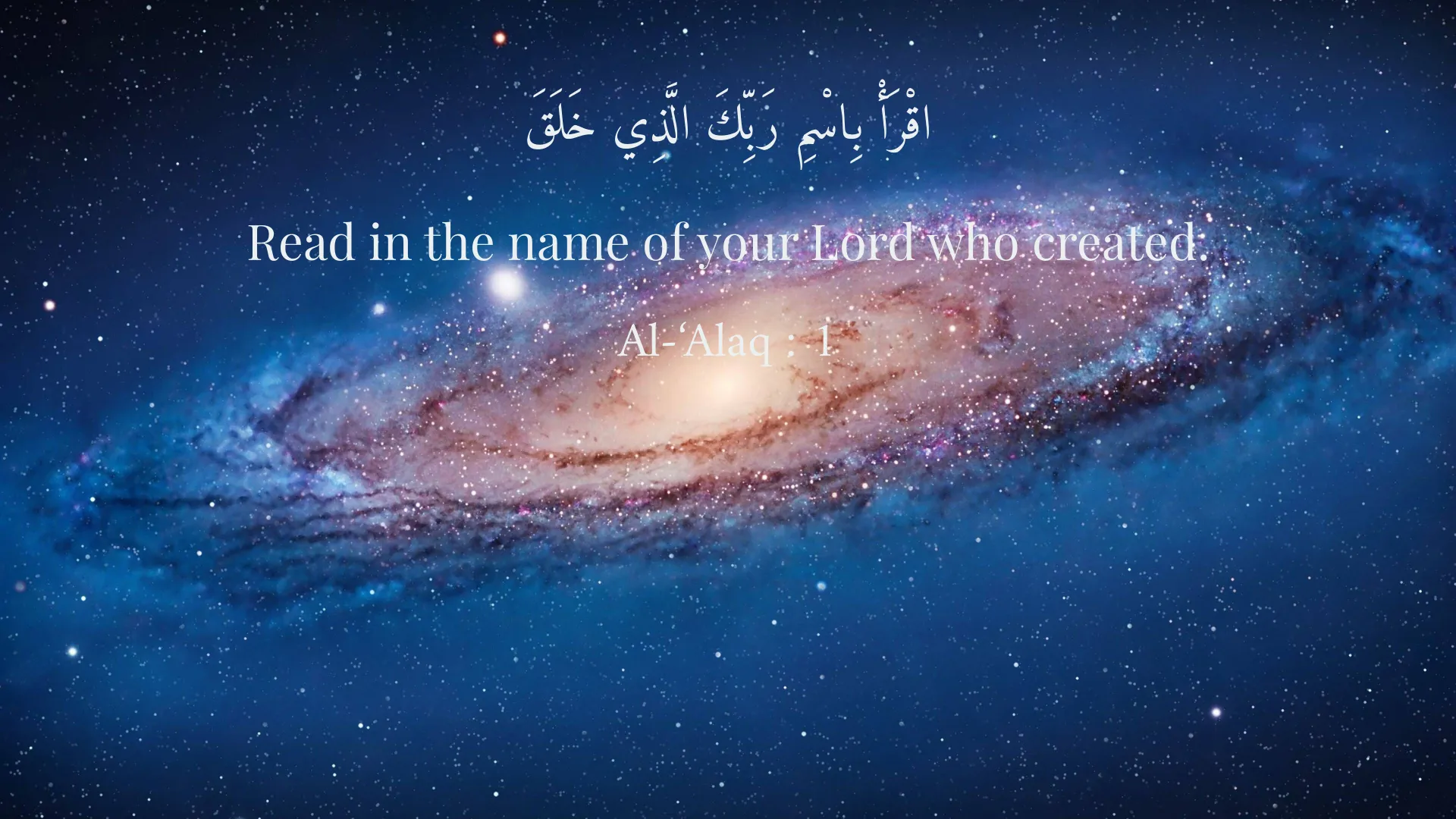
اقْرَأْ بِاسْمِ رَبِّكَ الَّذِي خَلَقَ
Read in the name of your Lord who created.
Al-‘Alaq : 1
عَلَّمَ الْإِنْسَانَ مَا لَمْ يَعْلَمْ
Taught man that which he knew not.
Al-‘Alaq : 5
Short Story
One day, a young man named Ali was sitting and thinking about how he could have a better life. He decided that instead of playing and having fun, he would focus more on studying and increasing his knowledge. One day, while reading a book, he came across verses from the Quran about knowledge that inspired him to continue his journey through life. Ali realized that knowledge could lead him to greater success, and he doubled his efforts. Over time, Ali became a successful person and always remembered that knowledge and learning had been his guiding lights in life.