Quranic Answer
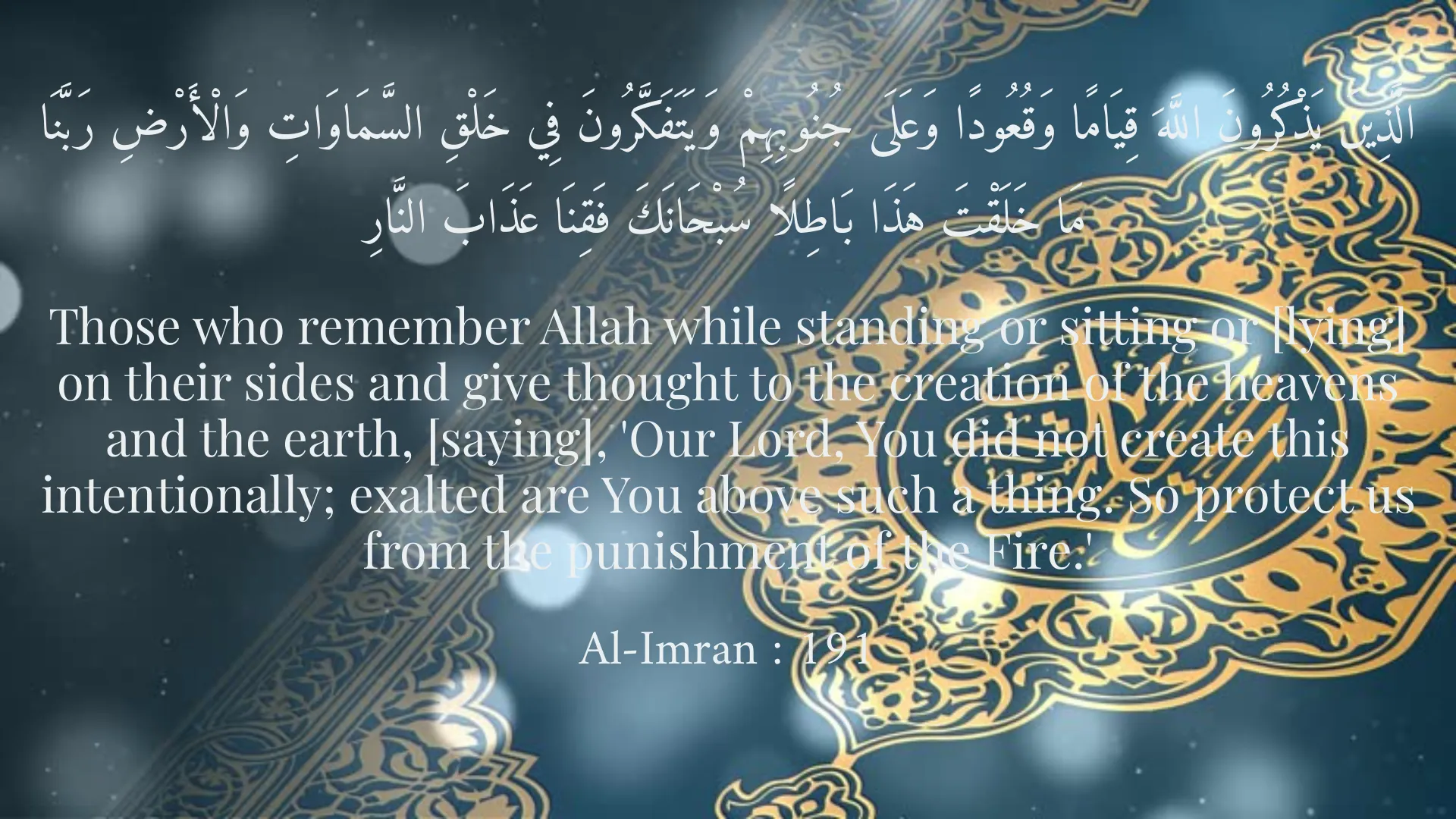
The Holy Quran serves as a profound source of guidance for humanity, emphasizing the critical role of reasoning and contemplation in understanding our existence and the universe around us. The Quran's call to think deeply about the creation of life and the cosmos is not only a spiritual directive but also an intellectual pursuit that encourages believers to engage with their surroundings thoughtfully. The various verses evocative of this inquiry into existence showcase a pattern of reflection that is paramount to human understanding and progression. In Surah Al-Imran, verse 191, the Quran invites the faithful to remember Allah in all conditions—while standing, sitting, or lying down—urging them to contemplate the creation of the heavens and the earth. This encompasses more than mere acknowledgment; it entails a deliberate focus on the world’s phenomena, prompting believers to question the intent behind creation. The verse states: 'Those who remember Allah while standing or sitting or [lying] on their sides and give thought to the creation of the heavens and the earth, [saying], 'Our Lord, You did not create this intentionally; exalted are You above such a thing. So protect us from the punishment of the Fire.' Here, the Quran emphasizes not only the importance of remembering God but also the significance of critically thinking about creation itself. It asserts that through contemplation, one should acknowledge that the universe was not created without purpose, thus steering individuals away from the punishment of ignorance. In addition, Surah Q, verse 36 poses rhetorical questions that stimulate reflective thought: 'Or were they created by nothing? Or were they the creators [of themselves]?' These provocations highlight the inherent need for reflection on one’s existence, urging individuals to ponder the origins and the essence of their being. By framing existence as a question of creation and causality, the Quran leads believers to explore concepts of divine authorship and the significant implications for their own lives. Furthermore, Surah Al-Baqarah, verse 164 reinforces this motif by stating: 'Indeed, in the creation of the heavens and the earth, and the alternation of the night and the day are signs for those of understanding.' This verse establishes a clear invitation to observe natural phenomena and to derive understanding from them. By presenting the alternation of day and night as signs, the Quran encourages humanity to seek knowledge and wisdom from the observable world. This not only fosters a sense of curiosity about nature but also promotes a methodology of rational inquiry that aligns with Islamic teachings. The continual refrain for reasoning and reflection within the Holy Quran illustrates that intellect is a gift from Allah that must be utilized diligently. The Quranic narrative holds that significant truths about the self, the universe, and the divine can only be grasped through a combination of faith and intellect. This profound relationship between spirituality and rationality is prevalent throughout Islamic philosophy and is central to the understanding of one's place in the cosmos. Moreover, the implications of these verses stretch beyond mere contemplation. They serve as a foundation for scientific inquiry and intellectual enlightenment. Historically, many Muslim scholars, during the Golden Age of Islam, advanced numerous fields, including astronomy, mathematics, and medicine, fueled by the Quranic encouragement to seek knowledge. The integration of faith and reason led to a flourishing of inquiry, with the Quran as its guiding text. As believers engage with the texts of the Quran, they find calls to intellect intertwined with spiritual matters. The Holy Quran does not merely demand blind faith; instead, it presents dilemmas and hypotheses to be evaluated and pondered, recognizing the multifaceted nature of human existence. The verses urge a harmonious balance between faith and reason, encouraging believers to utilize their intellects to navigate life's challenges and appreciate the wonders of God's creation. In modern contexts, the relevance of these Quranic calls remains pervasive. In an era overflowing with information and varying worldviews, the emphasis on reason and contemplation as highlighted in the Quran can offer respite and guidance. The Quran serves as a reminder that amidst the chaos, there is a profound order to the universe that can be understood through thoughtful engagement. Moreover, the act of contemplation as prescribed by the Quran fosters a deeper spiritual connection with God. This relationship is enhanced when believers use their reason to engage with their faith, leading to a more mature and nuanced understanding of their beliefs. This engagement transcends simple rituals, enabling adherents to grasp the essence of worship as a lived experience grounded in awareness and understanding. Ultimately, the Holy Quran's repeated invitation to think and reason is not merely a call to intellectual exercise; it is an integral aspect of what it means to be human. Through the lens of the Quran, reasoning and contemplation are pathways to faith, leading to liberation from ignorance and a deeper comprehension of one’s existence and divine purpose. Thus, the spiritual and intellectual journeys are intertwined in a way that reflects the true nature of human understanding. The Quran, through its verses, continues to inspire individuals towards a quest for knowledge and a deeper connection with the world around them, advocating for a life lived with purpose, understanding, and remembrance of the Creator.
Related Verses
الَّذِينَ يَذْكُرُونَ اللَّهَ قِيَامًا وَقُعُودًا وَعَلَى جُنُوبِهِمْ وَيَتَفَكَّرُونَ فِي خَلْقِ السَّمَاوَاتِ وَالْأَرْضِ رَبَّنَا مَا خَلَقْتَ هَذَا بَاطِلًا سُبْحَانَكَ فَقِنَا عَذَابَ النَّارِ
Those who remember Allah while standing or sitting or [lying] on their sides and give thought to the creation of the heavens and the earth, [saying], 'Our Lord, You did not create this intentionally; exalted are You above such a thing. So protect us from the punishment of the Fire.'
Al-Imran : 191
أَمْ خُلِقُوا مِنْ غَيْرِ شَيْءٍ أَمْ هُمُ الْخَالِقُونَ
Or were they created by nothing? Or were they the creators [of themselves]?
Q : 36
إِنَّ فِي خَلْقِ السَّمَاوَاتِ وَالْأَرْضِ وَاخْتِلَافِ اللَّيْلِ وَالنَّهَارِ لَآيَاتٍ لِأُولِي الْأَلْبَابِ
Indeed, in the creation of the heavens and the earth, and the alternation of the night and the day are signs for those of understanding.
Al-Baqarah : 164
Short Story
One day, Adel went to the park and sat down. He was gazing at the sky and contemplating its beauty. Suddenly, he recalled the verses of the Quran that always invited him to think and reason. Adel decided that he would focus more on remembering God and creation in his life. He felt that with this change, his life had become more peaceful.