Quranic Answer
The Holy Quran, the divine book of guidance, is replete with verses that invite humanity to contemplation, reflection, and reasoning in various matters. This invitation is not merely a moral recommendation but a fundamental pillar for understanding religion, knowing the world, and achieving true felicity. The Quran not only values rationality but repeatedly asks humans, 'Do you not reason?' or 'Do you not reflect?' to awaken their self-awareness and activate their intellectual faculties. One of the most prominent ways the Quran invites to reasoning is its emphasis on observing and contemplating the 'ayahs' (signs) in the cosmos (afaqi signs). From the creation of the heavens and the earth, the alternation of night and day, the movement of ships on the sea, the descent of rain, and the revival of the earth after its lifelessness, to the diversity of creatures and the system of winds and clouds – all are presented as 'signs for a people who reason.' The Quran constantly directs human eyes towards the grandeur and unparalleled order of the universe to make them realize that this magnificent system is not accidental and that there is a Wise and Knowing Creator behind it. This observation, coupled with reflection, guides humans from a superficial view to a deeper understanding of existence and the purpose of life. This method of inviting to reason prevents individuals from blindly following traditions and ancestral beliefs, encouraging them instead to use their God-given intellect to explore truths and arrive at conclusions. The Quran clearly states the difference between the knowledgeable and the ignorant, and considers human dignity to be contingent upon the use of this great divine gift: intellect. Indeed, in the Quran's view, rationality is a tool for distinguishing truth from falsehood and achieving insight-based faith, not mere imitation. The Quran desires humans to embrace faith with their whole being, and this is impossible without thinking and contemplating divine verses and the messages of the Prophets. Furthermore, the Quran invites reflection upon the 'ayahs' within oneself (anfusi signs). Allah says in the Quran: 'And in yourselves; do you not see?' This invitation to introspection and contemplation on the manner of creation, growth, and complexities of the human body and soul is as important as the invitation to contemplate the cosmos. This reflection not only leads to self-knowledge and an understanding of one's limitations but also opens a door to knowing the Creator and His infinite power. Understanding the truth that a human being is a sign of Allah's signs leads to humility before the Lord's majesty and responsibility towards life. Many verses that refer to mental health, peace of heart, and solutions to problems implicitly invite humans to reason about their psychological and spiritual state and find Quranic solutions for them. Moreover, the Quran calls humanity to ponder upon the verses of the Book (the Quran itself). Allah says: 'Do they not then ponder on the Quran, or are there locks on their hearts?' This verse indicates that the purpose of the Quran's revelation is not merely recitation but a deep understanding of its meanings, messages, and wisdoms. Pondering the Quran means going beyond superficial reading and striving to dive into the ocean of its concepts. It is this profound reflection that awakens hearts, grants insight, and guides individuals to righteous deeds and the right path in life. This invitation to reason and reflect is such that even in jurisprudential and legal matters, the Quran lays down general principles and entrusts details to intellect and ijtihad (independent reasoning), thereby providing the ground for the intellectual endeavors of jurists and scholars. This demonstrates that Islam is not only compatible with rationality but considers it one of the most important tools for attaining truth and holds it in high esteem. Thus, the Quran offers a comprehensive intellectual and practical system in which reason and revelation stand side by side, complementing each other so that humans can make the best decisions in the complexities of life and achieve the highest human virtues. This continuous invitation to reasoning is a path for the continuous intellectual and spiritual growth of humans in all aspects of their lives, from the most minor daily decisions to the greatest existential and ethical issues.
Related Verses
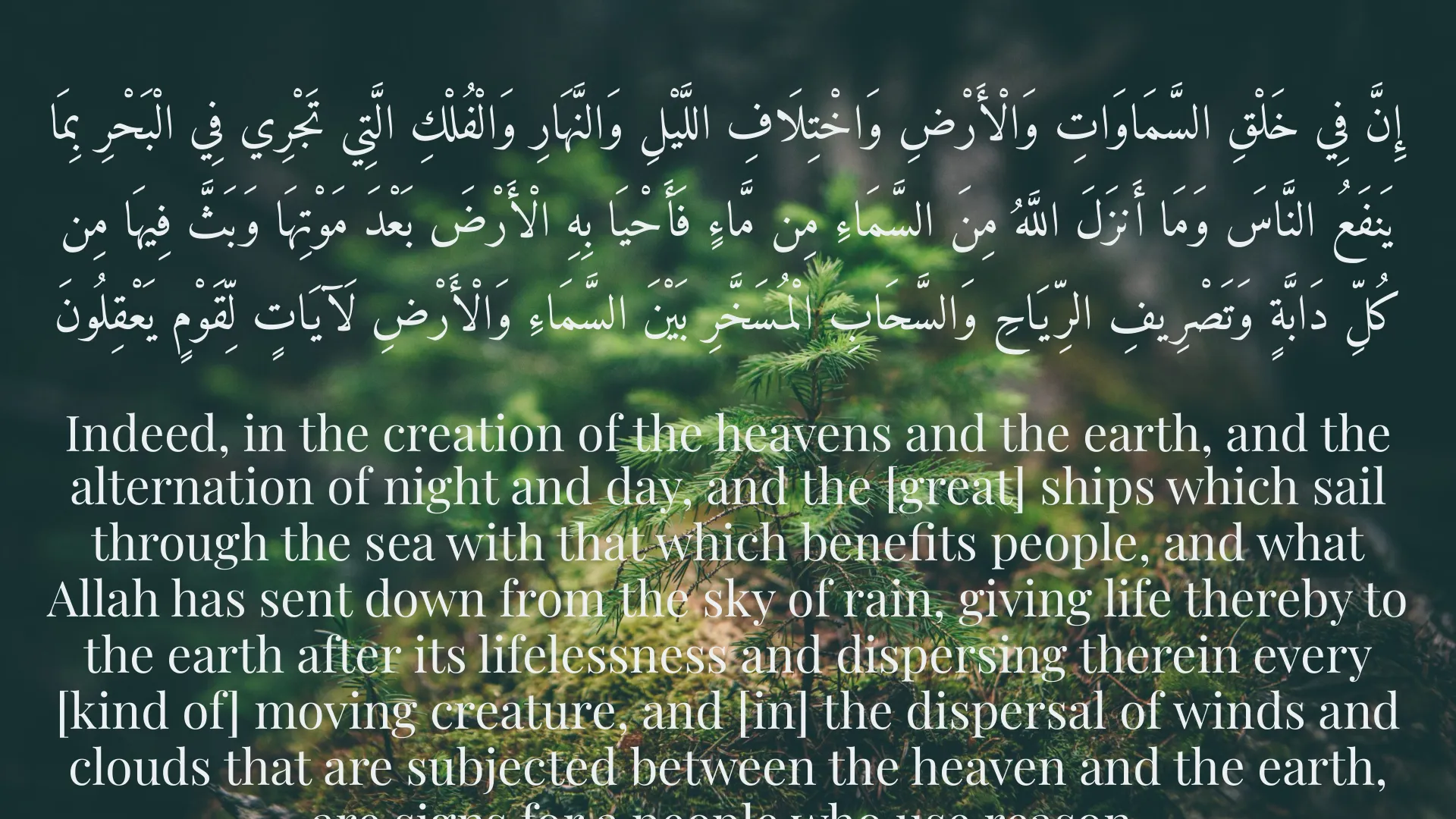
إِنَّ فِي خَلْقِ السَّمَاوَاتِ وَالْأَرْضِ وَاخْتِلَافِ اللَّيْلِ وَالنَّهَارِ وَالْفُلْكِ الَّتِي تَجْرِي فِي الْبَحْرِ بِمَا يَنفَعُ النَّاسَ وَمَا أَنزَلَ اللَّهُ مِنَ السَّمَاءِ مِن مَّاءٍ فَأَحْيَا بِهِ الْأَرْضَ بَعْدَ مَوْتِهَا وَبَثَّ فِيهَا مِن كُلِّ دَابَّةٍ وَتَصْرِيفِ الرِّيَاحِ وَالسَّحَابِ الْمُسَخَّرِ بَيْنَ السَّمَاءِ وَالْأَرْضِ لَآيَاتٍ لِّقَوْمٍ يَعْقِلُونَ
Indeed, in the creation of the heavens and the earth, and the alternation of night and day, and the [great] ships which sail through the sea with that which benefits people, and what Allah has sent down from the sky of rain, giving life thereby to the earth after its lifelessness and dispersing therein every [kind of] moving creature, and [in] the dispersal of winds and clouds that are subjected between the heaven and the earth, are signs for a people who use reason.
Al-Baqarah : 164
الَّذِينَ يَسْتَمِعُونَ الْقَوْلَ فَيَتَّبِعُونَ أَحْسَنَهُ ۚ أُولَٰئِكَ الَّذِينَ هَدَاهُمُ اللَّهُ ۖ وَأُولَٰئِكَ هُمْ أُولُو الْأَلْبَابِ
Those who listen to speech and follow the best of it. Those are the ones Allah has guided, and those are people of understanding.
Az-Zumar : 18
أَفَلَا يَتَدَبَّرُونَ الْقُرْآنَ أَمْ عَلَىٰ قُلُوبٍ أَقْفَالُهَا
Do they not then ponder on the Quran, or are there locks on their hearts?
Muhammad : 24
Short Story
It is narrated that one day, Luqman the Sage was sitting by a river, gazing at the flowing water. A man passed by and asked, "O Sage, what are you doing?" Luqman replied, "I am looking at this water that flows ceaselessly and never stops. This makes me reflect that human life is also like this; if it ceases to move and strive for a moment, it will stagnate like standing water. One must always pursue knowledge and wisdom, and approach every task with intellect and reason, so that life may be fruitful and ever-flowing." Upon hearing this, the man reflected and understood that wisdom illuminates the path of life, and stagnation is the bane of existence.