Quranic Answer
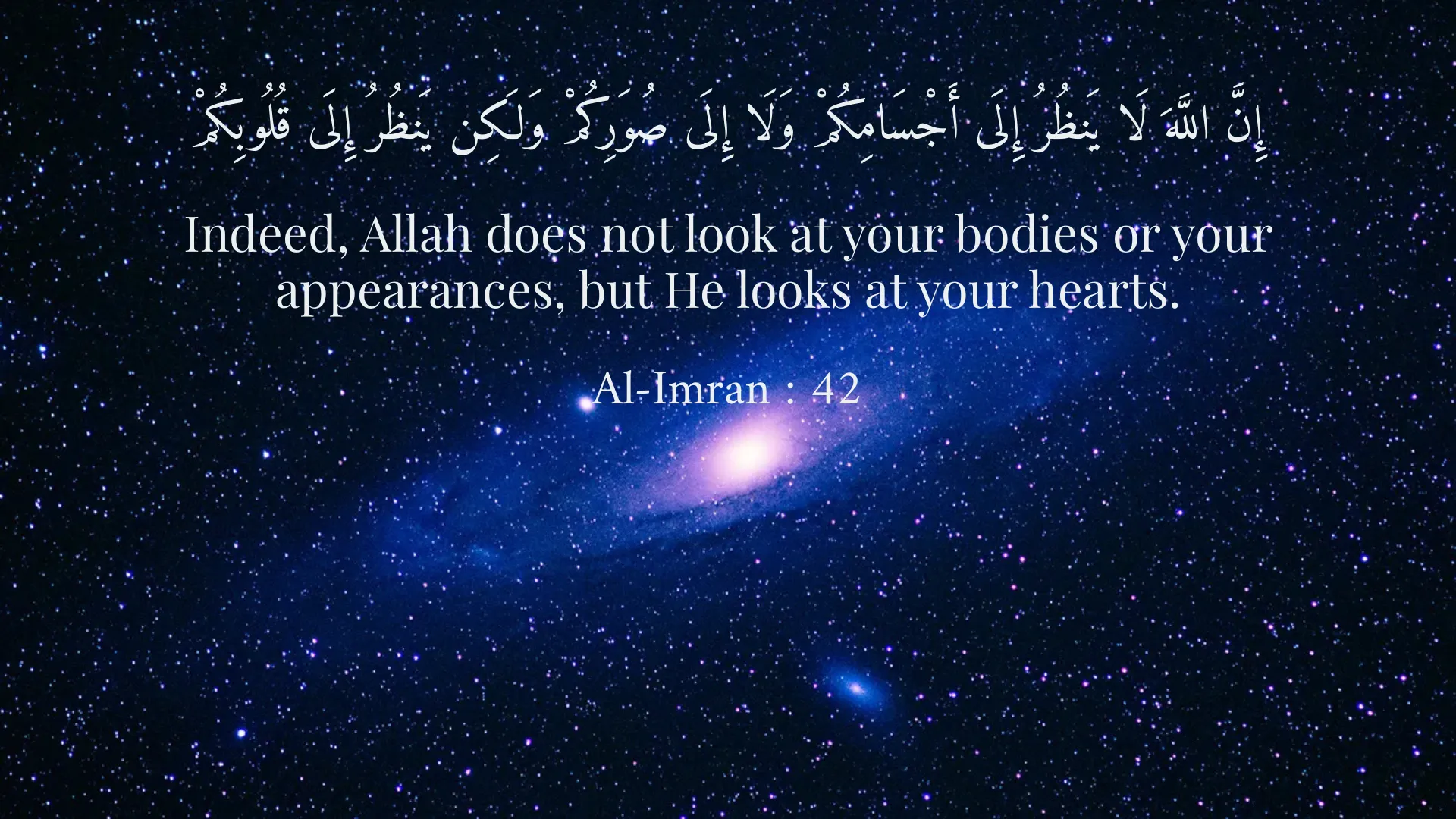
In the contemporary world, where physical appearances and external impressions dominate social interactions, the teaching of the Holy Quran regarding the distinction between outward appearances and the inner self resonates more than ever. One of the most profound insights within the Quran comes from Surah Al-Imran, verse 42, where Allah states, 'Indeed, Allah does not look at your bodies or your appearances, but He looks at your hearts.' This ellucidates a fundamental principle: that true value and worth are not determined by how one looks on the outside, but rather by the state of one's heart and intentions. The societal pressures to conform to certain look standards can overshadow the more significant, inner work of personal character development. In a world captivated by social media aesthetics, the emphasis has shifted to maintaining a perfect outward image—yet this verse from the Quran challenges us to reevaluate our priorities. It calls to our attention a deeper reality: that the inner self holds far more weight in the eyes of Allah. Understanding this, one might wonder why the Quran places such emphasis on the inner self. The answer lies in the nature of human existence, where our intentions drive our actions and ultimately our destinies. Allah's focus on our hearts implies a standard of accountability that demands self-reflection and a commitment to our ethical and moral values. In another powerful segment of the Quran, Surah Al-Baqarah, verses 8 and 10, Allah warns of individuals who may outwardly profess belief yet harbor disbelief and hypocrisy within. This stark reminder raises a critical issue surrounding authenticity and sincerity in one’s faith. The Islamic perspective on faith goes beyond mere verbal affirmation. It encompasses a holistic approach wherein one’s thoughts, feelings, and intentions align with their actions. In our interactions, be it with family, friends, or society, it is essential to embody sincerity that stems from a purified heart. The heart, as understood in Islamic teachings, is not just a physiological organ but is considered the seat of emotion, intention, and spirituality. The focus on the heart encourages believers to engage in a spiritual journey toward self-actualization and integrity. In a practical sense, this guidance leads us toward introspection; we must regularly assess our motivations and ensure they align with the teachings of Islam. Are we acting out of a desire for recognition, or are our actions motivated by a sincere wish to please Allah? The Quran's insistence on inner purification urges us to transcend superficial judgments based on what we see. Instead, it fuels our aspirations for personal growth and ethical living. The emphasis on the inward journey promotes an atmosphere where individuals can cultivate peace, empathy, and compassion toward others, fundamentally rooting these attributes in genuine love for Allah and His creation. Furthermore, to initiate the process of purifying the self, one can adopt several practical steps. Firstly, regular self-reflection through the practice of meditation or prayer creates an opportunity for individuals to evaluate their hearts. This can be accentuated by reciting Quranic verses that encourage one to ponder over their intentions and actions. Secondly, seeking knowledge and engaging with teachings of the Prophet Muhammad (peace be upon him) provides essential guidance on conducting oneself with sincerity. His life serves as a paradigm in the establishment of inner purity and authenticity that Muslims aim to emulate. As believers strive to imitate his character, they naturally orient their hearts towards compassion, humility, and integrity. Moreover, community engagement and charitable actions further facilitate inner growth. Giving back to others fosters a sense of gratitude and humility, allowing one to recognize the imperfections within themselves. These acts of kindness, born from pure intention, cultivate an environment of mutual support that uplifts both the giver and the receiver. As we embark on our daily lives, this principle of focusing on the inner self should guide our thoughts and actions. When faced with challenges or conflicts, recalibrating our approach based on inner intentions can yield transformative outcomes. For example, when disagreements arise, it might be easy to resort to a defensive posture. However, striving to maintain an open heart can pave the way for understanding and reconciliation. Ultimately, every action we perform should be directed towards attaining Allah's pleasure, stemming from a heart untainted by superficial desires. This conscious effort ensures we live truthfully and harmoniously in line with our beliefs. It calls on believers to open a window into their hearts—a metaphor for reflection and contemplation—where the realities of one’s essence dwell. The Quran beckons us to improve our inner self continuously, fostering a culture that deeply appreciates character over appearance. In conclusion, the distinction made in the Holy Quran between outward appearance and inner self holds timeless relevance. It prompts an exploration of our intentions, highlighting the need for sincerity in every deed. By striving for inner purity, believers are not merely engaging in a personal journey but are also contributing positively to the wider society. As we focus on nurturing our inner selves, we rise above superficial judgments, allowing for a deeper connection with Allah and those around us. Thus, the journey towards a cleansed heart and sincere intentions remains a vital aspect of Islamic faith and practice.
Related Verses
إِنَّ اللَّهَ لَا يَنظُرُ إِلَى أَجْسَامِكُمْ وَلَا إِلَى صُوَرِكُمْ وَلَكِن يَنظُرُ إِلَى قُلُوبِكُمْ
Indeed, Allah does not look at your bodies or your appearances, but He looks at your hearts.
Al-Imran : 42
وَمِنَ النَّاسِ مَنْ يَقُولُ آمَنَّا بِاللَّهِ وَبِالْيَوْمِ الْآخِرِ وَمَا هُمْ بِمُؤْمِنِينَ
And of the people are some who say, 'We have believed in Allah and the Last Day,' but they are not believers.
Al-Baqarah : 8
خَتَمَ اللَّهُ عَلَى قُلُوبِهِمْ وَعَلَى سَمْعِهِمْ ۖ وَعَلَى أَبْصَارِهِمْ غِشَاوَةٌ ۖ وَلَهُمْ عَذَابٌ عَظِيمٌ
Allah has set a seal upon their hearts and upon their hearing, and there is a veil over their eyes, and for them is a great punishment.
Al-Baqarah : 10
Short Story
One day, a man named Ahmad was in deep thought. He always tried to bring joy and comfort to others; however, he felt he was lacking something within himself. One day, while reciting the Quran, he came across the verse 'Indeed, Allah does not look at your bodies.' This verse prompted him to reflect deeply. He realized that having a beautiful appearance and sweet words were not enough, and he needed to focus on his inner self. From that day forward, Ahmad tried to cultivate purer intentions and dedicated more care to others than to himself.