Quranic Answer
Many people mistakenly assume that true faith necessitates unquestioning acceptance, effectively stifling any form of inquiry. However, a profound exploration of the Holy Quran reveals a remarkably different and inspiring perspective. Far from discouraging doubts or curiosity, the Quran actively invites and indeed compels humanity to engage in deep reflection, critical thinking, and thoughtful questioning. It posits a dynamic relationship where sincere inquiry, rather than undermining faith, serves as a powerful catalyst for its growth, deepening, and purification. This divine scripture encourages its readers to observe the universe, ponder its intricate design, reflect on historical events, and even engage in direct intellectual discourse, all as means to arrive at a more profound and unwavering conviction. The Quran is replete with verses that persistently urge contemplation, reasoning, and the active use of one's intellect. Rhetorical questions such as “Afa la ta’qiloon?” (Do you not reason?), “Afa la yatadabbaroon al-Quran?” (Do they not ponder the Quran?), and “Afa la yatafakkaroon?” (Do they not reflect?) are not mere literary devices; they are powerful divine invitations to stimulate the human mind. This intellectual stimulation is not just for academic pursuits but is fundamentally linked to understanding God’s signs (ayat) within the universe and within oneself, thereby reinforcing one’s belief. For instance, in Surah Al-Imran (3:190-191), Allah praises “those who remember Allah while standing or sitting or [lying] on their sides and reflect upon the creation of the heavens and the earth, [saying], ‘Our Lord, You have not created this in vain; exalted are You [above such a thing]; then protect us from the punishment of the Fire.’” Here, reflection on the marvels of creation is explicitly connected to recognizing God’s wisdom, power, and ultimately, fearing Him, which is a cornerstone of genuine faith. This highlights that seeking understanding is a spiritual act. One of the most compelling illustrations of legitimate questioning leading to stronger faith is the narrative of Prophet Abraham (Ibrahim) found in Surah Al-Baqarah (2:260). Abraham queries Allah, “My Lord, show me how You give life to the dead.” Allah responds, “Do you not believe?” Abraham replies, “Yes, but [I ask] only that my heart may be satisfied.” Allah then instructs him to take four birds, cut them into pieces, place a portion on each mountain, and then call them; they would miraculously fly back to him. This profound account beautifully demonstrates that even a prophet, a pinnacle of faith, sought tangible confirmation to elevate his knowledge (ilm) to absolute certainty (yaqin). His question was not born of doubt in God’s omnipotence, but from a sincere desire to solidify his conviction with experiential knowledge, rendering his faith impregnable. This powerful example unequivocally shows that asking “how” or seeking empirical evidence, when propelled by a genuine yearning for truth, is not only tolerated but actively facilitated by the Divine. It transforms theoretical belief into an unshakable inner conviction. It is paramount to distinguish between sincere questioning aimed at understanding and personal growth, and questioning that emanates from denial, arrogance, or a deliberate intention to mock or refute. The Quran unequivocally condemns those who question out of obstinacy, merely to dispute the truth without any genuine intention of acceptance, especially after clear signs have been presented to them. Such individuals are often described as having “diseased hearts” or being “blind” to the truth, implying a willful rejection. However, for those who genuinely seek answers, who approach inquiry with humility, who are open to divine guidance, and who earnestly strive to comprehend the sacred message, the Quran provides abundant space and encouragement. The story of Moses and Khidr (Surah Al-Kahf) further underscores the importance of patience and learning from what one may not immediately comprehend, suggesting that some answers unfold over time or through different perspectives, requiring a deep trust in divine wisdom. The Quran consistently elevates the stature of knowledge (ilm) and those who possess it. “Say, ‘Are those who know equal to those who do not know?’ Only those of understanding will remember.” (Surah Az-Zumar 39:9). This profound emphasis on knowledge inherently promotes and necessitates continuous inquiry, as true knowledge is acquired through asking pertinent questions, diligent research, and thoughtful reflection. A faith system built upon understanding, rational evidence, and intellectual conviction is incomparably more robust and resilient than one founded solely on inherited tradition, blind adherence, or fleeting emotional attachment. The Quran calls upon believers to actively seek knowledge, to comprehend the intricate mechanisms of the universe, and to reflect deeply on historical lessons. All these activities are forms of continuous questioning and learning that serve to solidify and invigorate one’s faith, transforming it into a conscious and deeply personal commitment. In essence, the Quran presents a highly sophisticated and deeply nuanced relationship between questioning and faith. It does not demand blind adherence but rather an enlightened conviction born from profound intellectual engagement, continuous contemplation, and sincere, humble inquiry. Questioning, when pursued with humility, an open and receptive mind, and a genuine yearning for truth, emerges as an exceptionally powerful tool for deepening one’s connection with the Divine. It transforms faith from a mere inherited belief into a personal, deeply reasoned, and vibrantly alive conviction, rendering the believer more resilient against the assaults of doubt and far more appreciative of the boundless wisdom and omnipotence of God. The Quran extends an invitation to us not merely to believe, but to truly understand what we believe and precisely why, thereby establishing questioning as an indispensable and integral component of the spiritual journey toward yaqin (certainty).
Related Verses
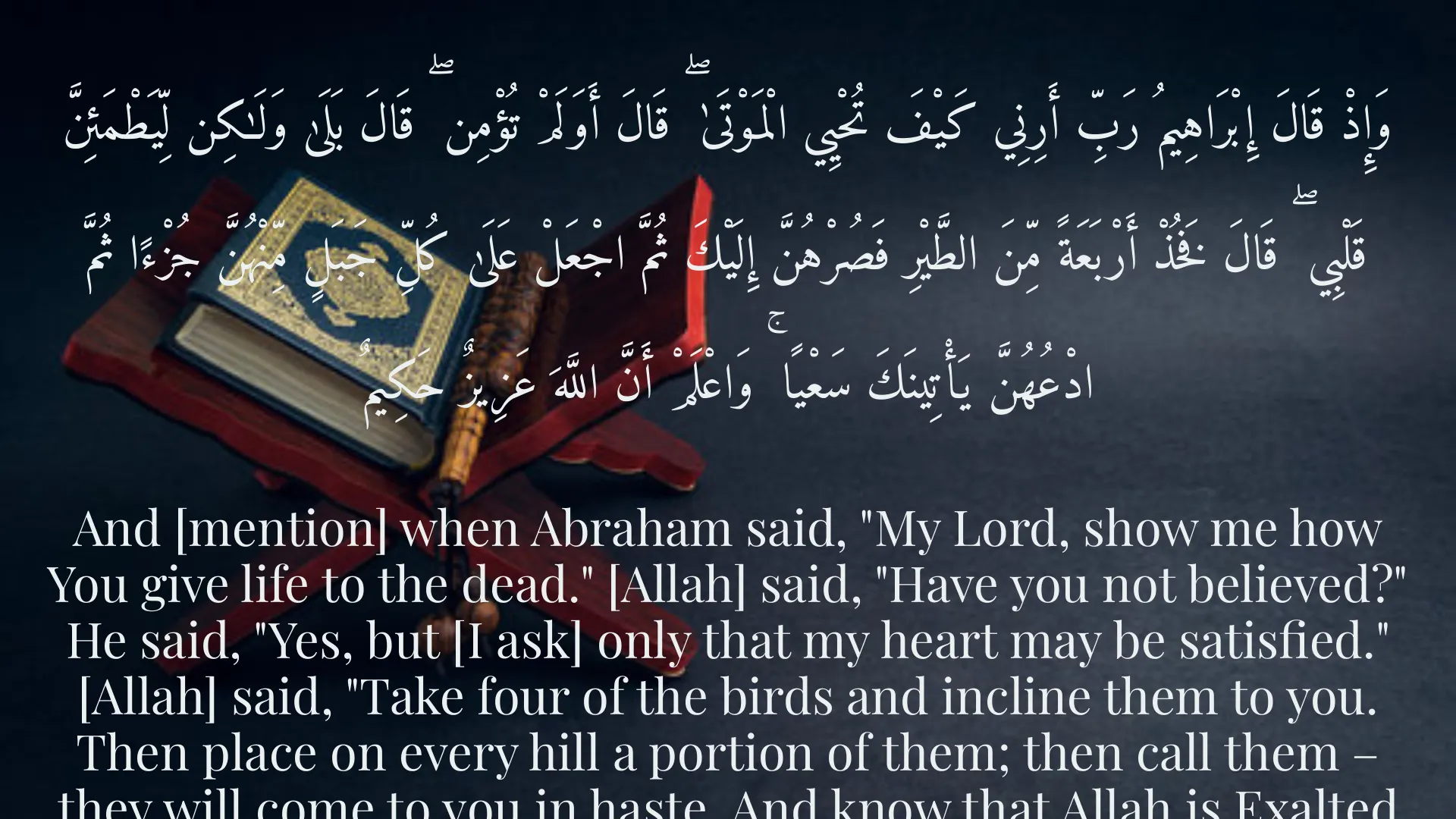
وَإِذْ قَالَ إِبْرَاهِيمُ رَبِّ أَرِنِي كَيْفَ تُحْيِي الْمَوْتَىٰ ۖ قَالَ أَوَلَمْ تُؤْمِن ۖ قَالَ بَلَىٰ وَلَٰكِن لِّيَطْمَئِنَّ قَلْبِي ۖ قَالَ فَخُذْ أَرْبَعَةً مِّنَ الطَّيْرِ فَصُرْهُنَّ إِلَيْكَ ثُمَّ اجْعَلْ عَلَىٰ كُلِّ جَبَلٍ مِّنْهُنَّ جُزْءًا ثُمَّ ادْعُهُنَّ يَأْتِينَكَ سَعْيًا ۚ وَاعْلَمْ أَنَّ اللَّهَ عَزِيزٌ حَكِيمٌ
And [mention] when Abraham said, "My Lord, show me how You give life to the dead." [Allah] said, "Have you not believed?" He said, "Yes, but [I ask] only that my heart may be satisfied." [Allah] said, "Take four of the birds and incline them to you. Then place on every hill a portion of them; then call them – they will come to you in haste. And know that Allah is Exalted in Might and Wise."
Al-Baqarah : 260
الَّذِينَ يَذْكُرُونَ اللَّهَ قِيَامًا وَقُعُودًا وَعَلَىٰ جُنُوبِهِمْ وَيَتَفَكَّرُونَ فِي خَلْقِ السَّمَاوَاتِ وَالْأَرْضِ رَبَّنَا مَا خَلَقْتَ هَٰذَا بَاطِلًا سُبْحَانَكَ فَقِنَا عَذَابَ النَّارِ
Who remember Allah while standing or sitting or [lying] on their sides and reflect upon the creation of the heavens and the earth, [saying], "Our Lord, You have not created this in vain; exalted are You [above such a thing]; then protect us from the punishment of the Fire."
Al-Imran : 191
أَمَّنْ هُوَ قَانِتٌ آنَاءَ اللَّيْلِ سَاجِدًا وَقَائِمًا يَحْذَرُ الْآخِرَةَ وَيَرْجُو رَحْمَةَ رَبِّهِ ۗ قُلْ هَلْ يَسْتَوِي الَّذِينَ يَعْلَمُونَ وَالَّذِينَ لَا يَعْلَمُونَ ۗ إِنَّمَا يَتَذَكَّرُ أُولُو الْأَلْبَابِ
Is he who is devoutly obedient during periods of the night, prostrating and standing [in prayer], fearing the Hereafter and hoping for the mercy of his Lord, [like one who does not]? Say, "Are those who know equal to those who do not know?" Only those of understanding will remember.
Az-Zumar : 9
Short Story
One day, in a warm and friendly gathering, a man asked the elders of the city, "O wise ones, what is the path to truth?" One of the elders, who only concerned himself with outward appearances and was oblivious to depth, immediately replied, "Unquestioning obedience and worship!" But another, a wise scholar and a man of contemplation, smiled and kindly said, "Obedience is good and purifies the heart, but truth must be found through seeking and curiosity. If you ask about a path you do not know, you will attain knowledge. And if you doubt what you know, you will reach certainty." He continued, "In the garden of the heart, the sapling of certainty does not grow without the watering of persistent questioning and contemplation. The flower of knowledge blossoms from the thorns of doubt, provided you illuminate these doubts with the light of reason and the voice of revelation and seek their answers." The attendees were astonished by these wise words and understood that true seeking arises not from the denial of faith, but from the depth of understanding and the attainment of peace of heart, and that questioning is a bridge that leads one to the spring of certainty.