Quranic Answer
In the profound and luminous teachings of the Holy Quran, death is never seen as absolute annihilation or non-existence, but rather as a gateway to another realm and the beginning of a new, eternal chapter of existence. This perspective not only brings solace to humanity but also bestows profound meaning and purpose upon our worldly lives. The Quran explicitly states that life in this world is a temporary phase, a passage, and a test whose outcome will be determined in the everlasting abode. Therefore, if death is not the end, what comes after it and marks the true beginning of eternal life is a series of stages, commencing with 'Barzakh,' culminating in the 'Day of Judgment,' and concluding with 'eternal life' in Paradise or Hell. Immediately after death, an individual enters a realm known as 'Barzakh.' Linguistically, Barzakh means a barrier or an intermediate space between two things. In Quranic terminology, Barzakh is a realm situated between this world and the Hereafter. This period is a time of waiting and preparation where souls reside until the Day of Resurrection. In Barzakh, individuals become partially acquainted with the consequences of their deeds; the righteous will experience comfort and tranquility, while the wicked will endure hardship and torment. However, these experiences are merely precursors to the ultimate reward or punishment in the Hereafter. This stage marks the initial step in the eternal journey, allowing individuals to taste the preliminary fruits of their worldly actions and prepare for the grand event that follows: the resurrection. The Quran alludes to this realm in Surah Al-Mu'minun, verse 100, stating: "And behind them is a barzakh until the Day they are resurrected." However, the true and grand beginning of eternal life commences with the blowing of the trumpet and the establishment of the 'Day of Judgment' or 'Yawm al-Hisab.' The Day of Judgment is the day when all beings, from the dawn of creation until the end of the world, will be resurrected and gathered before Allah to be held accountable for their deeds. This day is a day of revelation of hidden truths and precise recompense for actions. The Quran repeatedly emphasizes the certainty of the Day of Judgment, referring to it as a day when no injustice will be committed, and everyone will receive the precise consequence of their actions. On this day, each person's book of deeds will be opened, and their actions will be weighed in the scales of divine justice. Even human limbs, including hands, feet, and tongues, will bear witness against them. This stage signifies the beginning of absolute justice, where nothing is overlooked, and every deed, whether small or large, will be accounted for. This belief serves as a powerful motivator for individuals to be mindful of their actions and intentions in their worldly lives, knowing that nothing remains hidden from Allah. Following the thorough and complete reckoning, humanity will be divided into two main groups: the people of Paradise and the people of Hell. This point marks the beginning of an everlasting life that has no end. The people of Paradise are those who believed and performed righteous deeds, and by the vast mercy of Allah, they will enter the gardens of Paradise, beneath which rivers flow. In Paradise, they will eternally experience countless blessings and divine pleasure. Paradise is the manifestation of beauty, tranquility, and eternal felicity, where desires are fulfilled, and there is no suffering or sorrow. Conversely, the people of Hell are those who disbelieved in Allah, denied His signs, and engaged in corruption and oppression in the world. They will enter a fire that never subsides, where they will taste painful and countless torments. Hell is a symbol of divine justice and the consequence of human misdeeds, where punishments are proportionate to the actions performed in the world. Therefore, the true beginning after death is the ultimate manifestation of God's purpose in creating humanity: an eternal life of peace for the righteous and a life of torment for the wicked. This world is a farm for the Hereafter. Our actions, intentions, and words in this world are seeds that will bear fruit in the Hereafter. This Quranic perspective instills a sense of responsibility in individuals and guides them towards righteousness, justice, and piety. Belief in this eternal beginning gives depth and meaning to human life, allowing individuals to live with hope and purpose, rather than fear of an end. In essence, every breath we take, every step we make, and every decision we choose contributes to shaping our eternal destiny. This beginning is not merely the end of the worldly journey but the commencement of an unending journey towards the Lord, where eternity awaits, and we will face the fruits of our deeds. This belief reminds us that this world is but a bridge, not a home, and we must prepare provisions for the eternal home where we are destined to reside forever.
Related Verses
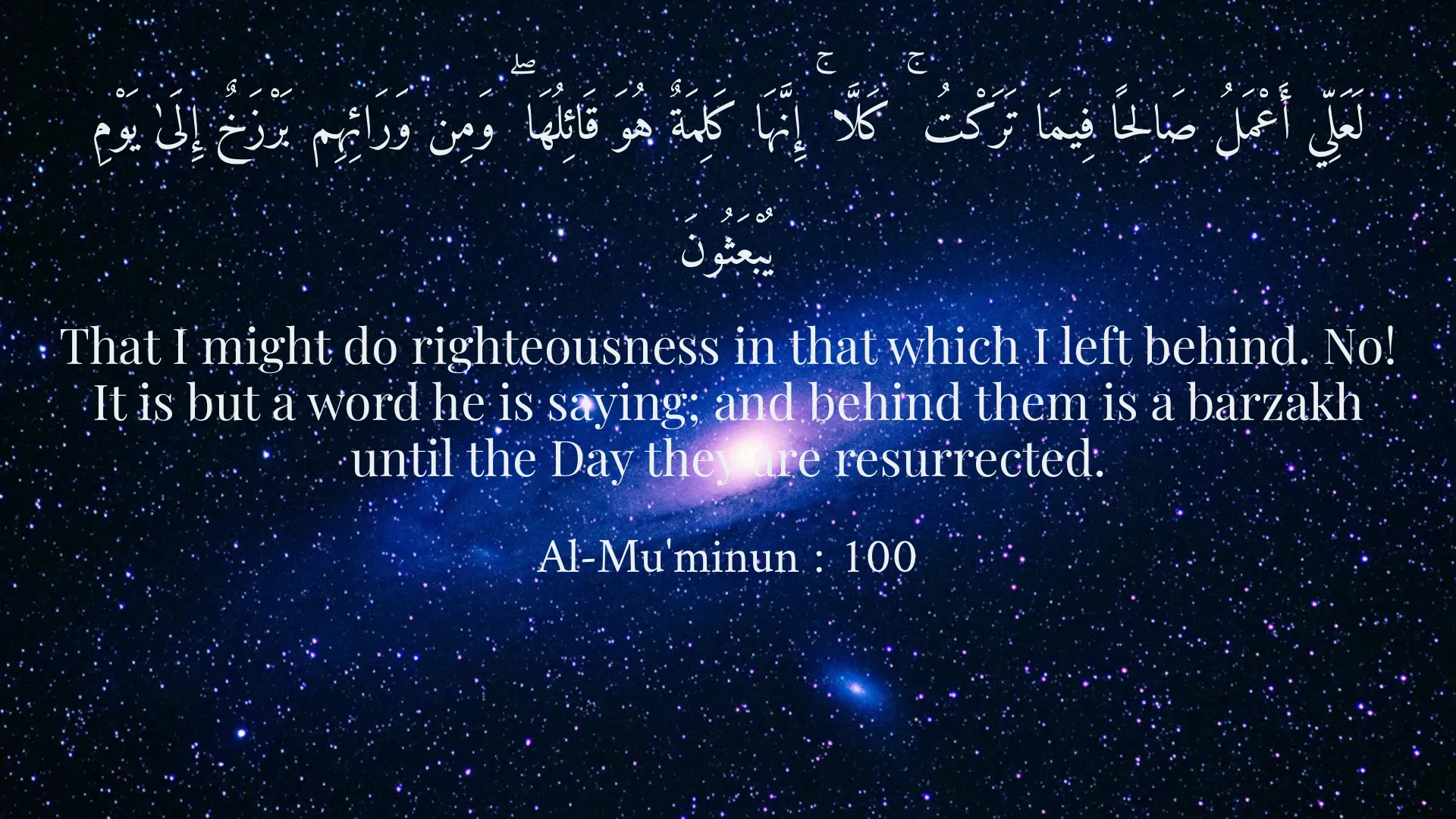
لَعَلِّي أَعْمَلُ صَالِحًا فِيمَا تَرَكْتُ ۚ كَلَّا ۚ إِنَّهَا كَلِمَةٌ هُوَ قَائِلُهَا ۖ وَمِن وَرَائِهِم بَرْزَخٌ إِلَىٰ يَوْمِ يُبْعَثُونَ
That I might do righteousness in that which I left behind. No! It is but a word he is saying; and behind them is a barzakh until the Day they are resurrected.
Al-Mu'minun : 100
وَنُفِخَ فِي الصُّورِ فَإِذَا هُم مِّنَ الْأَجْدَاثِ إِلَىٰ رَبِّهِمْ يَنسِلُونَ
And the Horn will be blown; and suddenly from the graves to their Lord they will hasten.
Ya-Sin : 51
فَمَن يَعْمَلْ مِثْقَالَ ذَرَّةٍ خَيْرًا يَرَهُ
So whoever does an atom's weight of good will see it,
Al-Zalzalah : 7
وَمَن يَعْمَلْ مِثْقَالَ ذَرَّةٍ شَرًّا يَرَهُ
And whoever does an atom's weight of evil will see it.
Al-Zalzalah : 8
Short Story
It is narrated that one day, a pious and world-renouncing man passed by a royal palace. He saw the king, in all his grandeur and splendor, sitting in a lush garden, engrossed in revelry. The pious man sighed and said, 'O King, all this pomp and glory, and these worldly pleasures, are fleeting and have an end. I have never seen anyone take anything from this worldly abode to the everlasting realm except their good deeds.' The king pondered this remark and asked, 'Then what should be done?' The pious man smiled and said, 'The true beginning is when you find the end of this world and return to your Lord with your righteous deeds. Gather provisions of piety and service to creation, for that provision will be the source of your eternal peace and felicity in the next abode.' The king, having taken heed of his words, thereafter paid more attention to his people and began to contemplate the Hereafter, for he understood that this world is merely a bridge to the eternal beginning.