Quranic Answer
Faith and knowledge are intertwined concepts emphasized throughout the Holy Quran, establishing a profound relationship that cannot be overlooked. The Quran does not just promote faith as an abstract notion; it grounds faith in knowledge, urging believers to pursue understanding in various aspects of life. This relationship indicates that true faith is not mere acceptance of doctrines but is deeply rooted in awareness and comprehension of the world and oneself. The Quran repeatedly reinforces the idea that one cannot exist without the other, highlighting how faith and knowledge complement one another in the pursuit of a meaningful life and spiritual fulfillment. One of the pivotal moments that encapsulate the Quranic view on this relationship is found in Surah Al-Baqarah, verse 282. Here, Allah instructs believers regarding the meticulous nature of writing debts and transactions. He states, "...And let him write between you in justice..." This directive is not merely a financial regulation; it symbolizes a broader principle of awareness and caution. The verse emphasizes the significance of being attentive and knowledgeable when engaging in transactions. Such awareness is not only about avoiding potential disputes but is integral to building a moral and just community. This wisdom is reflective of how Islam encourages its followers to be informed and conscious in their interactions and dealings with others. The lesson expands further when combined with the clarion call found in Surah Al-Anfal, verse 22. Here, Allah articulates a stern warning, stating, "Indeed, the worst of creatures in the sight of Allah are the deaf and dumb who do not use reason." This reminder highlights that ignorance, whether willful or circumstantial, renders one vulnerable. In the context of conflict, a lack of understanding and insight appears as a debilitating disadvantage. The Quran here stresses that to fully embrace one’s faith, believers must also cultivate their awareness and knowledge of the environment around them, empowering them to stand firm against adversaries both spiritually and physically. Moreover, the Quran acknowledges the significance of faith in the unseen. Faith in Allah and the Day of Resurrection are central to Islamic teaching. However, this does not suggest that believers should neglect empirical knowledge or the sciences. In Surah Al-Baqarah, verse 163, the connection between faith and knowledge is reiterated. Allah emphasizes that belief in Him and acknowledgment of the Day of Judgment should coexist with an understanding of worldly knowledge. Thus, this verse reinforces that true faith encompasses both spiritual conviction and intellectual pursuit, forming a holistic approach to life that does not shy away from the quest for knowledge. The linkage between faith and knowledge can be appreciated through countless examples throughout Islamic history, where scholars made invaluable contributions to various fields such as mathematics, astronomy, medicine, and philosophy. The legacy of these scholars echoes through the mutual reinforcement of faith and knowledge, proving successful practices intertwined with spiritual pursuit. Figures like Ibn Sina (Avicenna) and Al-Khwarizmi not only engaged with the faith but similarly enriched it through their understanding of the material universe, demonstrating that faith can coexist and thrive alongside scientific inquiry and rational thought. Furthermore, in contemporary times, this connection remains ever vital. In an age marked by rapid advancements in technology and science, the religious community must engage with these developments constructively. The Quran’s teachings encourage believers to seek knowledge, and this paradigm should push the community towards educational advancement, critical thinking, and informed discourse. Emphasizing education fosters an environment where individuals not only hold beliefs, but also understand the rational and empirical foundations supporting those beliefs. To illustrate the implications of this relationship, one can consider ethical decision-making within the business realm. As guided by the principles stated in Surah Al-Baqarah, verse 282, businesses that incorporate knowledge into their operational ethics contribute positively to society. This means more than just following regulations; it involves understanding market dynamics, social implications, and ethical considerations, empowering them as responsible stewards of their resources. When faith in divine justice and accountability intertwines with knowledge about ethical practices, businesses can operate successfully while contributing positively to the fabric of society. Moreover, in personal relationships, faith coupled with knowledge cements lasting bonds founded on respect and understanding. For instance, a marriage built on mutual respect and comprehension—knowledge about each partner’s aspirations, dreams, and struggles—reflects the deep-seated values promoted by the Quran. This highlights how applying the concept of knowledge while engaging with faith leads to holistic interpersonal dynamics that thrive on awareness and empathy. In conclusion, the intricate relationship between faith and knowledge as elucidated in the Holy Quran is both profound and essential. The teachings of the Quran establish that faith is not isolation from knowledge; instead, it is a compelling call to cultivate awareness and understanding. True faith, as guided by the Holy Quran, embodies a comprehensive framework where believers actively seek knowledge to foster justice, ethical living, and responsible interactions within society. This synthesis of faith and knowledge ensures that believers are not only faithful in their spiritual commitments but also wise and informed in their daily lives, thus painting a picture of a holistic and enriched Islamic identity.
Related Verses
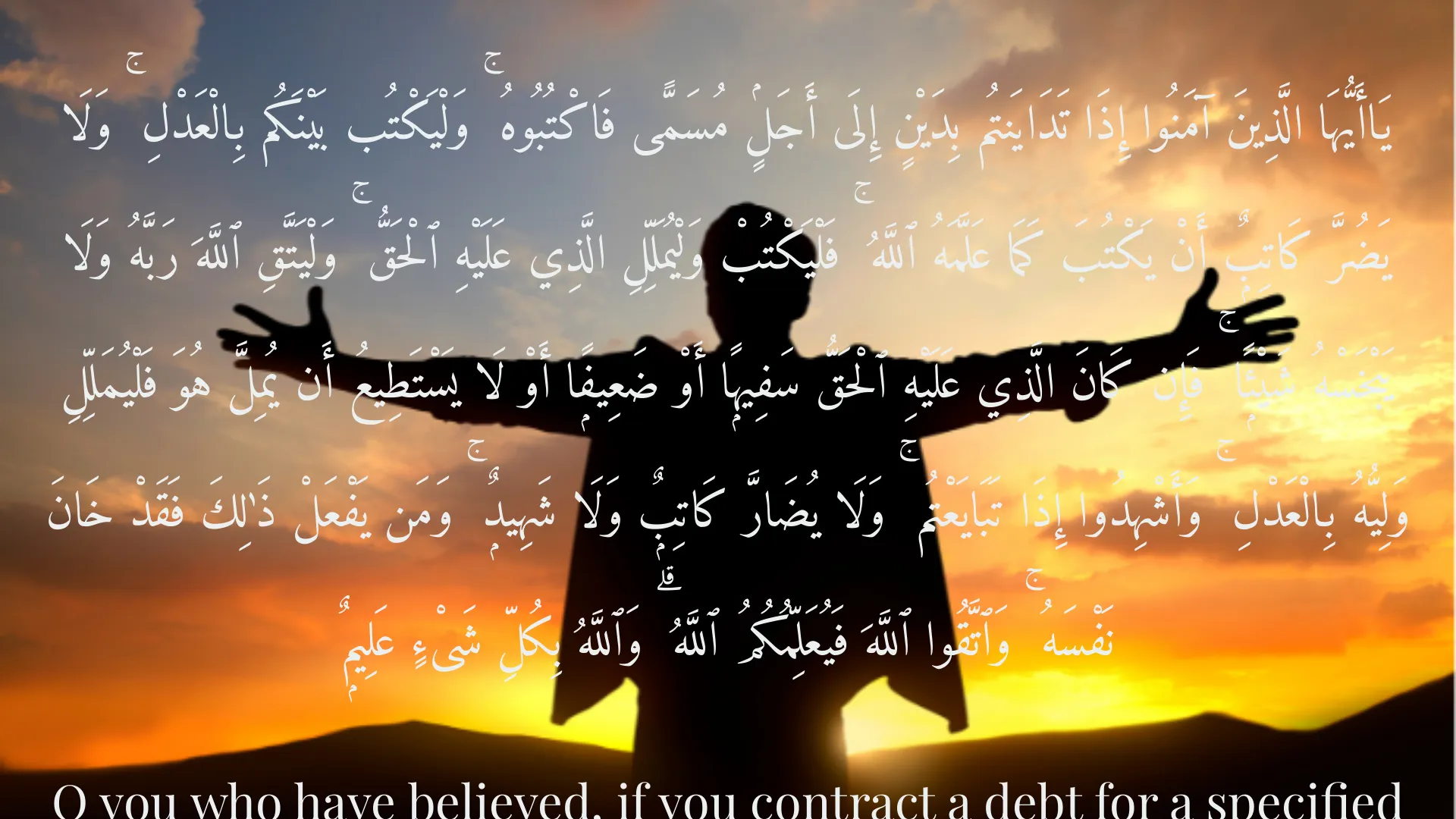
يَاأَيُّهَا الَّذِينَ آمَنُوا إِذَا تَدَايَنتُم بِدَيْنٍ إِلَى أَجَلٍۢ مُسَمًّى فَاكْتُبُوهُ ۚ وَلْيَكْتُب بَيْنَكُم بِالْعَدْلِ ۚ وَلَا يَضُرَّ كَاتِبٌۭ أَنْ يَكْتُبَ كَمَا عَلَّمَهُ ٱللَّهُ ۚ فَلْيَكْتُبْ وَلْيُمَلِّلِ الَّذِي عَلَيْهِ ٱلْحَقُّ ۚ وَلْيَتَّقِ ٱللَّهَ رَبَّهُ وَلَا يَبْخَسْهُ شَيْئًۭا ۚ فَإِن كَانَ الَّذِي عَلَيْهِ ٱلْحَقُّ سَفِيهًۭا أَوْ ضَعِيفًۭا أَوْ لَا يَسْتَطِيعُ أَن يُمِلَّ هُوَ فَلْيُمَلِّلِ وَلِيُّهُ بِالْعَدْلِ ۚ وَأَشْهِدُوا إِذَا تَبَايَعْتُم ۚ وَلَا يُضَارَّ كَاتِبٌۭ وَلَا شَهِيدٌۭ ۚ وَمَن يَفْعَلْ ذَٰلِكَ فَقَدْ خَانَ نَفْسَهُ ۚ وَٱتَّقُوا ٱللَّهَ فَيُعَلِّمُكُمُ ٱللَّهُ ۗ وَٱللَّهُ بِكُلِّ شَىْءٍ عَلِيمٌۭ
O you who have believed, if you contract a debt for a specified term, then write it down. And let a scribe write between you in justice. And let no scribe refuse to write as Allah has taught him. So let him write, and let the one who has the obligation dictate. And let him fear Allah, his Lord, and not leave anything out of it. But if the one who is in debt is inarticulate or weak or unable to dictate for himself, then let his guardian dictate in justice. And bring to witness two witnesses from among your men. And if there are not two men [available], then a man and two women from those whom you accept as witnesses, so that if one of the women errs, then the other can remind her. And let not the witnesses refuse when they are called upon. And do not be wary to write it, whether it is small or large, for its specified term. That is more just in the sight of Allah and stronger as evidence and more likely to prevent doubt between you. Except when it is an immediate transaction which you conduct among yourselves. And there is no blame upon you if you do not write it. And take witnesses when you conclude a contract. And let no harm be done to either scribe or witness. And if you do that, it is indeed a transgression against you. And fear Allah. And Allah teaches you. And Allah is Knowing of all things.
Al-Baqarah : 282
إِنَّ شَرَّ الدَّوَابِّ عِندَ اللَّهِ الصُّمُّ الْبُكْمُ الَّذِينَ لَا يَعْقِلُونَ
Indeed, the worst of creatures in the sight of Allah are the deaf and dumb who do not use reason.
Al-Anfal : 22
وَإِلَٰهُكُمْ إِلَٰهٌ وَاحِدٌ ۖ لَا إِلَٰهَ إِلَّا هُوَ الرَّحْمَـٰنُ الرَّحِيمُ
And your God is one God. There is no deity [worthy of worship] except Him, the Most Gracious, the Most Merciful.
Al-Baqarah : 163
Short Story
One day, a learned scholar was teaching knowledge to his students. He expressed that knowledge is the light of faith, and without the light of knowledge, faith remains in darkness. The students listened attentively and realized that without knowledge, faith could not grow and deepen. The scholar said, "Just like a tree whose roots are cut off, faith also becomes weak against the storms of life without knowledge." These words made all the students decide to strive more for increasing their knowledge and awareness.