Quranic Answer
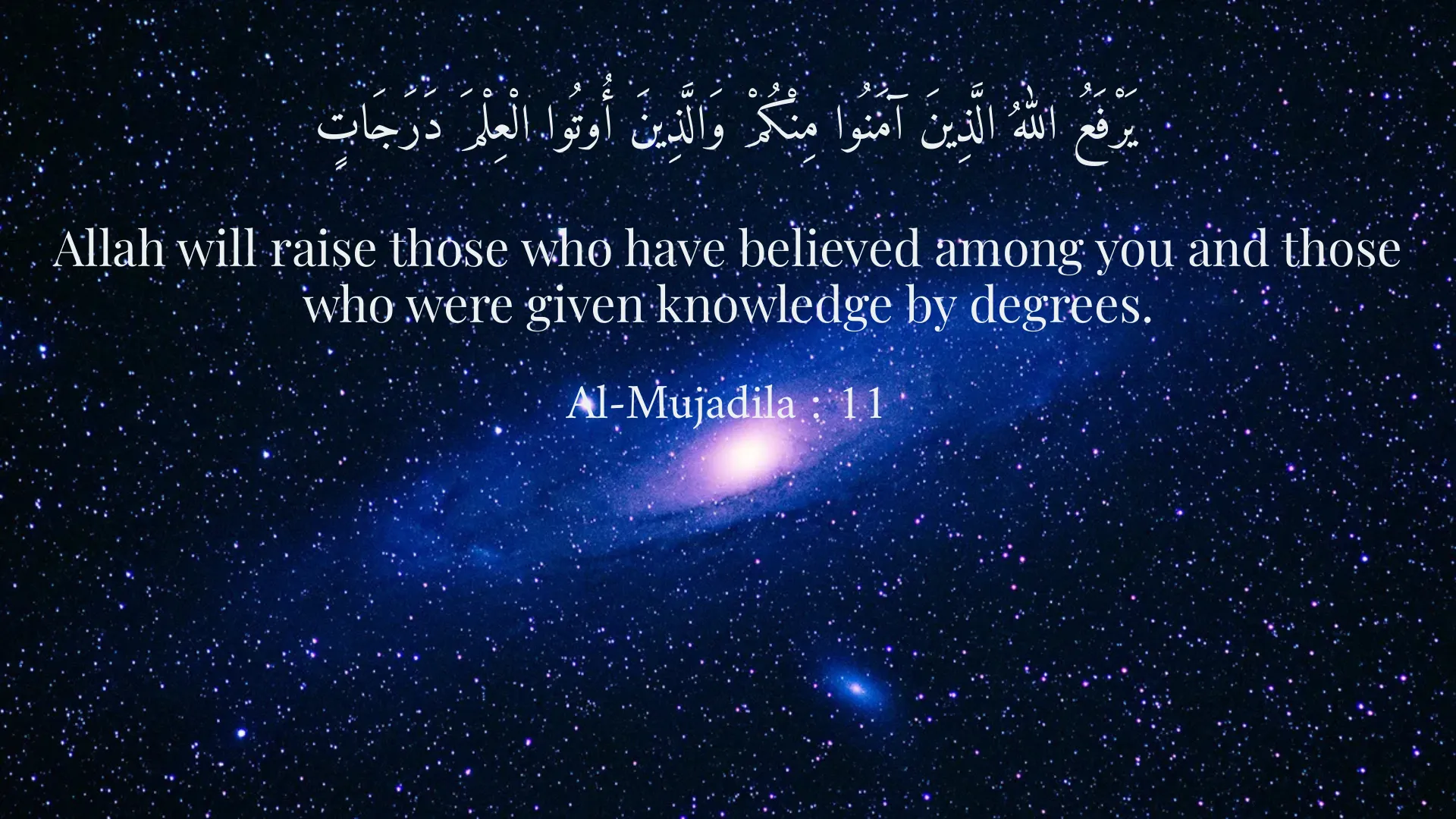
The relationship between knowledge and faith is a vital and intricate aspect of Islamic teachings, as articulated in the Holy Quran. In various verses, Allah conveys the importance of knowledge as an essential component of faith and highlights the profound bond that exists between these two concepts. One of the most notable verses that encapsulates this relationship is found in Surah Mujadila, verse 11, which states, 'Allah will raise those who have believed among you and those who were given knowledge by degrees.' This verse is not merely a statement about the status of believers and scholars; it represents a profound theological assertion about the nature of knowledge and its interrelation with faith. Through these words, Allah prioritizes knowledge and emphasizes that those who possess both faith and understanding will be elevated in status, reflecting the comprehensive framework upon which the Islamic tradition rests. In this context, knowledge and faith are seen not as isolated concepts but rather as complementary components that together form a holistic worldview. The Quran suggests that knowledge derived from divine revelation fosters a deeper understanding of faith. The truest form of knowledge involves an awareness of God’s existence and attributes, which ultimately leads to a more profound submission to His will. It is noteworthy that the Quran asserts that knowledge must be combined with faith to attain fulfillment and purpose. Without faith, knowledge risks becoming hollow and devoid of meaning, as individuals may fail to use their understanding for the greater good of humanity. Conversely, faith without knowledge is equally problematic. In Surah Al-Anfal, verse 22, Allah warns about those who lack knowledge and do not sincerely believe in their hearts, stating: 'Indeed, the worst of creatures in the sight of Allah are the deaf and dumb who do not use reason.' This particular verse serves as a stark reminder of the importance of utilizing one's intellect and understanding in the practice of faith. It indicates that faith should be informed by knowledge, as ignorance could potentially lead to misguided beliefs and actions. The Quranic message underscores a balanced approach where belief is supported by rational thought and an informed conscience. Faith should not be blind; rather, it should be a reasoned commitment that is nurtured through knowledge and understanding. Furthermore, the Quran encourages believers to seek knowledge actively and prayerfully. In Surah Taha, verse 114, it is mentioned that Allah grants greater awareness to scholars: 'And say, My Lord, increase me in knowledge.' This prayer of the Prophet Muhammad highlights an essential aspect of Islamic learning; it is not merely about the acquisition of facts or information. Instead, it emphasizes a continual pursuit of enlightenment and divine wisdom. Believers are urged to seek knowledge from every legitimate source, as gaining understanding is seen as a way to strengthen faith and foster a greater connection with Allah. Through this lens, it becomes evident that knowledge is not merely a means to an end; it is an intrinsic part of one’s spiritual journey. The pursuit of knowledge should encompass both religious learning as well as the sciences, arts, and humanities. Each of these fields contributes to an individual’s understanding of creation and the divine order, allowing one to navigate the complexities of life with wisdom and insight. The Quran, therefore, serves as both a spiritual guide and a source of knowledge that encourages believers to reflect and engage deeply with their faith and the world around them. Islam encourages a culture of inquiry and intellectual engagement. This pursuit is not just limited to religious texts but extends to the broader body of human knowledge. The Islamic Golden Age is a historical testament to this interdependence when scholars such as Al-Farabi, Ibn Sina, and Ibn Rushd emerged, merging philosophy, science, and theology. These scholars exemplified the Quranic injunction to seek knowledge, displaying that exploration in the realms of reason and faith are not mutually exclusive; rather, they enhance one another. Moreover, embracing both faith and knowledge allows individuals to become more active and responsible recipients of their beliefs. The Quran provides a framework in which believers are called to think critically and reflect upon the signs of Allah in the cosmos, as well as the ethical implications of their knowledge. This is poignantly captured in various verses that encourage humans to ponder the creations of Allah as a pathway to recognize the Creator Himself. The relationship between knowledge and faith inspires individuals not only to believe but also to act in ways that align their understanding with divine principles. In conclusion, the intertwining of knowledge and faith in the Holy Quran signals a crucial tenet of Islamic teaching. It is clear that knowledge without faith remains unfulfilled, and faith without knowledge can lead to misinterpretation and superficial belief. The Quran emphasizes the need for a balanced approach that encompasses both elements, encouraging believers to seek knowledge unceasingly while deepening their faith in God. This synergy of knowledge and faith ultimately cultivates a more profound understanding of life and the divine, urging believers to live a life that reflects their commitment to both knowing and believing. As such, individuals are challenged to create harmony between these two vital components, establishing a robust framework for personal development and spiritual enlightenment.
Related Verses
يَرْفَعُ اللهُ الَّذِينَ آمَنُوا مِنْكُمْ وَالَّذِينَ أُوتُوا الْعِلْمَ دَرَجَاتٍ
Allah will raise those who have believed among you and those who were given knowledge by degrees.
Al-Mujadila : 11
إنَّ شَرَّ الدَّوَابِّ عِندَ اللَّهِ الصُّمُّ الْبُكْمُ الَّذِينَ لا يَعْقِلُونَ
Indeed, the worst of creatures in the sight of Allah are the deaf and dumb who do not use reason.
Al-Anfal : 22
وَقُل رَّبِّ زِدْنِي عِلْمًا
And say, 'My Lord, increase me in knowledge.'
Taha : 114
Short Story
One day, a great scholar sat with his students discussing the importance of knowledge and faith. He said, 'Know that knowledge without faith is like a tree that has roots in dry land. It will never bear fruit.' The students listened carefully and understood that only by connecting knowledge with faith could they make a difference in life. This memorable lesson taught them to steer away from ignorance and strengthen their faith.