Quranic Answer
The Holy Quran, regarded by Muslims as the verbatim word of God, holds a significant place in the hearts and minds of over a billion individuals globally. One of the profound themes that can be observed in its verses is the concept of freedom of thought. Unlike certain viewpoints that promote blind faith and unquestioned adherence to beliefs, the Quran embodies an ethos that puts great emphasis on critical thinking, contemplation, and the pursuit of understanding. This article endeavors to delve deeper into these aspects, particularly through selected verses that illustrate the importance of rational thought and the freedom of belief in Islam. The Quran indirectly refers to the freedom of thought by encouraging its followers to engage in intellectual inquiry and reflection. In Surah Al-Imran, verses 190 to 191, Allah imparts a clear message: "Indeed, in the creation of the heavens and the earth and the alternation of the night and day are signs for those of understanding. Who remember Allah while standing or sitting or lying on their sides and give thought to the creation of the heavens and the earth, [saying], 'Our Lord, You did not create this aimlessly; exalted are You above such a thing.' Hence, protect us from the punishment of the Fire." This passage emphasizes the vital role of contemplation in grasping the truth of existence and the natural world. The verses present a call to action for believers, urging them to reflect on the signs of God in the cosmos. The alternating cycles of night and day, the vastness of the heavens, and the intricate design of the earth all serve as reminders of a thoughtful and purposeful Creator. Through contemplation, believers are guided towards a deeper understanding of their faith and their relationship with the universe. The Quran stresses that developing one's understanding stems from independent thinking, and this is an essential component of freedom of thought. Furthermore, the notion of freedom of thought is asserted explicitly in Surah Al-Baqarah, verse 256, where Allah reveals: "There shall be no compulsion in [acceptance of] the religion." This crucial verse forms one of the cornerstone principles in Islam regarding religious belief and practice. It asserts that faith must be the result of personal conviction and reflective thought, not coercion or pressure from others. This highlights the importance of individual autonomy in matters of belief, reinforcing the idea that true faith arises from personal discovery rather than imposed dogma. The implications of this verse are profound. In many religious and socio-political contexts, coercion has historically been employed to enforce compliance to certain beliefs or practices. However, the Quran advocates for a paradigm in which individuals are encouraged to engage actively with their faith, explore its tenets, and come to their own conclusions through reasoning and reflection. This shows a respect for the innate cognitive abilities granted by Allah and emphasizes that these faculties should be nurtured rather than suppressed. Additionally, the Quranic teachings about freedom of thought align closely with the principles of democracy and human rights which are prevalent in contemporary discourse. The freedom to think, question, and choose is a fundamental human right and the Quran advocates for this entitlement within the framework of Islamic teachings. It celebrates the diversity of thought and encourages believers to think critically and independently, thereby enriching the tapestry of human understanding and coexistence. Moreover, the Quran often refers to the consequences of thoughtlessness. In various verses, Allah warns against following others without discernment, highlighting the need for individuals to utilize their reason. For instance, in Surah Al-Anfal, verse 22, Allah describes the worst creatures in His eyes as those who are deaf and dumb, and who do not reason. This metaphor illustrates that the absence of reflection and critical engagement renders one devoid of the most valuable faculties endowed by God. It is noteworthy that the Quran recognizes different capacities for thought, and this acknowledgment reflects a profound understanding of human diversity. Not everyone will arrive at the same conclusions or beliefs, which speaks to the necessity of freedom of thought. The Quran's universal message makes a profound case for tolerance, understanding, and acceptance of differing viewpoints, thereby contributing to harmonious cohabitation of diverse beliefs within a community. The Quran’s advocacy for the freedom of thought fosters an environment where innovation, intellectual growth, and personal development can flourish. When individuals are free to explore ideas, question established norms, and seek truth, they contribute more effectively to society. Empirical thinking, scientific inquiry, and philosophical discussions all thrive in an atmosphere that respects individual reasoning. In conclusion, the Quran’s explicit and implicit messages about the freedom of thought underscore its critical importance in the lives of believers. Through contemplation, reflection, and the pursuit of understanding, individuals are encouraged to engage deeply with their faith and the world around them. The teachings of Allah promote a model of faith that is grounded in personal conviction and intellectual rigor, challenging the notion of blind adherence and celebrating the innate abilities of human reasoning. The Quran not only acknowledges but champions freedom of thought, providing a guiding framework for individuals to explore the vast complexities of existence and spirituality. Ultimately, it serves as a timeless reminder of the need to harness our cognitive abilities to seek truth, sustenance for the spirit, and peace for the soul.
Related Verses
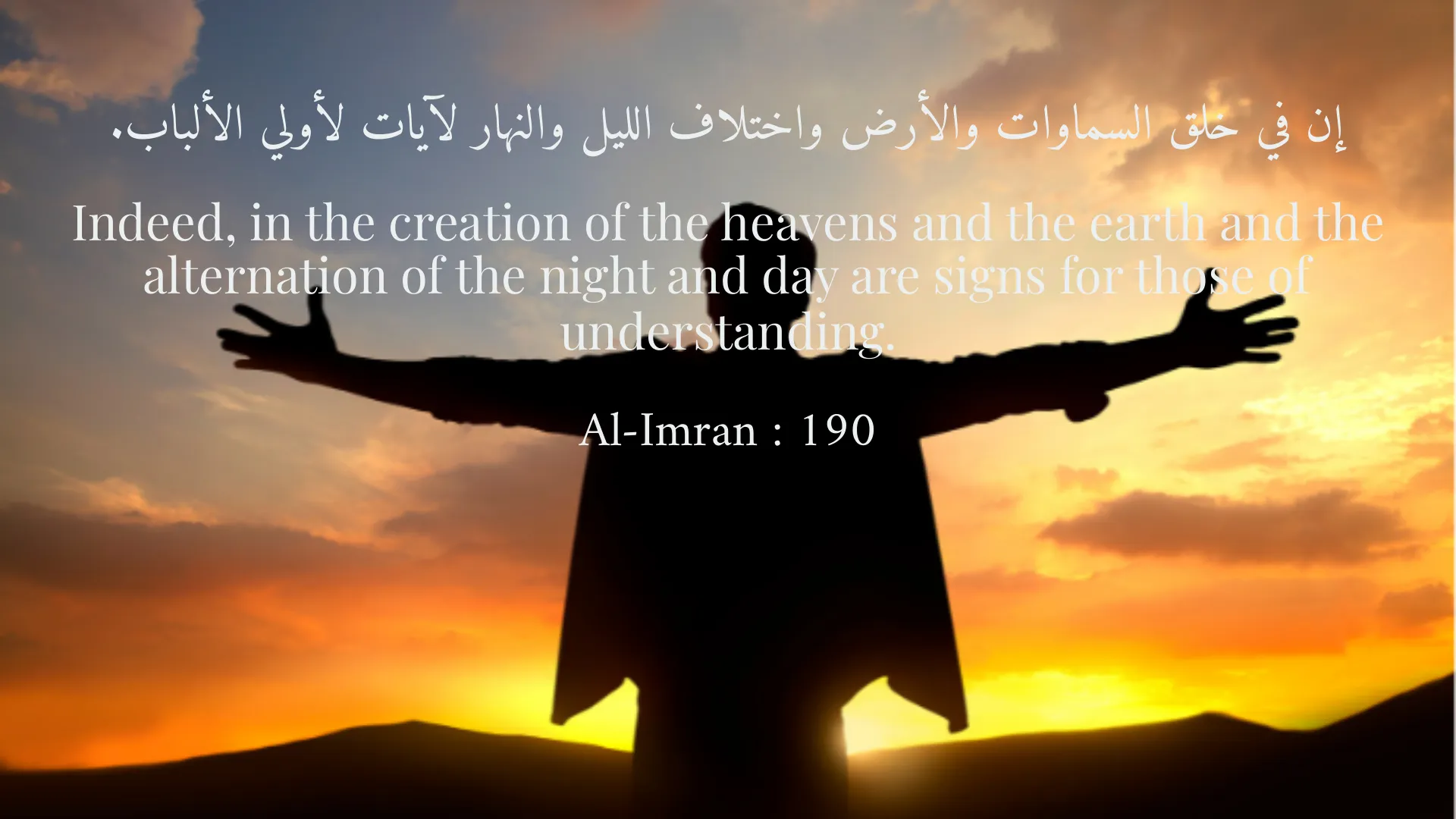
إن في خلق السماوات والأرض واختلاف الليل والنهار لآيات لأولي الألباب.
Indeed, in the creation of the heavens and the earth and the alternation of the night and day are signs for those of understanding.
Al-Imran : 190
لا إكراه في الدين.
There shall be no compulsion in [acceptance of] the religion.
Al-Baqarah : 256
Short Story
Once upon a time, there was a young man named Amir who pondered the questions of life. He valued the freedom of thought and decided to seek the right answers. By studying the Quran and reflecting on its verses, Amir realized that Allah had granted him the freedom to reach perfection and that no one could force him to accept a specific belief. With increased hope and faith, he continued on his path and found greater peace and understanding.