Quranic Answer
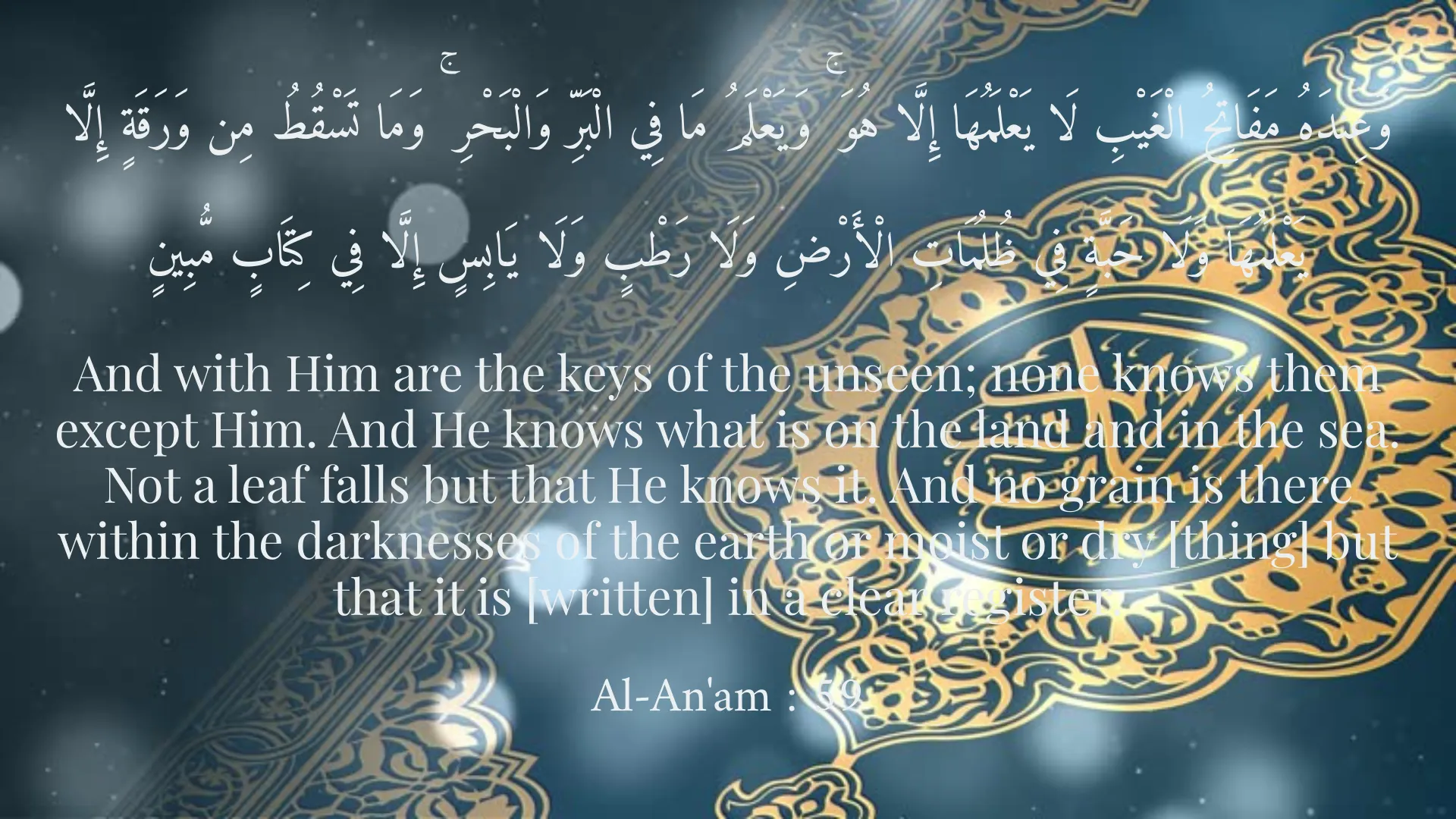
Yes, the Holy Quran explicitly and clearly addresses the concept of “prior knowledge,” but not in the sense of human foresight or limited predictions. Instead, it refers to the absolute, eternal, and boundless knowledge of God Almighty. This concept is conveyed in the Quran through various terms such as “Allah’s knowledge” (Ilm Allah), “knowledge of the unseen” (Ilm al-Ghaib), “Qadar” (Divine Decree), and the “Preserved Tablet” (Lawh al-Mahfuz), each clarifying an aspect of this comprehensive and all-encompassing divine knowledge. Understanding this Quranic teaching strengthens the foundations of faith and reliance upon God, offering a profound insight into humanity's place in existence and the divine wisdom. The Holy Quran unequivocally states that Allah is aware of everything, and nothing escapes His knowledge. This knowledge encompasses the past, present, and future, the apparent and the hidden, and what is revealed or concealed in the hearts. God Almighty possesses perfect and flawless knowledge of everything and every event before its creation. For instance, in Surah Al-An'am, verse 59, Allah says: “And with Him are the keys of the unseen; none knows them except Him. And He knows what is on the land and in the sea. Not a leaf falls but that He knows it. And no grain is there within the darknesses of the earth or moist or dry [thing] but that it is [written] in a clear register.” This verse beautifully and with unparalleled precision demonstrates the vastness of divine knowledge, showing that even the falling of a leaf or the existence of a grain in the depths of the earth is not hidden from Him. This exemplifies the ultimate prior and comprehensive knowledge that includes the minutest details of existence. Another manifestation of divine prior knowledge in the Quran is the concept of the “Preserved Tablet” (Lawh al-Mahfuz). The Lawh al-Mahfuz is an eternal and everlasting book in which all destinies, events, decrees, and knowledge of the universe are recorded before they manifest in the real world. Surah Al-Buruj, verses 21 and 22, state: “Rather, it is a glorious Quran, [inscribed] in a Preserved Tablet.” Although this verse specifically refers to the Quran, in Islamic exegesis and traditions, the Lawh al-Mahfuz is understood as the source of divine knowledge and the place where all destinies of the world are recorded. Furthermore, verse 22 of Surah Al-Hadid explicitly states: “No disaster strikes upon the earth or among yourselves except that it is in a register before We bring it into being — indeed that, for Allah, is easy.” This verse clearly indicates that all occurrences, even calamities, were known and recorded in divine knowledge before they happened, which is a clear proof of God's absolute prior knowledge. The concept of “Qadar” or divine decree is also intimately linked with God's prior knowledge. The Quran states that everything has been created with a measure and decree. Surah Al-Qamar, verse 49, says: “Indeed, all things We created with predestination.” This means that, based on His infinite knowledge, God has set a specific measure and destiny for every phenomenon and every creature. This divine decree, founded on God’s eternal knowledge, does not contradict human free will. God's knowledge does not imply that humans are forced to do something; rather, He knows what path a person will choose by their own free will. Divine knowledge encompasses all possibilities and choices that humans make throughout their lives. In other words, God knows in advance what choices we will make, not that He compels us to make those choices. This balance between divine knowledge and human free will is one of the profound subtleties of Quranic teachings. It must be emphasized that the prior knowledge mentioned in the Quran is exclusive to God, and humans are not inherently and independently aware of the unseen or the future. Surah An-Naml, verse 65, states: “Say, 'None in the heavens and earth knows the unseen except Allah.'” God, by His permission and will, sometimes reveals a portion of the knowledge of the unseen to His chosen prophets, but this knowledge is granted and limited, not inherent and absolute. This distinction is crucial as it prevents false claims regarding prophecy and fortune-telling and guides believers towards reliance and trust in the only true source of knowledge and power, which is God. Ultimately, understanding the principle that God is aware of everything and has prior complete command over all matters grants believers a unique sense of peace and reassurance. This absolute divine knowledge encompasses not only major, fate-determining events but also the smallest details of individual and collective life. This teaching guides us to trust in divine wisdom and planning in all circumstances, whether in hardship or ease. The assurance of this prior knowledge also enhances our sense of responsibility, as we know that none of our actions will be hidden from God’s knowledge and will ultimately be revealed on the Day of Judgment. Therefore, by presenting the concept of divine prior knowledge, the Quran not only adds a deep epistemological dimension to our worldview but also establishes our ethical and behavioral foundations on principles of trust, obedience, and accountability.
Related Verses
وَعِندَهُ مَفَاتِحُ الْغَيْبِ لَا يَعْلَمُهَا إِلَّا هُوَ ۚ وَيَعْلَمُ مَا فِي الْبَرِّ وَالْبَحْرِ ۚ وَمَا تَسْقُطُ مِن وَرَقَةٍ إِلَّا يَعْلَمُهَا وَلَا حَبَّةٍ فِي ظُلُمَاتِ الْأَرْضِ وَلَا رَطْبٍ وَلَا يَابِسٍ إِلَّا فِي كِتَابٍ مُّبِينٍ
And with Him are the keys of the unseen; none knows them except Him. And He knows what is on the land and in the sea. Not a leaf falls but that He knows it. And no grain is there within the darknesses of the earth or moist or dry [thing] but that it is [written] in a clear register.
Al-An'am : 59
مَا أَصَابَ مِن مُّصِيبَةٍ فِي الْأَرْضِ وَلَا فِي أَنفُسِكُمْ إِلَّا فِي كِتَابٍ مِّن قَبْلِ أَن نَّبْرَأَهَا ۚ إِنَّ ذَلِكَ عَلَى اللَّهِ يَسِيرٌ
No disaster strikes upon the earth or among yourselves except that it is in a register before We bring it into being — indeed that, for Allah, is easy.
Al-Hadid : 22
إِنَّا كُلَّ شَيْءٍ خَلَقْنَاهُ بِقَدَرٍ
Indeed, all things We created with predestination.
Al-Qamar : 49
قُل لَّا يَعْلَمُ مَن فِي السَّمَاوَاتِ وَالْأَرْضِ الْغَيْبَ إِلَّا اللَّهُ ۚ وَمَا يَشْعُرُونَ أَيَّانَ يُبْعَثُونَ
Say, 'None in the heavens and earth knows the unseen except Allah, and they do not perceive when they will be resurrected.'
An-Naml : 65
Short Story
Once, a king summoned a wise man who claimed to possess knowledge of the unseen, predicting the future by observing stars and celestial movements. The king asked him, "Can you tell what will befall this land next year? Will there be abundance and prosperity, or famine and hardship?" The wise man proudly declared, "O King! By my astronomical calculations, I know that next year there will be plentiful rain, the land will yield abundant crops, and the people will live in comfort and well-being." The king smiled and said, "This knowledge is commendable, but the truth is that absolute knowledge rests only with God. He alone knows what will happen, and we, His servants, can only strive for what is ordained and trust in Him. Perhaps divine decree holds something beyond all prediction and conjecture." A few days later, despite the wise man's predictions, a fierce storm arose, and floods damaged the fields. The wise man returned ashamed to the king. The king kindly said, "You see that human knowledge is limited, and only God is aware of everything and knows best what is good for His servants. The important thing is to always, whether in hardship or ease, trust in His wisdom and knowledge and not be heedless of His planning." This story reminds us that although humans seek to know the future, true prior knowledge belongs only to God Almighty, and relying on Him is the best approach to the uncertainties of time.