Quranic Answer
The Holy Quran, the eternal word of God and a guide for humanity, is a miracle in its eloquence, rhetoric, and depth of meaning. However, something that might seem a bit unusual at first glance is its frequent use of simple and understandable parables and analogies. This mode of expression is not due to weakness, but rather to the height of wisdom and perfection, and there are profound and multiple reasons for it, which we will discuss in detail. The primary goal of the Quran is to guide humanity, and to achieve this goal, the divine word must be presented in a way that all segments of society, regardless of their level of education or understanding, can benefit from it. The use of simple examples is one of the most powerful tools for achieving this universality. For instance, when the Quran speaks of a 'mosquito' or a 'spider,' it conveys profound concepts like the grandeur of divine power, the worthlessness of idols, or the fragility of the world in a tangible and understandable manner for everyone. These examples are imprinted in the mind of the audience and are quickly conceivable, without requiring complex philosophical or scientific knowledge. This simplicity in no way implies superficiality of the message; rather, it is a means to convey the deepest truths in absorbable forms. Another significant reason for using parables is to make abstract and unseen concepts tangible. Topics such as resurrection, the power of God, the nature of faith, or hypocrisy are concepts that are difficult to grasp without a clear mental framework. The Quran, by presenting examples from natural phenomena or everyday human experiences, makes these abstract concepts tangible for us. For example, the revival of dead earth after rain is an example repeatedly used in the Quran to explain God's power in resurrection and the Last Day. Anyone can observe this scene in nature and draw a profound lesson from it. Or the example of God's light in Surah An-Nur, which provides a mental image of divine guidance in the most beautiful way possible. These parables help to bring grand and distant concepts within the scale of human understanding, allowing the audience to establish a sensory and intellectual connection with them. Parables in the Quran play a powerful educational and moral role. They not only explain concepts but also indirectly teach ethical and behavioral lessons. Stories and parables, more than dry statements of laws, have the power to penetrate the human heart and soul. When the Quran presents the example of two gardeners, one relying on God and the other becoming arrogant, it vividly and reflectively shows the consequences of reliance and arrogance. This method makes learning more engaging and lasting. Humans are naturally attracted to stories and examples, and messages presented in these forms are better retained in memory and encourage thought and contemplation. This feature ensures that the Quran does not become merely an informational book, but rather a perpetual teacher and companion in life. The Quran also utilizes parables to awaken human nature and intellect. When examples are presented, the audience is prompted to reflect and discover the connection between the example and the core concept. This intellectual process is itself a form of exercise for the mind and a means to attain certainty. The Quran constantly urges people to 'reflect,' 'contemplate,' and 'reason.' Examples are tools to facilitate this contemplation. Each example is a window to greater depth of meaning and an invitation to delve into divine wisdom. This approach does not make the audience passive; rather, it transforms them into active participants in understanding the divine message. Furthermore, the use of parables is one of the prominent rhetorical features of the Quran. Parables break the monotony of speech and add beauty, impact, and depth to it. They enhance the power of persuasion and influence of the discourse. A good example can sometimes prove a truth more effectively than hundreds of logical arguments. This eloquence also reinforces the miraculous aspect of the Quran, as it demonstrates how the most complex and profound concepts of existence can be expressed in the most beautiful and perfect way using the simplest words and surrounding phenomena. In summary, the simplicity in Quranic examples is the epitome of divine complexity and wisdom, designed in the best possible way for the guidance and upbringing of all humanity. This approach has transformed the Quran into a universally comprehensible, profound, and eternal book for all ages and generations.
Related Verses
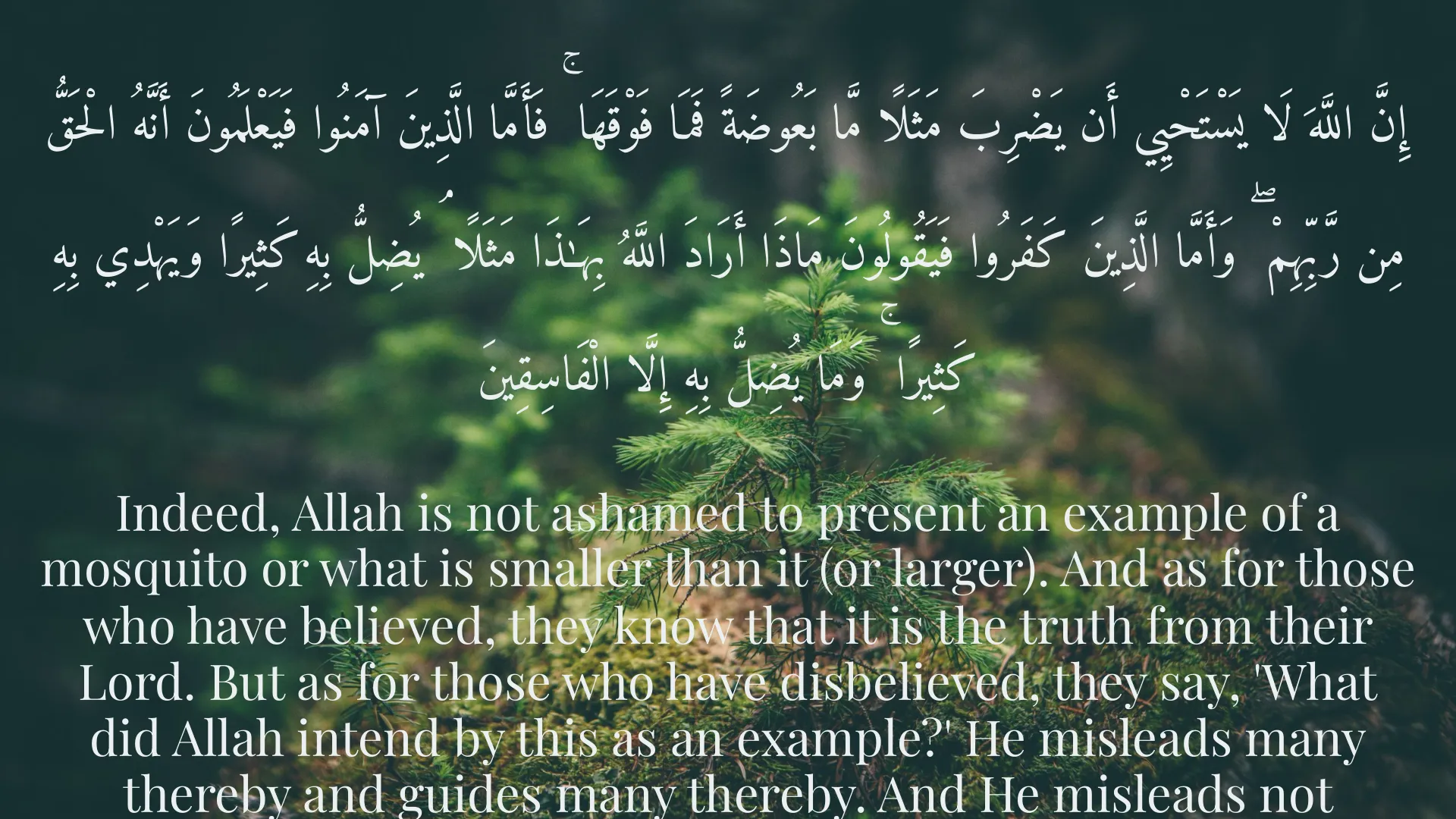
إِنَّ اللَّهَ لَا يَسْتَحْيِي أَن يَضْرِبَ مَثَلًا مَّا بَعُوضَةً فَمَا فَوْقَهَا ۚ فَأَمَّا الَّذِينَ آمَنُوا فَيَعْلَمُونَ أَنَّهُ الْحَقُّ مِن رَّبِّهِمْ ۖ وَأَمَّا الَّذِينَ كَفَرُوا فَيَقُولُونَ مَاذَا أَرَادَ اللَّهُ بِهَٰذَا مَثَلًا ۘ يُضِلُّ بِهِ كَثِيرًا وَيَهْدِي بِهِ كَثِيرًا ۚ وَمَا يُضِلُّ بِهِ إِلَّا الْفَاسِقِينَ
Indeed, Allah is not ashamed to present an example of a mosquito or what is smaller than it (or larger). And as for those who have believed, they know that it is the truth from their Lord. But as for those who have disbelieved, they say, 'What did Allah intend by this as an example?' He misleads many thereby and guides many thereby. And He misleads not thereby except the defiantly disobedient.
Al-Baqarah : 26
مَثَلُ الَّذِينَ اتَّخَذُوا مِن دُونِ اللَّهِ أَوْلِيَاءَ كَمَثَلِ الْعَنكَبُوتِ اتَّخَذَتْ بَيْتًا ۖ وَإِنَّ أَوْهَنَ الْبُيُوتِ لَبَيْتُ الْعَنكَبُوتِ ۖ لَوْ كَانُوا يَعْلَمُونَ
The example of those who take allies other than Allah is like that of the spider who takes a home. And indeed, the weakest of homes is the home of the spider, if they only knew.
Al-Ankabut : 41
وَلَقَدْ ضَرَبْنَا لِلنَّاسِ فِي هَٰذَا الْقُرْآنِ مِن كُلِّ مَثَلٍ لَّعَلَّهُمْ يَتَذَكَّرُونَ
And We have certainly presented for the people in this Quran every kind of example, that they might remember.
Az-Zumar : 27
Short Story
It is narrated that one day a king asked his minister: “Why are the words of great scholars sometimes so complex that the common people cannot understand them?” The wise minister, who had learned from Saadi, replied: “Your Majesty, words are like water. If poured into a beautiful but narrow vessel, only the select few can quench their thirst from it. But if it flows in a clear, running stream, all people can benefit from it, whether pauper or prince. God has done the same in the Quran; He has brought simple examples so that even a child living in a remote village can draw from the sea of divine wisdom and find the path to salvation. This is divine generosity, that His word is understandable to all.” The king was pleased with this answer and understood that simplicity itself is the pinnacle of perfection and eloquence.