Quranic Answer
The concept of the afterlife has always been a significant focal point in many religions, providing believers with a moral framework that guides their actions and decisions in their earthly lives. Among these, the Holy Quran stands out with its profound teachings regarding Paradise (Jannah) and Hell (Jahannam). The Quran often discusses both realms simultaneously to serve a dual purpose: reminding humanity about the realities that await them after death and motivating individuals to live righteously in the present. This duality is essential for fostering a sense of accountability among individuals, as it emphasizes that every action and thought has consequences that extend beyond mortal existence. To understand the Quran's depiction of Paradise and Hell, we need to delve deeper into the descriptions provided within its verses. Paradise is portrayed as an abode of eternal bliss, adorned with pleasures that surpass human imagination. The Quran describes it as a place where rivers of milk, honey, and fresh water flow, and where the inhabitants will have access to fruits and delights beyond comparison. It is a realm where righteousness, kindness, and devotion to God are rewarded abundantly. On the other hand, Hell is depicted as a place of suffering and agony, characterized by torment that reflects the severity of the sins committed in life. This vivid contrast not only serves to illustrate the ultimate fate of the believers and disbelievers but also acts as a source of motivation for individuals to engage in righteous behavior. In Surah Maryam, verses 60 and 61 explicitly delineate this dichotomy by stating, 'Only those who have believed and done righteous deeds will enter Paradise,' followed by, 'Those who disbelieved will face torment in Hellfire.' These verses encapsulate the essence of the Islamic worldview regarding the afterlife: belief in God and righteous deeds are prerequisites for attaining eternal happiness, while disbelief and sinful behavior lead to punishment. This discourse emphasizes that life on Earth is a temporary state, a test that determines one's ultimate fate in the hereafter. The notion that this worldly life is merely a test intertwines the belief in the afterlife with the moral and ethical conduct of individuals. Many believers view their actions as investments into their eternal life. The awareness of potential consequences—whether rewards or punishments—encourages individuals to make conscious choices that align with ethical and moral values. This perspective is intended to inspire acts of charity, compassion, honesty, and justice, which resonate deeply within the teachings of the Quran. Moreover, the Quran emphasizes the significance of engaging in good deeds and shunning sin as a means to attain success. In various verses, the Quran reiterates that virtuous deeds are connected to faith in God, and it frequently urges believers to strive for goodness while warning them against the dangers of transgressions. This framework serves as a guide for individuals, helping them to remain cognizant of their duties as servants of God. Through the awareness of Paradise and Hell, the Quran seeks to instill a sense of mindfulness among individuals regarding their actions. It conveys a message that human beings are not merely existing but are actively participating in shaping their destinies. The concept of accountability is central to the Islamic faith; hence, believers are encouraged to constantly reflect on their lives, behaviors, and choices. Furthermore, the narratives surrounding the descriptions of Heaven and Hell serve to foster a deeper understanding of divine justice. Paradise is often reserved for those who embody humility, sincerity, and compassion, while Hell serves as a stringent reminder of the consequences of self-serving actions and neglect of moral duties. This contrasts not only highlights the fairness of divine judgment but also acts as an impetus for individuals to critically evaluate their intentions and strive towards self-improvement. In addition to motivating individuals, the concept of the afterlife is equally important in building a cohesive community. By collectively aspiring towards righteousness and encouraging one another to avoid sinful behavior, members of the community create an environment conducive to moral development. This collective consciousness, fostered by shared beliefs in Paradise and Hell, emphasizes the importance of communal responsibility and support. The narrative presented in the Quran about Paradise and Hell transcends mere fear or hope; it also calls for critical engagement with one's faith. Believers are encouraged not only to seek rewards but also to foster genuine connections with others and the divine through their actions. This relational dynamic is fundamental in Islam, as it ultimately guides believers towards achieving holistic well-being—spiritually, morally, and socially. In conclusion, the Holy Quran's discussion of Paradise and Hell serves multiple purposes: it acts as a reminder of the ultimate truths of the afterlife and as a motivator for individuals to lead virtuous lives. With the understanding that every action has a significant consequence, believers can maneuver through life with a mindfulness that inspires them to seek goodness and righteousness. The duality of reward and punishment portrayed in the Quran not only shapes individual experiences but also strengthens communal bonds, creating societies rooted in shared values and a commitment to moral excellence. Thus, contemplation of the afterlife becomes a pivotal tenet of faith that transcends mortality and embeds itself into the essence of human existence.
Related Verses
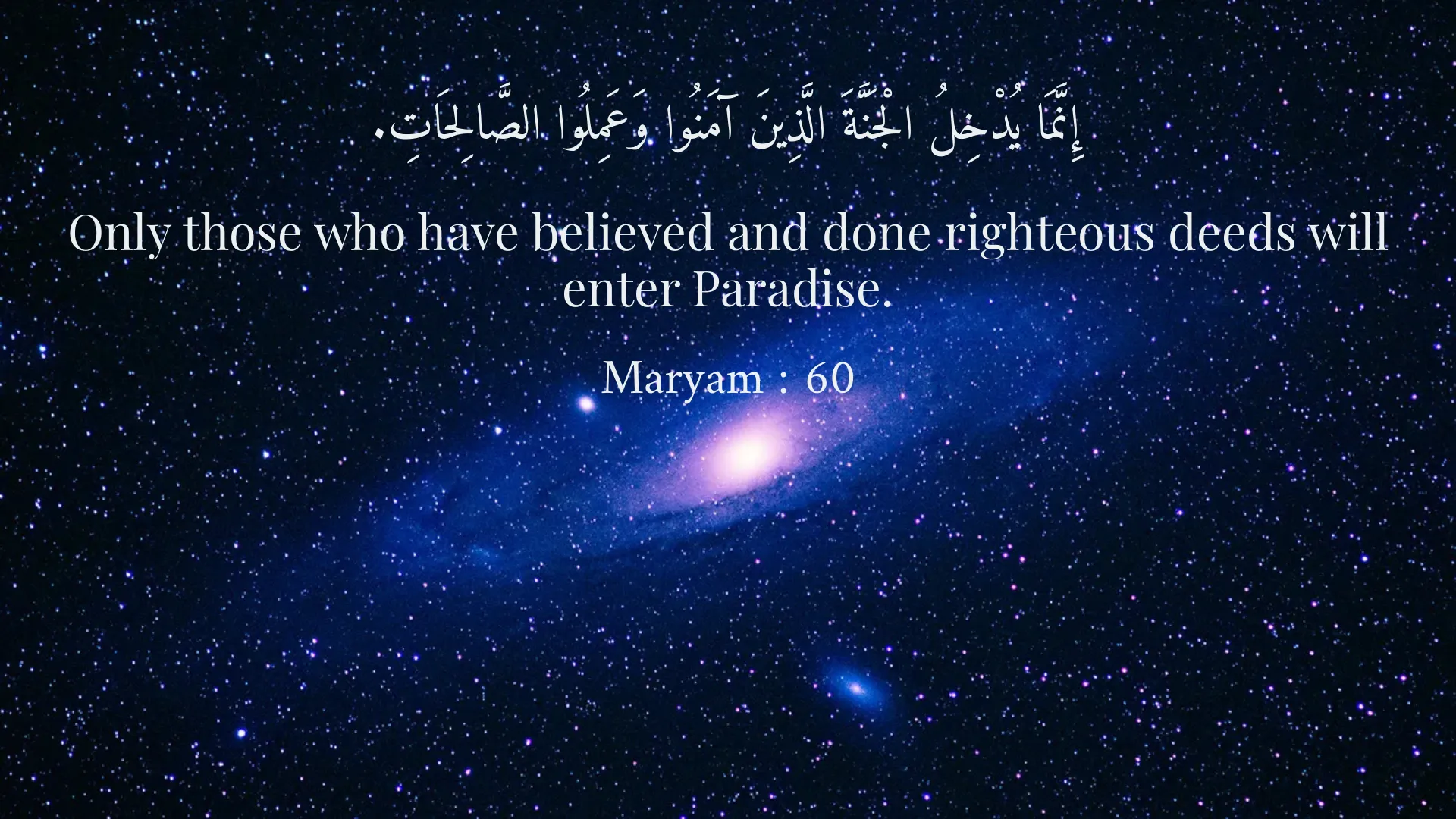
إِنَّمَا يُدْخِلُ الْجَنَّةَ الَّذِينَ آمَنُوا وَعَمِلُوا الصَّالِحَاتِ.
Only those who have believed and done righteous deeds will enter Paradise.
Maryam : 60
وَالَّذِينَ كَفَرُوا أُو۟لَـٰئِكَ هُمْ وَقُودُ النَّارِ.
And those who disbelieved will face the torments of the hellfire.
Maryam : 61
Short Story
One day, a man named Solomon went to the market, and while talking to people, he brought up the topics of Paradise and Hell. He said, 'If you want to enter Paradise, you must be good and forsake your sins. Only the righteous will be there.' One of his friends replied, 'But I believe in Hell too.' Solomon smiled and said, 'Then by being good to others, not only guide yourself but also lead others towards Paradise!'