Quranic Answer
Why does the Holy Quran use nature for examples? This is a profound and meaningful question rooted in the Quran's unique approach to guiding humanity. In the Quran, the divine book of guidance, Allah Almighty employs various methods to convey His messages, and one of the most effective of these is using natural phenomena as "Ayat" or signs. These signs are not merely literary examples; rather, they are windows into the grandeur, wisdom, power, and oneness of God. The primary purpose of this approach is to encourage humans to reflect, contemplate, and gain a deeper understanding of the Creator and the universe. The first and most important reason for using nature is to prove the existence and oneness of God (Tawhid). The Quran repeatedly invites humans to gaze deeply at the heavens and the earth, the movement of the sun and moon, the succession of night and day, the descent of rain, and the growth of plants. These are all clear evidences of a precise order, a flawless design, and a wise and powerful Creator whose creation is without fault. When one observes and contemplates these phenomena, one inevitably concludes that this immense order cannot be the result of chance; rather, it necessitates a sole Organizer and Creator. For instance, the water cycle, from the evaporation of ocean water to the formation of clouds, the descent of rain, and the revival of dead earth, followed by the sprouting of seeds, all bear witness to Allah's infinite power. This process is not only life-giving but also a great lesson about God's power to revive and resurrect. The second reason is to facilitate the understanding of complex and abstract concepts. Concepts such as resurrection, God's power of recreation, and even the grandeur of the Day of Judgment might seem somewhat difficult for the human mind to grasp. By using examples from nature, the Quran makes these concepts tangible and understandable. For instance, in numerous verses, Allah cites the revival of dead earth after rainfall as an example for the resurrection of the dead on the Day of Judgment. This analogy connects a hidden and future-oriented concept with a tangible and observable reality in nature, making it accessible to humans of all educational levels. This approach makes the language of the Quran universal and comprehensive, as natural phenomena are observable and understandable to every human being, at any time and place. The third reason is to instill a sense of awe, gratitude, and humility in the face of Divine majesty. When one meticulously observes the details of creation – from the intricate structure of a tiny leaf to the vastness of galaxies – one involuntarily bows down in reverence before the Creator's power and artistry. This observation awakens a sense of gratitude in the heart, as all these blessings have been created for human benefit and life. Through these examples, the Quran invites humans to be grateful for God's countless blessings and to avoid ingratitude. The fourth reason is to encourage reflection and contemplation (tadabbur). The Quran is a book that calls humanity to reason and ponder, and natural verses are powerful tools for this invitation. In many verses, after mentioning a natural phenomenon, phrases such as "Indeed in that are signs for a people who reflect" or "for those who reason" are appended. These phrases indicate that the goal is not just superficial observation but going beyond it to reach a deeper and spiritual understanding of existence. This contemplation, in turn, leads to the strengthening of faith and the knowledge of God. The fifth reason is to demonstrate divine wisdom and order in creation. Every part of nature, from the smallest particle to the grandest phenomenon, has been created with precise order and a specific purpose. The cycle of life, the balance of ecosystems, the Earth's gravity, and many other physical and biological laws all testify to the infinite wisdom of a Creator who has created everything with precise measure and a sublime purpose. This order teaches humanity that the world is not futile or absurd but operates according to divine laws and traditions that must be observed. In summary, the Quran's use of nature as examples is a multifaceted approach through which profound religious and spiritual truths are conveyed to audiences in a tangible, convincing, and impactful manner. This method not only helps to prove the existence and power of God but also deepens faith, increases gratitude, and encourages reflection and contemplation on creation. Nature, as an open book before our eyes, is constantly whispering divine signs, and the Quran provides us with the key to understanding these whispers, thereby allowing us to gain greater knowledge of God and the purpose of creation. This method of exemplification ensures that the Quran's messages transcend the limitations of time and place, remaining understandable and impactful for all generations and nations, which itself is a sign of the miraculous nature of this divine book. This is what transforms the Quran into a living and ever-flowing book whose lessons are discoverable and ponderable in every corner of nature and every moment of our lives.
Related Verses
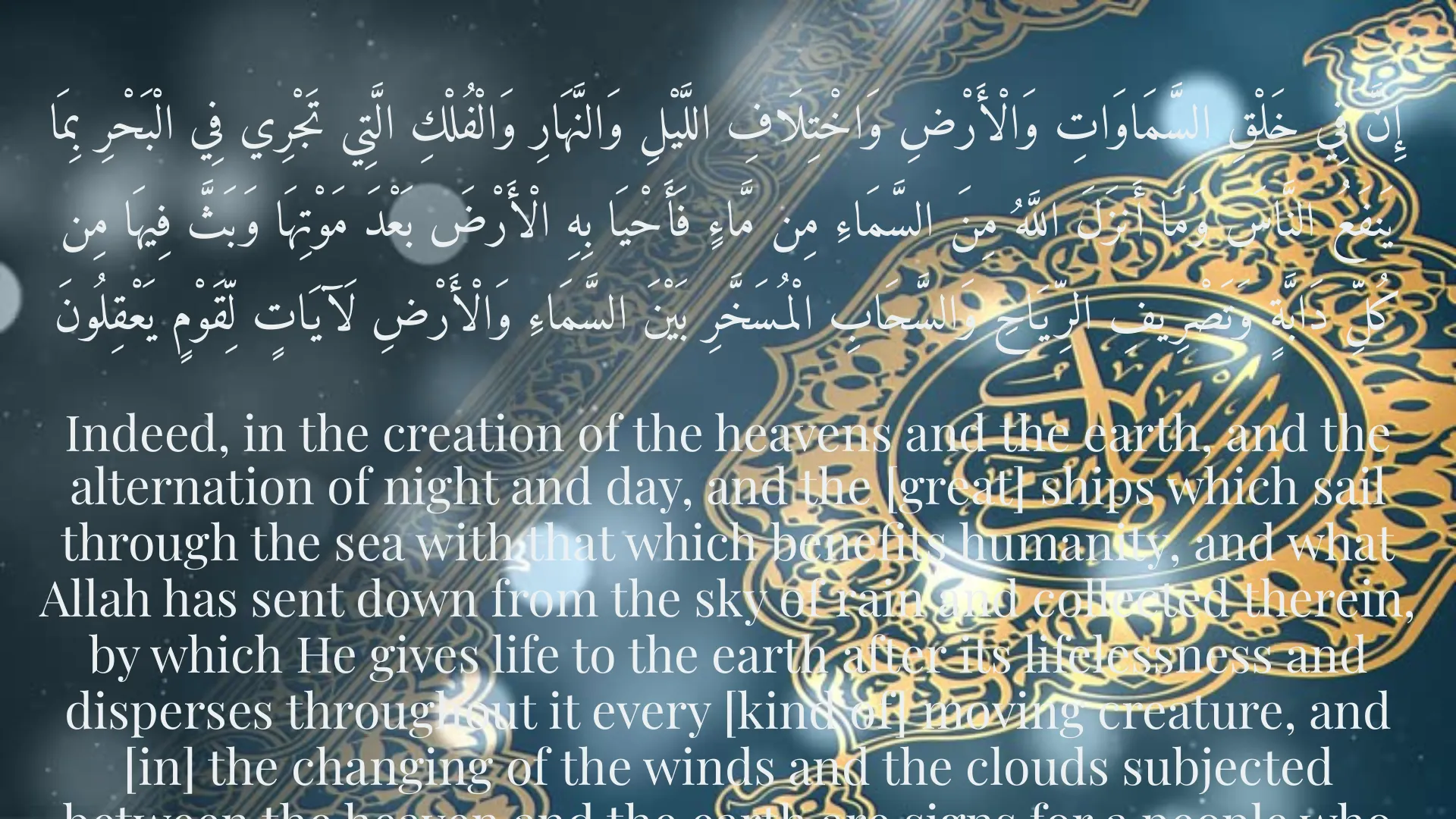
إِنَّ فِي خَلْقِ السَّمَاوَاتِ وَالْأَرْضِ وَاخْتِلَافِ اللَّيْلِ وَالنَّهَارِ وَالْفُلْكِ الَّتِي تَجْرِي فِي الْبَحْرِ بِمَا يَنفَعُ النَّاسَ وَمَا أَنزَلَ اللَّهُ مِنَ السَّمَاءِ مِن مَّاءٍ فَأَحْيَا بِهِ الْأَرْضَ بَعْدَ مَوْتِهَا وَبَثَّ فِيهَا مِن كُلِّ دَابَّةٍ وَتَصْرِيفِ الرِّيَاحِ وَالسَّحَابِ الْمُسَخَّرِ بَيْنَ السَّمَاءِ وَالْأَرْضِ لَآيَاتٍ لِّقَوْمٍ يَعْقِلُونَ
Indeed, in the creation of the heavens and the earth, and the alternation of night and day, and the [great] ships which sail through the sea with that which benefits humanity, and what Allah has sent down from the sky of rain and collected therein, by which He gives life to the earth after its lifelessness and disperses throughout it every [kind of] moving creature, and [in] the changing of the winds and the clouds subjected between the heaven and the earth are signs for a people who use reason.
Al-Baqarah : 164
وَمِنْ آيَاتِهِ أَنْ خَلَقَكُم مِّن تُرَابٍ ثُمَّ إِذَا أَنتُم بَشَرٌ تَنتَشِرُونَ
And of His signs is that He created you from dust; then, suddenly, you are human beings dispersing [throughout the earth].
Ar-Rum : 20
وَإِنَّ لَكُمْ فِي الْأَنْعَامِ لَعِبْرَةً ۖ نُّسْقِيكُم مِّمَّا فِي بُطُونِهِ مِن بَيْنِ فَرْثٍ وَدَمٍ لَّبَنًا خَالِصًا سَائِغًا لِّلشَّارِبِينَ
And indeed, for you in grazing livestock is a lesson. We give you drink from that which is in their bellies—between excretion and blood—pure milk, palatable to drinkers.
An-Nahl : 66
Short Story
It is said that a wise man once told his disciple, "Come, let us learn a lesson from the great book of existence." Then he took him to a garden where every flower had a different color and every tree a distinct form. The wise man said, "Behold! How these colorful flowers, without uttering a word, proclaim the beauty of their Creator. Every leaf, every bud, every drop of dew on a petal, is a sign of the boundless power and unparalleled wisdom of the Maker." The disciple looked more deeply and saw how a bee settled on a flower and made honey, and how a tiny seed transformed into a mighty tree. His heart filled with wonder, and he said, "Master, you are right. The world is a book full of divine verses; one only needs to open the eyes of the heart." From then on, whenever the disciple gazed at nature, he found not only its outward beauty but also signs of God's wisdom and power within it, and his faith grew.