Quranic Answer
Piety, often referred to as Taqwa in Islamic discourse, embodies the essential principles of moral behavior and righteousness as underscored in the Holy Quran. Taqwa is not merely a concept; it represents a profound state of being that guides individuals in their relationship with Allah, as well as their interactions with fellow human beings. The Quran emphasizes that piety involves the avoidance of sin and the execution of good deeds, and this duality of abstaining from wrongdoing while actively seeking to do good is a central theme that permeates the text. To understand the significance of Taqwa, we can look to Surah Al-Baqarah, verse 177, where Allah explicitly states that piety and moral behavior hold greater value than mere scholarly knowledge. This verse reveals a crucial truth: possessing extensive knowledge, while important, does not guarantee a person’s path to righteousness. Rather, it is the state of one's heart and the presence of Taqwa within it that count the most in the eyes of God. Those who embody Taqwa are said to have God firmly in their hearts, making their actions inherently more valuable. This introduces a critical differentiation between types of knowledge. Knowledge devoid of piety can lead individuals astray, leading them further away from the righteous path. It illustrates the risk of becoming overly intellectualized, relying solely on information without applying it morally. This perspective encourages an integrated approach where one’s understanding must harmonize with a heartfelt commitment to ethical principles. In addition to this, Surah Al-Ahzab, verse 35, marks Taqwa as integral to salvation and righteousness, associating it closely with moral and ethical conduct. It reveals how awareness of God (Consciousness of Allah) elevates an individual's moral standing — delineating a clear connection between one’s actions and their spiritual implications. Here, Taqwa is described as a guiding force, intertwined with the essence of faith and the actions taken in life, reinforcing the idea that true righteousness is grounded in a profound awareness of God's presence and command. Moreover, Taqwa carries with it numerous benefits, which can be seen in both an individual's personal life and their broader interactions with the world. People who embody Taqwa often experience ease in sustenance, reflecting a divine promise that those who live righteously will find their needs met. This speaks to the idea that when one aligns their life with ethical conduct and the avoidance of sin, they can expect blessings to pervade their existence. In a practical sense, one might observe that those who genuinely embody Taqwa may find their lives enriched with peace, fulfillment, and success. Additionally, healing from ailments is often attributed to having Taqwa. Narratives in Islamic tradition suggest that sincere faith and piety can invite divine mercy, leading to physical and spiritual healing. This reveals the holistic nature of Taqwa, showcasing how piety extends beyond the spiritual realm into tangible aspects of life, including health and personal well-being. The notion that prayers of the pious are accepted further underscores the idea that Taqwa acts as a bridge between humans and the divine. The heart of a pious person is attuned to the needs of others, fostering compassion, kindness, and charity. The concept of Taqwa also serves as a transformative light within individuals, illuminating the path toward goodness and righteousness. It acts as a moral compass, guiding individuals as they navigate challenges and ethical dilemmas. In the intricacies of daily life, Taqwa encourages honest dealings, empathy toward others, and a profound respect for the sanctity of life — all of which are critical for fostering a harmonious society. In summary, Taqwa is not simply a state of fear or unfounded concern regarding God’s judgment; it represents an inner conviction that drives ethical choices, a commitment to goodness, and a sincere effort to lead a life aligned with divine principles. It embodies a comprehensive approach to living that encompasses reverence for God and care for creation. Taqwa transforms knowledge into wisdom, aligning intellectual pursuits with ethical action, crafting individuals who not only know right from wrong but actively choose righteousness in their daily lives. Thus, as we reflect on the values inherent in Taqwa, it becomes clear that this divine gift is essential for personal development and the collective welfare of society. Encouraging a lifestyle rooted in piety and moral behavior will not only benefit individuals on a personal level but also contribute positively to the community at large. In light of these discussions, it is evident that Taqwa stands as a cornerstone of Islamic teachings, serving as guidance for believers to cultivate a God-conscious life filled with righteousness, compassion, and integrity. Such a path is not merely about avoiding sin, but actively embracing and promoting goodness in a world that often challenges the pursuit of such ideals.
Related Verses
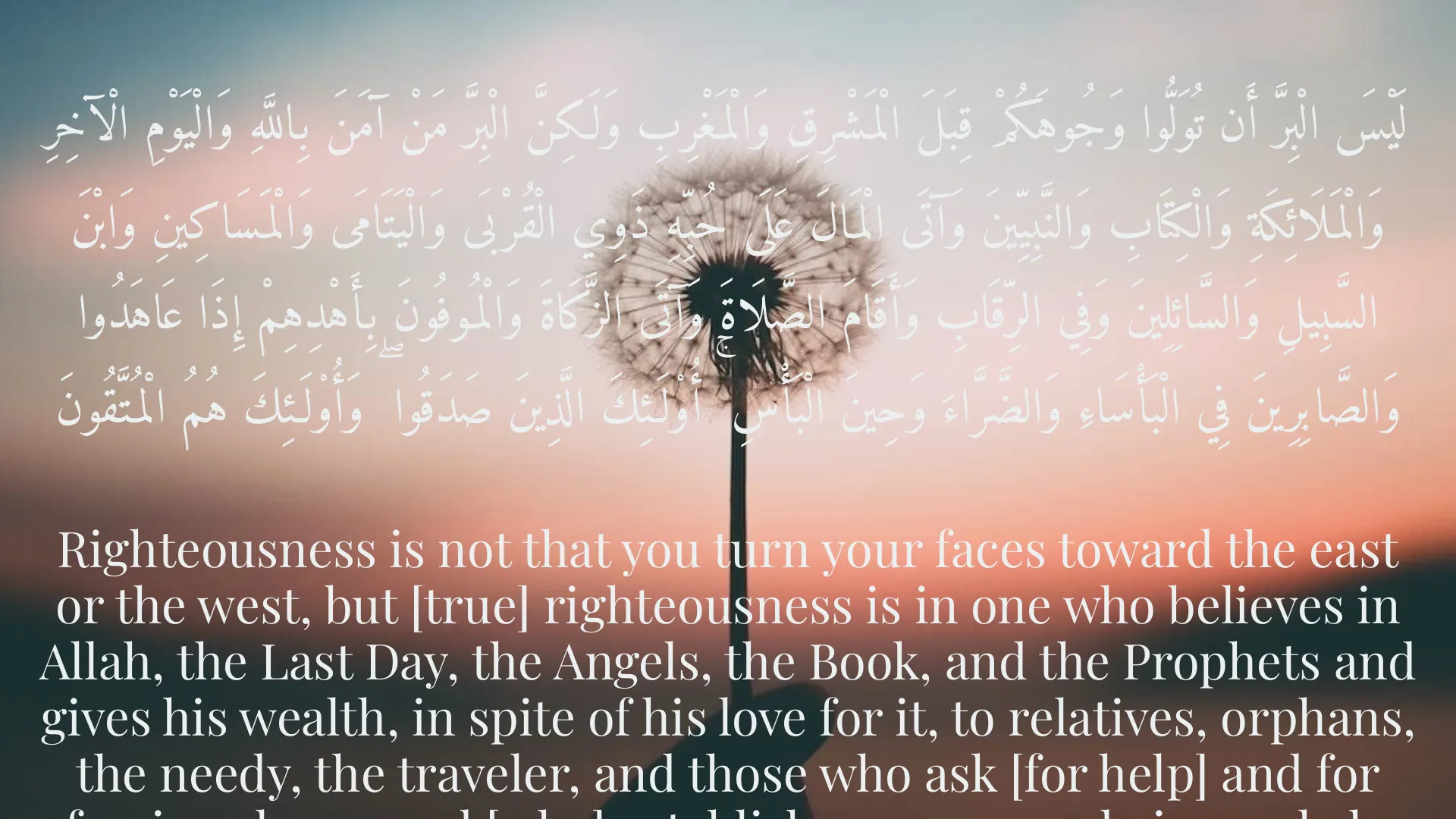
لَيْسَ الْبِرَّ أَن تُوَلُّوا وَجُوهَكُمْ قِبَلَ الْمَشْرِقِ وَالْمَغْرِبِ وَلَـكِنَّ الْبِرَّ مَنْ آمَنَ بِاللَّهِ وَالْيَوْمِ الْآخِرِ وَالْمَلَائِكَةِ وَالْكِتَابِ وَالنَّبِيِّينَ وَآتَى الْمَالَ عَلَى حُبِّهِ ذَوِي الْقُرْبَى وَالْيَتَامَى وَالْمَسَاكِينِ وَابْنَ السَّبِيلِ وَالسَّائِلِينَ وَفِي الرِّقَابِ وَأَقَامَ الصَّلَاةَ وَآتَى الزَّكَاةَ وَالْمُوفُونَ بِأَهْدِهِمْ إِذَا عَاهَدُوا وَالصَّابِرِينَ فِي الْبَأْسَاءِ وَالضَّرَّاءَ وَحِينَ الْبَأْسِ ۚ أُو۟لَـئِكَ الَّذِينَ صَدَقُوا ۖ وَأُو۟لَـئِكَ هُمُ الْمُتَّقُونَ
Righteousness is not that you turn your faces toward the east or the west, but [true] righteousness is in one who believes in Allah, the Last Day, the Angels, the Book, and the Prophets and gives his wealth, in spite of his love for it, to relatives, orphans, the needy, the traveler, and those who ask [for help] and for freeing slaves; and [who] establishes prayer and gives zakah; [those who fulfill their promise when they promise; and [those who are patient in poverty and hardship and during battle. Those are the ones who have been true, and it is those who are the righteous.
Al-Baqarah : 177
إِنَّ الْمُسْلِمِينَ وَالْمُسْلِمَاتِ وَالْمُؤْمِنِينَ وَالْمُؤْمِنَاتِ وَالْقَانِتِينَ وَالْقَانِتَاتِ وَالصَّادِقِينَ وَالصَّادِقَاتِ وَالصَّابِرِينَ وَالصَّابِرَاتِ وَالْخَاشِعِينَ وَالْخَاشِعَاتِ وَالْمُتَصَدِّقِينَ وَالْمُتَصَدِّقَاتِ وَالصَّائِمِينَ وَالصَّائِمَاتِ وَالْمُحْصَنِينَ وَالْمُحْصَنَاتِ وَالذَّاكِرِينَ اللَّهَ كَثِيرًا وَالذَّاكِرَاتِ أَعَدَّ اللَّهُ لَهُمْ مَغْفِرَةً وَأَجْرًا عَظِيمًا
Indeed, the Muslim men and Muslim women, the believing men and believing women, the devout men and devout women, the truthful men and truthful women, the patient men and patient women, the humble men and humble women, the charitable men and charitable women, the fasting men and fasting women, the chaste men and chaste women, and the ذكرers of Allah, much are those for whom Allah has prepared forgiveness and a great reward.
Al-Ahzab : 35
Short Story
One day, Isa was sitting next to a tree pondering his life. He was doing well at school and always seeking knowledge. Just then, an old man approached him and said, 'O young man! Knowledge is good, but piety is above it all.' Isa was taken aback and asked the old man for his reasoning. The old man continued, 'Knowledge, if it does not lead to piety, becomes merely a burden on one’s shoulders. However, piety directs a person towards goodness and keeps them away from sin.' From that day on, Isa realized that piety should be the foundation of his life.