Quranic Answer
The Holy Quran, considered the cornerstone of Islamic theology and philosophy, places significant emphasis on the ideas of thinking and reasoning. In a world that often knee-jerks to instinct and dogma, the Quran offers a refreshing and intellectually stimulating perspective. This sacred text invites followers not only to recite guidance but to engage in profound contemplation and introspection. It urges believers to examine the creation of the heavens and the earth, and their own roles within this magnificent tapestry. Through a careful reading of the Quran, particularly the verses that highlight the importance of thought, reflection, and reason, one can gain a deeper understanding of the Islamic worldview and its encouraging attitude towards inquiry and knowledge. Central to the essence of Quranic teaching is the divine invitation to think critically about one’s surroundings and existence. Surah Al-Imran, verse 191, states, "Those who remember Allah while standing or sitting or [lying] on their sides and give thought to the creation of the heavens and the earth." This particular verse not only emphasizes remembering Allah but underscores the act of thought itself. Reflecting upon the natural world and the cosmos invites believers to appreciate their surroundings, fostering a deeper connection with their Creator. It encourages a mindset of inquiry, pushing individuals to consider the grandiosity of creation and the wisdom embedded in it. The Quran recognizes that this act of contemplation is crucial for spiritual development and personal growth. The act of thinking becomes an avenue through which individuals can draw nearer to divine knowledge. When one contemplates the complexity of the universe—from the intricate balance of ecosystems to the vastness of galaxies—one cannot help but see the fingerprints of a wise Creator. This reflection is an invitation to recognize the interconnectedness of creation and human existence. By pondering such truths, believers are reminded of their place within the universe and their responsibilities as stewards of this earth. Moreover, in Surah Ghafir, verse 57, the text stresses, "Indeed, it is only those who have knowledge among His servants who fear Allah." This presents a compelling argument for the acquisition of knowledge and understanding. Knowledge in Islam is not merely an accumulation of facts or theoretical understanding; it is tied intrinsically to faith and reverence for Allah. The verse implies that true knowledge leads to wisdom, which in turn results in a profound awareness of one’s responsibilities to both Allah and creation. This is a call to action for Muslims to seek knowledge relentlessly, as it is through understanding that they can foster an authentic relationship with the divine. The Quran’s call for reasoning and critical thinking bridges the gap between faith and intellect. It dismantles the misconception that religious belief and rational thought are inherently at odds. Instead, it encourages a harmonious relationship between the two, where faith augments the rational mind and reasoning bolsters spiritual conviction. Faith, when supported by logic and understanding, leads to a more robust and unwavering belief system. The Quran explicitly promotes critical thinking as a valuable personal asset, steering people toward self-discovery and awareness. In contemplating the relationship between thought and action, it becomes clear that thinking is not merely about collecting information but rather utilizing that knowledge to inform life decisions. The Quran fosters a culture of self-reflection, compelling its followers to evaluate their choices, learn from their past mistakes, and strive to improve their future. This active engagement in reasoning enables individuals to navigate the challenges of life more effectively. The beliefs and choices one makes are often influenced by their capacity to critically analyze situations, which is a recurring theme throughout the Quran. The Quran addresses various existential questions and dilemmas, providing foundational answers that encourage thoughtful deliberation and reflection. For instance, delving into the themes of existence, morality, purpose, and the nature of reality, readers are prompted to apply their intellect in search of truth. This pursuit of reality does not lead one away from faith; instead, it brings a greater understanding of the faith itself and offers clarity in a seemingly chaotic world. In addition to individual introspection, the Quran values communal reasoning and collective growth. Encouraging people to engage in discussions, debates, and shared exploration of faith further enhances the understanding within a community. Such interactions can lead to greater unity, empathy, and a collective pursuit of truth. An informed society, equipped with knowledge and reasoning, fosters environments where dialogue thrives—a significant aspect of Islamic principles. The exploration of the Quranic emphasis on reasoning extends to its portrayal of figures who engaged deeply with thought. Stories of Prophets within the Quran illustrate the importance of rational inquiry paired with divine inspiration. These narratives serve as models for individuals striving to intertwine reasoning with faith, validating the pursuit of knowledge as a sacred endeavor. Each narrative compels believers to draw connections between divine guidance and everyday life, leading them to develop a more meaningful and informed relationship with their faith. As individuals delve into the practice of reasoning and reflection, they begin to cultivate mindfulness in their daily lives. The act of thinking becomes integral—not just during religious practices, but throughout everyday experiences and decisions. Recognizing that the universe operates according to divine wisdom encourages believers to align their intentions and actions with that inherent order. In conclusion, the Holy Quran's profound emphasis on thinking and reasoning transcends mere intellectual pursuits, illuminating the path toward spiritual growth and enlightenment. It is an invitation to engage actively with creation and Allah’s signs, fostering a rigorous quest for knowledge that enhances one’s understanding of the divine. This reasoning can empower individuals to walk the righteous path, making informed decisions that reflect wisdom and consciousness. Ultimately, this Quranic perspective encapsulates a holistic approach to life that marries faith with intellect, guiding believers not only in their spiritual endeavors but also in their everyday choices, promoting a cycle of growth and progress.
Related Verses
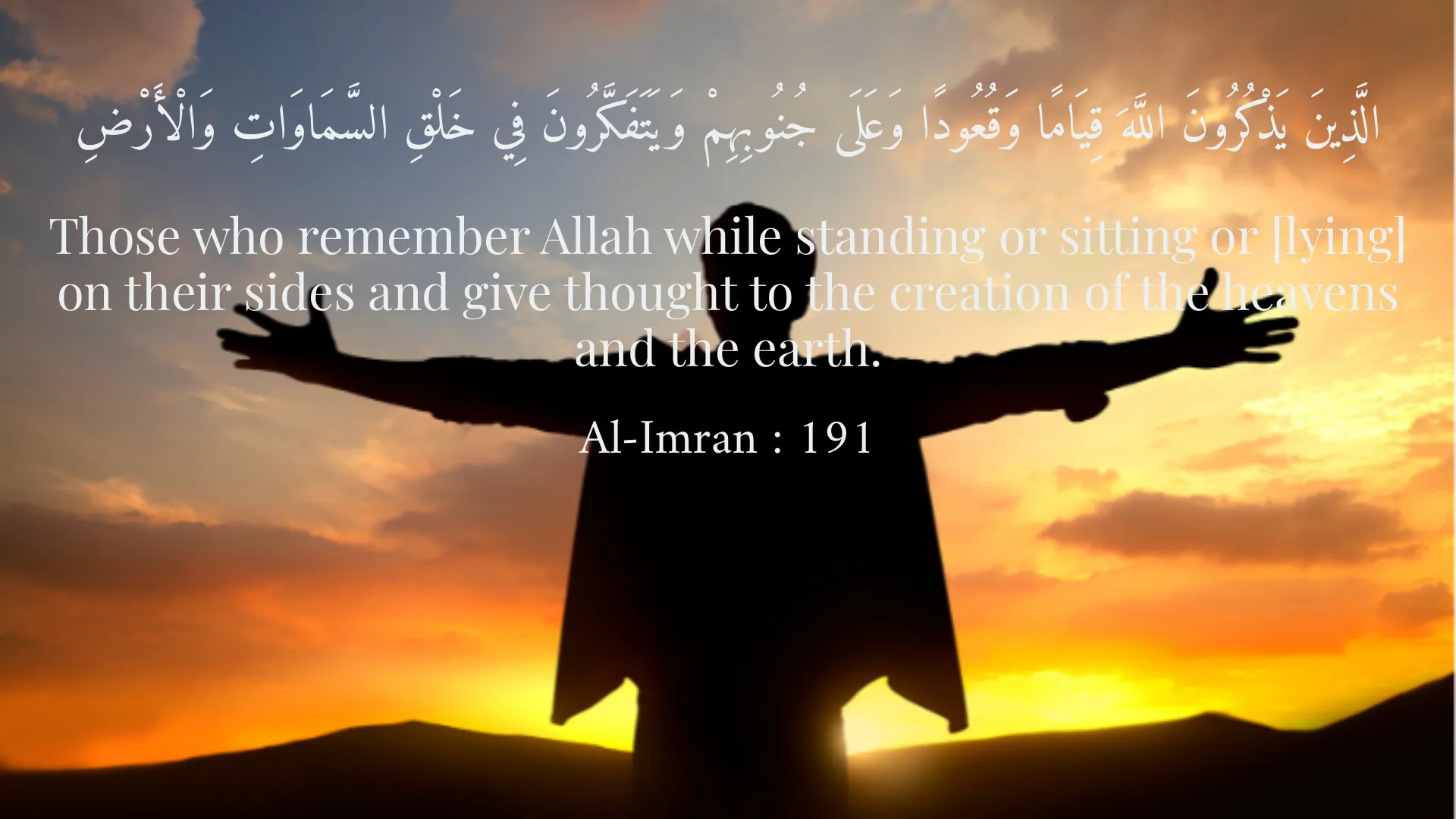
الَّذِينَ يَذْكُرُونَ اللَّهَ قِيَامًا وَقُعُودًا وَعَلَى جُنُوبِهِمْ وَيَتَفَكَّرُونَ فِي خَلْقِ السَّمَاوَاتِ وَالْأَرْضِ
Those who remember Allah while standing or sitting or [lying] on their sides and give thought to the creation of the heavens and the earth.
Al-Imran : 191
إِنَّمَا يَخْشَى اللَّهَ مِنْ عِبَادِهِ الْعُلَمَاءُ
Indeed, it is only those who have knowledge among His servants who fear Allah.
Ghafir : 57
Short Story
Once upon a time, a young man named Hasan was sitting in the mountains, closely observing the nature around him. He pondered whether all this beauty was created by chance. When he reflected on the verses of the Quran, he realized that this vast creation has great purpose and he should contemplate this creation. Hasan decided to continue thinking about his life and faith, and to teach others to reflect in their own lives as well. After a while, he felt that his connection with God and nature had become stronger.