Quranic Answer
In the Holy Quran, charity is recognized as a benevolent and praiseworthy act, with Allah emphasizing the importance of helping the needy. Through various verses, the Quran elucidates the significance of giving, not only as a form of support for those in need but also as a means of fostering spiritual growth and communal bonds. The essence of charity is multifaceted, encapsulating the virtues of compassion, generosity, and the promotion of harmony within society. This article aims to explore the Islamic perspective on charity and its implications, shedding light on various Quranic verses that stress its importance and the profound influence it has on both individual and collective levels. One of the most profound verses regarding charity is found in Surah Al-Baqarah, verse 261. In this verse, Allah states: "The example of those who spend their wealth in the way of Allah is like a seed from which seven ears grow; in every ear is a hundred grains." This metaphor beautifully illustrates the process of giving; it likens the act of donating wealth to planting a seed that, when nurtured and placed in fertile soil, yields abundant returns. This analogy signifies that charity is not merely a transaction of wealth; it is an investment in goodness and virtue. When individuals give, they are not losing their wealth; instead, they are sowing the seeds of compassion that will grow into a bounty of blessings, not just for themselves but for the entire community. Furthermore, charity extends beyond just financial assistance. Acts of kindness, generous behavior, and compassionate actions are all considered forms of charity in Islam. The Quran encourages believers to embody these virtues in their daily lives. Helping a neighbor, providing emotional support, or volunteering time for community service are all manifestations of charitable behavior. Islam emphasizes that serving the needs of others enhances one's spiritual depth and fosters a more humane society. Additionally, charity plays a crucial role in spiritual purification. In Surah At-Tawbah, verse 60, Allah elaborates on the categories of individuals who are deserving of charity, such as the poor, the needy, those who work to collect and distribute charity, and those whose hearts are to be reconciled. Understanding these categories allows believers to direct their charitable efforts effectively, thereby ensuring that their contributions have the most significant impact possible. By giving to the less fortunate, individuals not only provide material support but can also relieve their spiritual burdens. Charity is seen as a means of atonement for sins and a pathway to draw closer to Allah. This relationship between giving and spiritual elevation fosters a sense of responsibility among believers to contribute positively to society. Surah Al-Imran, verse 92, reinforces this perspective when Allah states: "You will never attain righteousness until you spend from that which you love." This verse uniquely highlights the notion that true virtue and righteousness stem from the willingness to part with what one cherishes. It encourages individuals to reflect on the value of their possessions and to consider how they can extend a helping hand to those in need. By relinquishing their beloved belongings or wealth, individuals experience a deeper understanding of empathy and connection to others. This adaptive perspective of charity fosters emotional resilience and creates a sense of unity within the community. The implications of charity extend beyond individual growth; they significantly influence the fabric of society. Charity fosters friendship, love, and compassion among community members. When individuals participate in charitable acts, they promote a sense of belonging and solidarity. This sense of interconnectedness nurtures a community atmosphere that values cooperation over competition and altruism over self-interest. Families, neighborhoods, and societies become strengthened through shared experiences of loss, joy, and support, further emphasizing the Islamic belief in the collective welfare of humanity. Moreover, charity has a transformational power in alleviating societal issues, such as poverty and injustice. When individuals and communities engage in regular charitable acts, they are making a direct impact on social outcomes. Charity programs can provide essential resources, education, and opportunities to those who might otherwise remain marginalized. Through community-building initiatives, individuals become deeply involved not only in helping those in need but also in creating systemic changes that address the root causes of societal problems. In conclusion, the concept of charity in Islam is a profound and multidimensional principle intricately woven into the fabric of faith. It serves as a reminder of the importance of resource sharing and community support, encouraging the practice of generosity while also emphasizing the profound benefits that arise from charitable acts. Quranic verses such as those found in Surah Al-Baqarah, Surah At-Tawbah, and Surah Al-Imran collectively characterize charity as a noble and essential virtue that nurtures not only individual spirituality but also collective wellbeing. As believers strive to embody these teachings, they contribute meaningfully to their communities, promoting harmony and fostering an environment rich in love, support, and solidarity. Therefore, charity transcends the act of giving; it becomes a legacy of compassion that enriches both the giver and the recipient, establishing a pathway toward a more equitable and cohesive society.
Related Verses
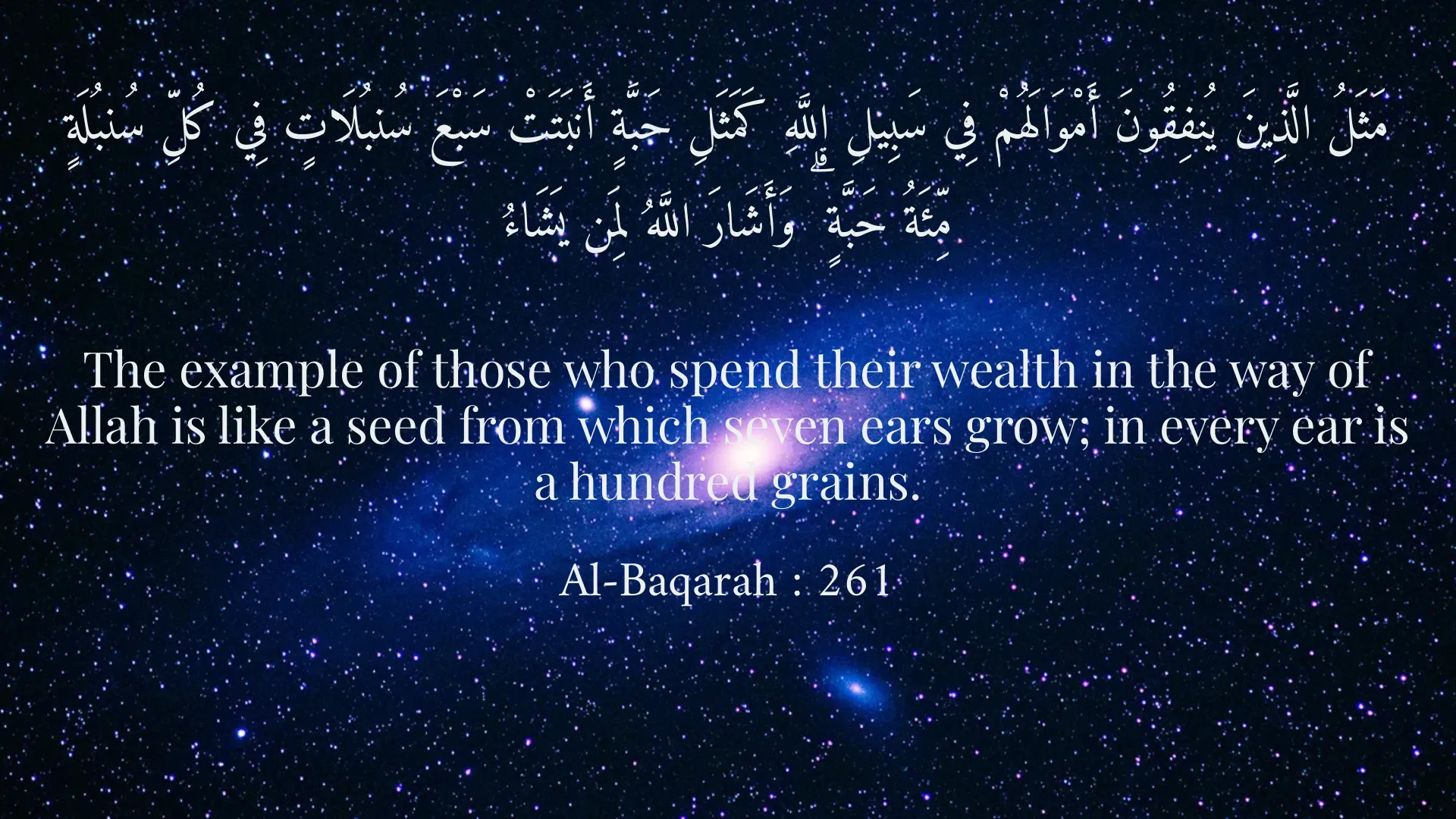
مَثَلُ الَّذِينَ يُنفِقُونَ أَمْوَالَهُمْ فِي سَبِيلِ اللَّهِ كَمَثَلِ حَبَّةٍ أَنبَتَتْ سَبْعَ سُنبُلَاتٍ فِي كُلِّ سُنبُلَةٍ مِّئَةُ حَبَّةٍ ۗ وَأَشَارَ اللَّهُ لِمَن يَشَاءُ
The example of those who spend their wealth in the way of Allah is like a seed from which seven ears grow; in every ear is a hundred grains.
Al-Baqarah : 261
إِنَّمَا الصَّدَقَاتُ لِلْفُقَرَاءِ وَالْمَسَاكِينِ وَالْعَامِلِينَ عَلَيْهَا وَالْمُؤَلَّفَةِ قُلُوبُهُمْ وَفِي الرِّقَابِ وَالْمَدينِينَ وَفِي سَبِيلِ اللَّهِ وَابْنِ السَّبِيلِ ۚ فَرِيضَةً مِّنَ اللَّهِ ۗ وَاللَّهُ عَلِيمٌ حَكِيمٌ
Charities are for the poor, the needy, those employed to collect them, and for those whose hearts have been reconciled (to Islam) and for freeing captives and for those in debt and for the cause of Allah and for the wayfarer. This is an obligation from Allah, and Allah is Knowing and Wise.
At-Tawbah : 60
لَن تَنَالُوا الْبِرَّ حَتَّى تُنفِقُوا مِمَّا تُحِبُّونَ ۗ وَمَا تُنفِقُوا مِن شَيْءٍ فَإِنَّ اللَّهَ بِهِ عَلِيمٌ
You will never attain righteousness until you spend from that which you love. And whatever you spend, indeed, Allah is Knowing of it.
Al-Imran : 92
Short Story
One day, a young man named Ahmad decided to help the needy more often. Every day after prayer, he would give a portion of his income to the poor. As time went by, he immediately noticed positive changes in his life. He felt a deeper happiness and satisfaction in his heart, knowing that this act not only helped others but also cleansed his soul.