Quranic Answer
From the perspective of the Holy Quran, the answer to the question of whether all people are responsible for their path of faith is unequivocally "yes." The Quran repeatedly emphasizes the fundamental principle of human free will and holds individuals accountable for their choices, especially concerning faith (Iman) and disbelief (Kufr). Almighty Allah has clearly shown the path of truth and falsehood, sent prophets, and placed countless signs and wonders in the universe and within human beings to guide them. However, He has never compelled anyone to accept faith. Indeed, the path of faith is a conscious and responsible choice, the consequences of which directly return to the individual. The Quran explicitly states that whoever chooses the path of guidance does so for their own benefit, and whoever chooses deviation does so to their own detriment, and Allah never wrongs His servants. This principle is rooted in divine justice; if humans were not free to choose their faith, then accountability, reward, and punishment would lose their meaning and significance. One of the clearest verses in this regard is Surah Al-Kahf 18:29, which states: "And say, 'The truth is from your Lord, so whoever wills - let him believe; and whoever wills - let him disbelieve.'" This verse clearly articulates the complete freedom of choice for humans in embracing faith or disbelief. This freedom is not merely a right but also a profound responsibility. Humanity is Allah's vicegerent on Earth, distinguished from other creations by the gift of intellect and free will. This gift makes them accountable before Allah. Furthermore, Surah Al-Baqarah 2:256 declares: "There shall be no compulsion in [acceptance of] the religion. The right course has become clear from the wrong." This verse establishes the foundation of freedom of belief in Islam, indicating that forced faith lacks true value. Genuine faith must originate from the depths of the heart and through an individual's free will. Allah merely shows the path and warns of the consequences, but the ultimate choice rests with the individual. The responsibility of a person concerning their faith is not limited to the initial moment of choice; it also encompasses maintaining, strengthening, and acting upon its requirements. The Quran calls upon believers to remain steadfast in faith, strive in the way of Allah, reflect and contemplate divine signs, and perform righteous deeds. These all indicate a dynamic and continuous path that requires constant vigilance and responsibility. Even in verses referring to guidance and misguidance, such as Surah Al-Insan 76:3: "Indeed, We guided him to the way, whether grateful or ungrateful," the emphasis remains on human will in accepting or rejecting guidance. Allah provides guidance, but the ultimate decision to walk that path belongs to the individual. This individual responsibility culminates on the Day of Judgment, where every soul will be held accountable for its deeds, and no one will bear the burden of another's sin. The Quran clearly states that Allah wrongs no one; rather, it is humans who wrong themselves. Self-wronging, in this context, means turning away from the truth and choosing the path of error despite clear divine signs and explicit guidance. Therefore, every individual, from the moment of maturity and awareness until the end of their life, bears direct responsibility for their path of faith. This responsibility includes seeking truth, contemplating creation, reflecting on the verses of the Quran, and following the call of their innate disposition (Fitra), which guides humanity towards the Oneness of God. Any negligence in this path is the result of indifference or a conscious choice by the individual, leading to specific worldly and otherworldly consequences. Ultimately, the concept of individual responsibility in faith is one of the main pillars of the Quranic worldview, emphasizing human dignity and free will, and paving the way for just reward and punishment in the hereafter.
Related Verses
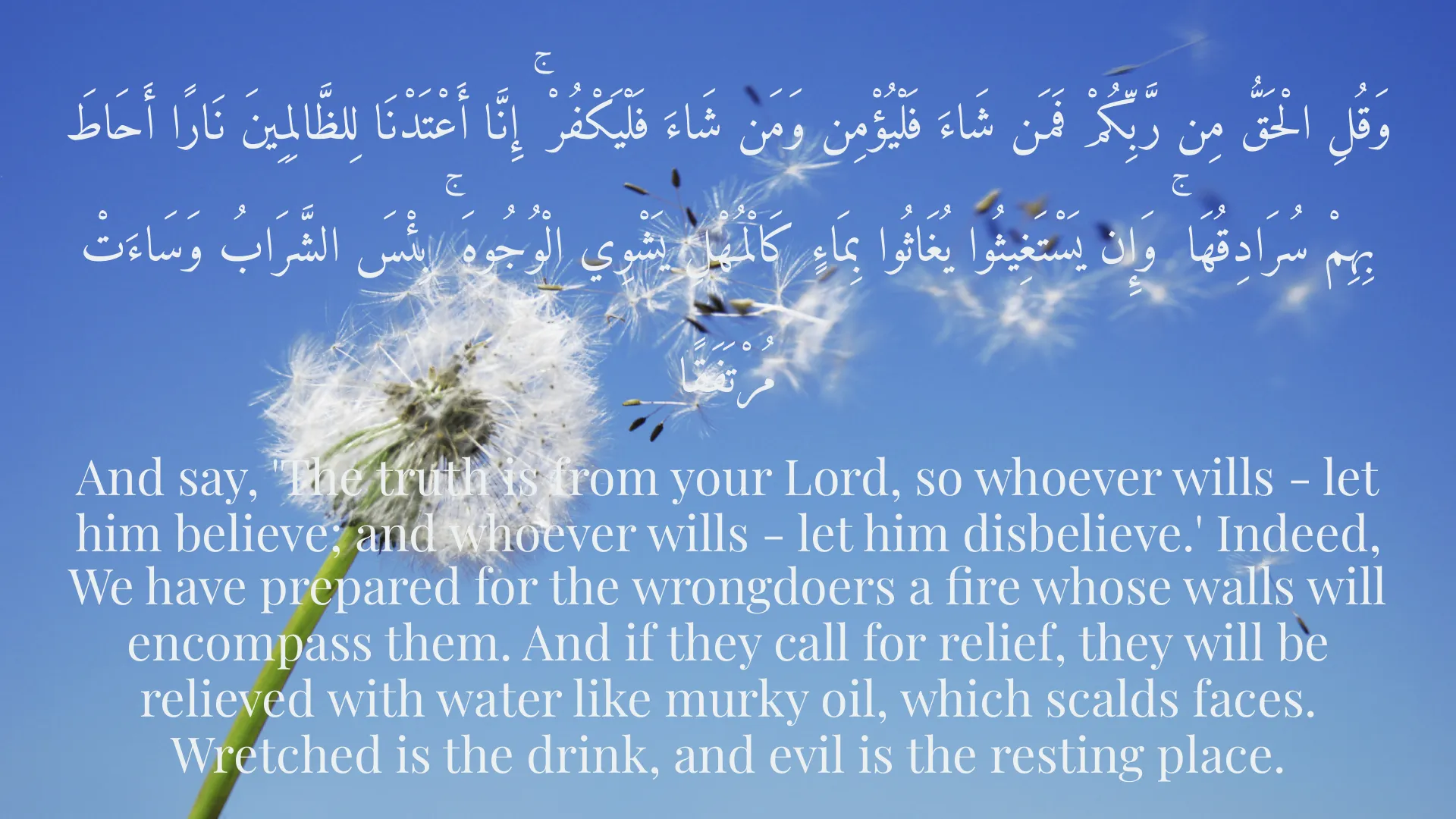
وَقُلِ الْحَقُّ مِن رَّبِّكُمْ فَمَن شَاءَ فَلْيُؤْمِن وَمَن شَاءَ فَلْيَكْفُرْ ۚ إِنَّا أَعْتَدْنَا لِلظَّالِمِينَ نَارًا أَحَاطَ بِهِمْ سُرَادِقُهَا ۚ وَإِن يَسْتَغِيثُوا يُغَاثُوا بِمَاءٍ كَالْمُهْلِ يَشْوِي الْوُجُوهَ ۚ بِئْسَ الشَّرَابُ وَسَاءَتْ مُرْتَفَقًا
And say, 'The truth is from your Lord, so whoever wills - let him believe; and whoever wills - let him disbelieve.' Indeed, We have prepared for the wrongdoers a fire whose walls will encompass them. And if they call for relief, they will be relieved with water like murky oil, which scalds faces. Wretched is the drink, and evil is the resting place.
Al-Kahf : 29
لَا إِكْرَاهَ فِي الدِّينِ ۖ قَد تَّبَيَّنَ الرُّشْدُ مِنَ الْغَيِّ ۚ فَمَن يَكْفُرْ بِالطَّاغُوتِ وَيُؤْمِن بِاللَّهِ فَقَدِ اسْتَمْسَكَ بِالْعُرْوَةِ الْوُثْقَىٰ لَا انفِصَامَ لَهَا ۗ وَاللَّهُ سَمِيعٌ عَلِيمٌ
There shall be no compulsion in [acceptance of] the religion. The right course has become clear from the wrong. So whoever disbelieves in Taghut and believes in Allah has grasped the most trustworthy handhold with no break in it. And Allah is Hearing and Knowing.
Al-Baqarah : 256
إِنَّا هَدَيْنَاهُ السَّبِيلَ إِمَّا شَاكِرًا وَإِمَّا كَفُورًا
Indeed, We guided him to the way, whether grateful or ungrateful.
Al-Insan : 3
Short Story
They say that in Saadi's time, a virtuous man embarked on a journey. His guide showed him two paths: one smooth and well-trodden, leading to the marketplace and commerce, and another difficult and rugged, leading to a high mountain where hermits resided. The wise man initially hesitated but listened to the call of his intellect and heart. He said to himself: "The marketplace offers worldly opportunities, but the mountain, spiritual ones. Everyone chooses the path to which their heart inclines more." Although he knew the mountain path was harder, he chose it. He walked with steady steps, and with each step, his conviction grew. After a while, he reached the top of the mountain, where he found peace and insight that no marketplace could buy. This tale illustrates that the path of faith and salvation is a personal choice that each individual makes with their own will, and they are responsible for its consequences, whether the path is easy or difficult, because the ultimate destination depends on their individual effort and choice.