Quranic Answer
In the rich and comprehensive teachings of the Holy Quran, intention (niyyah – the inner resolve and purpose of the heart) holds an exceptionally high and fundamental position. In Islam, intention is the spirit and essence of every action, and without a correct intention, many acts of worship and good deeds are considered valueless. The Prophet Muhammad (peace be upon him) famously stated: 'Indeed, actions are by intentions.' This noble Hadith highlights the extraordinary importance of intention in determining the otherworldly and spiritual value of an action. However, the crucial question arises: can a pure and good intention justify or legitimize an act that is inherently bad or forbidden (haram)? The unequivocal answer, based on Quranic principles and Islamic teachings, is no. A good intention cannot justify an inherently bad or prohibited act and transform it into a righteous one. Islam provides a comprehensive and balanced system for human ethics and conduct, wherein both the purity of the inner self (intention) and the rectitude of the external action are paramount. The Holy Quran clearly defines the boundaries between what is lawful (halal) and unlawful (haram), good and evil, right and wrong. Allah Almighty has forbidden actions that are detrimental to human well-being and societal order. These prohibitions are absolute and cannot be circumvented by justifications such as 'good intentions.' For instance, stealing others' property, killing an innocent person, lying, slandering, or engaging in usury are all actions explicitly prohibited in the Quran. Imagine a person who commits theft from a bank with the intention of helping the poor. While their intention (helping the poor) might be emotionally and philanthropically understandable, the act of theft itself is a major sin and an invalid act that disrupts social order and infringes upon the rights of others. The Quran never sanctions such behavior, nor does it justify it on account of a good intention. In Islam, 'the end does not justify the means,' and to achieve noble goals, one must use legitimate and lawful means and methods. The Quran strongly emphasizes the adherence to justice and avoidance of injustice. In numerous verses, Allah calls upon humanity to uphold justice in all matters, even with adversaries: 'O you who have believed, be persistently Qawwameen (stand firmly) for Allah, witnesses in justice, and do not let the hatred of a people prevent you from being just. Be just; that is nearer to righteousness.' (Al-Ma'idah, 5:8). This verse demonstrates that even enmity and hatred towards a group should not prevent the implementation of justice. If intention could justify a bad deed, the concept of justice, which is one of the most fundamental pillars of Islam, would become meaningless. Actions such as backbiting, slander, oppression of the weak, deception, and treachery, even if performed with personal intentions and mental justifications, are considered reprehensible and sinful in the sight of Allah. The consequences of these actions are societal corruption, loss of trust, and the prevalence of injustice, all of which the Quran vehemently prohibits. Furthermore, the Holy Quran emphasizes human accountability for their actions. Every individual is responsible for their deeds and will be held accountable for them on the Day of Judgment. 'So whoever does an atom's weight of good will see it, And whoever does an atom's weight of evil will see it.' (Az-Zalzalah, 99:7-8). These verses explicitly state that even the smallest act of good or evil will have its consequence. This indicates that the action, irrespective of the intention, has its own weight and reality. If an action is inherently evil, a good intention cannot change its nature; at most, it might mitigate the severity of punishment in cases of ignorance or necessity, but the fundamental prohibition of the action remains. The wisdom and expediency behind divine laws also reinforce this truth. Allah Almighty, due to His infinite wisdom and knowledge, has established laws whose observance is beneficial for humanity. These laws, both commandments and prohibitions, are set to preserve the best order in society and ensure individual salvation. Allowing intention to justify a forbidden act would mean disregarding this divine wisdom and would lead to chaos and moral relativism in ethical values. Islam never permits believers to pursue noble goals through impure and forbidden means. This is to prevent both internal and external corruption. The goal of Islam is to cultivate individuals who possess pure intentions and whose actions are in accordance with divine law and ethics. In essence, a pure intention paves the way for performing good deeds, but it can never be a license for committing evil. For a Muslim, both the intention must be divine and pure, and the action originating from them must be within the framework of divine pleasure and legal rulings. This balance between the inner and outer self is a distinguishing feature of Islamic ethics, and for this reason, the justification of a bad deed with a good intention has no place in the Quranic lexicon. In conclusion, while intention is the heart and soul of an action and adds to the value and reward of good deeds, it cannot alter the nature of an inherently bad or forbidden act or render it permissible. Any forbidden act, even with a good intention, remains forbidden, and its responsibility rests upon the perpetrator. The Holy Quran establishes the criteria for right and wrong based on divine commands, not on personal interpretations or justifications arising from intention. This approach forms the foundation of a just, moral, and orderly society.
Related Verses
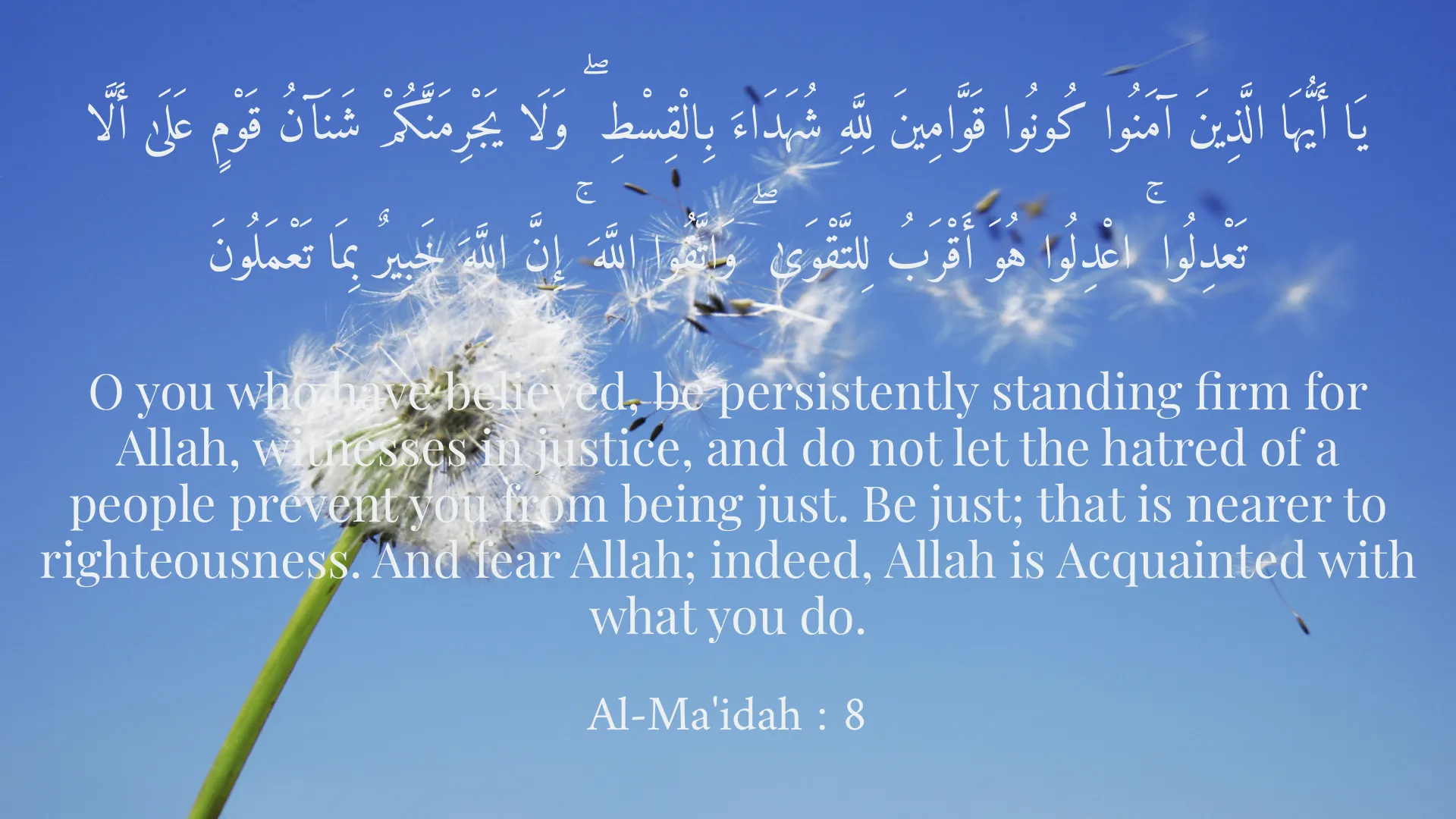
يَا أَيُّهَا الَّذِينَ آمَنُوا كُونُوا قَوَّامِينَ لِلَّهِ شُهَدَاءَ بِالْقِسْطِ ۖ وَلَا يَجْرِمَنَّكُمْ شَنَآنُ قَوْمٍ عَلَىٰ أَلَّا تَعْدِلُوا ۚ اعْدِلُوا هُوَ أَقْرَبُ لِلتَّقْوَىٰ ۖ وَاتَّقُوا اللَّهَ ۚ إِنَّ اللَّهَ خَبِيرٌ بِمَا تَعْمَلُونَ
O you who have believed, be persistently standing firm for Allah, witnesses in justice, and do not let the hatred of a people prevent you from being just. Be just; that is nearer to righteousness. And fear Allah; indeed, Allah is Acquainted with what you do.
Al-Ma'idah : 8
وَلَا تَقْرَبُوا الزِّنَا ۖ إِنَّهُ كَانَ فَاحِشَةً وَسَاءَ سَبِيلًا
And do not approach unlawful sexual intercourse. Indeed, it is ever an immorality and is evil as a way.
Al-Isra : 32
فَمَن یَعْمَلْ مِثْقَالَ ذَرَّةٍ خَیْرًا یَرَهُ
So whoever does an atom's weight of good will see it,
Az-Zalzalah : 7
وَمَن یَعْمَلْ مِثْقَالَ ذَرَّةٍ شَرًّا یَرَهُ
And whoever does an atom's weight of evil will see it.
Az-Zalzalah : 8
Short Story
It is said that in Saadi's time, there was a wealthy man who wished to perform a good deed with his riches. He decided to build a mosque, but to secure building materials, he took some from an orphan's property without permission. When the mosque was completed, the man proudly told Saadi: 'O Master, I built a mosque with pure intention so that people may worship in it and benefit from its grace. Is this not a good deed?' Saadi smiled and said: 'O generous man, your intention is commendable, but a charitable structure built on the foundation of injustice and transgression against the rights of others holds no benefit. Your mosque, although seemingly a house of God, has a brick of injustice within it, and God is self-sufficient without it. It would have been better to build even with less wealth, but through lawful means, for a pure intention is perfected by a pure action, not by justifying an impure action with a pure intention. For God is pure and accepts nothing but purity.' The man understood Saadi's words, repented, and strove to restore the orphans' rights, so that his action might align with his intention.