Quranic Answer
The relationship between intention and action within Islamic teachings is a topic of utmost significance, as illuminated in the Holy Quran and through the sayings of the Prophet Muhammad (PBUH). Understanding this dynamic requires a deeper exploration of the importance of both intention and action, and how they interplay within a believer's life. In Islamic doctrine, it is well-established that an individual's intentions provide the foundation for their actions. However, it is crucial to recognize that having a good intention alone is insufficient; it must be accompanied by corresponding actions for it to be deemed significant in the eyes of Allah. In Surah Al-Imran, verse 108, Allah emphasizes that His attention is not directed toward external appearances or material wealth. He is primarily concerned with the states of our hearts and the actions we undertake. The divine message conveyed through this verse underscores the necessity of actions as manifestations of our intentions. It is not enough merely to harbor good thoughts or noble resolutions; these intentions must materialize in practical ways. Without action, good intentions remain unfulfilled and empty. The Quran stresses that actionable steps are essential for demonstrating the authenticity of one's intention. Additionally, the teachings of the Prophet Muhammad (PBUH) reinforce this idea in the hadith: "Actions are judged by intentions, and every person will be rewarded according to their intention." This statement illuminates the dual importance of intention in Islam: while a good intention is crucial and might offer a degree of salvific merit, it is ultimately the action that accompanies it that holds more significance. Islamic teachings advocate that having good intentions is merely the starting point of a spiritual journey. It lays the groundwork upon which actions can be constructed, but it is the actions themselves that lead to real change and impact the world around us. To illustrate this concept further, let us consider a person who wishes to lend their support to others in need; for instance, someone who intends to donate time and resources to a charitable cause. If this individual does not follow through with their intent by taking the necessary steps, such as volunteering or making a donation, the potential benefits of their good intentions remain unrealized. The desires to help, empower, or uplift others remain latent and have no tangible outcome. Thus, the good intention, though genuine, does not yield results nor does it fulfill the duty of compassion and support that one is capable of extending. One might also draw parallels with educational achievements. A student who harbors the desire to excel academically must combine their good intentions with diligent study, participation in discussions, and practice. Without these concrete steps, the student may possess the wish for success but will find it unattainable. Similarly, in the realm of religious practice, a worshiper may have excellent intentions to pray regularly, seek knowledge, or engage in community service, but if these intentions are not acted upon, they will not fulfill their spiritual obligations or benefit from the rewards associated with those deeds. Between intention and action lies a responsibility for every believer. The Quran presents a comprehensive guide on how spirituality interweaves with practical living. By emphasizing the significance of deeds, Allah encourages Muslims to transform their intentions into productive actions that can spur positive outcomes in this world and the hereafter. The integration of intention with action forms a holistic approach that defines the essence of a faithful believer. Furthermore, when intentions are acted upon, they have the potential to create a ripple effect, impacting not only the individual but also the wider community. A collective movement toward beneficial actions based on good intentions can lead to transformative change in society. Whether through charitable acts, social justice initiatives, or building supportive communities, the act of turning intention into action can significantly uplift others and foster love, understanding, and progress. In light of these principles, it becomes clear that merely wishing for a better world, personal growth, or close relations with Allah is not enough. Effective change necessitates action. A one-time charitable donation, a single act of kindness, or a moment of self-reflection does not encompass the consistent effort required to build a life rooted in faith and dedicated to the well-being of others. Actions driven by intention should be regular and persistent, establishing a lifestyle where good deeds become habitual, and intentions continue to inspire positive behavior. Moreover, understanding the balance and synergy between intention and action can lead to personal accountability and growth. Believers are encouraged to evaluate their intentions regularly and ensure that they translate into meaningful actions. This introspective practice not only strengthens one’s relationship with Allah but also enhances one’s impact on the community and overall society. As believers assess the alignment of their intentions with their actions, they pave the way for authentic living and purpose-driven existence. In conclusion, the teachings of the Holy Quran and the Prophet Muhammad (PBUH) illuminate the critical nature of both intention and action in the life of a believer. Intentions serve as the guiding force, while actions bring those intentions to life. As highlighted in Surah Al-Imran and reinforced through prophetic teachings, mere good intentions will ultimately hold little value without the transformative power of action to realize them. Therefore, it is imperative for all believers to integrate good intentions with consistent, meaningful actions to yield positive results in their lives and the lives of others. Through this thoughtful and proactive approach to life, believers can contribute to bringing about the ideals of compassion, service, and exemplary character that Islam promotes.
Related Verses
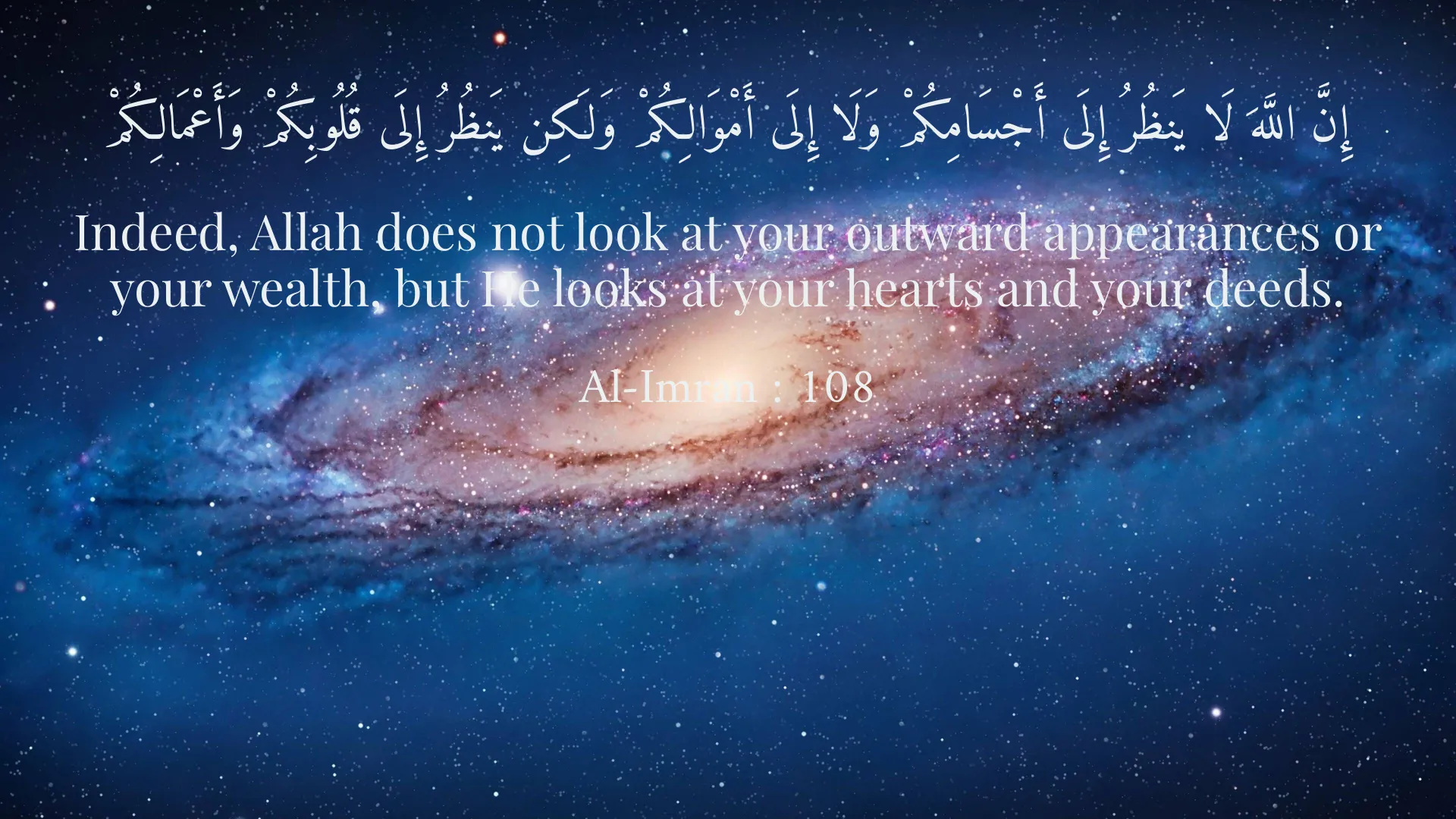
إِنَّ اللَّهَ لَا يَنظُرُ إِلَى أَجْسَامِكُمْ وَلَا إِلَى أَمْوَالِكُمْ وَلَكِن يَنظُرُ إِلَى قُلُوبِكُمْ وَأَعْمَالِكُمْ
Indeed, Allah does not look at your outward appearances or your wealth, but He looks at your hearts and your deeds.
Al-Imran : 108
لَيْسَ الْبِرَّ أَنْ تُوَلُّوا وَجْهَكُمْ قِبَلَ الْمَشْرِقِ وَالْمَغْرِبِ وَلَكِنَّ الْبِرَّ مَنْ آمَنَ بِاللَّهِ وَالْيَوْمِ الْآخِرِ وَالْمَلَائِكَةِ وَالْكِتَابِ وَالنَّبِيِّينَ وَآتَى الْمَالَ عَلَى حُبِّهِ ذَوِي الْقُرْبَى وَالْيَتَامَى وَالْمَسَاكِينِ وَابْنَ السَّبِيلِ وَالسَّائِلِينَ وَفِي الرِّقَابِ وَأَقَامَ الصَّلَاةَ وَآتَى الزَّكَاةَ وَالْمُوفُونَ بِعَهْدِهِمْ إِذَا عَاهَدُوا وَالصَّابِرِينَ فِي الْبَأْسَاءَ وَالضَّرَّاءَ وَحِينَ الْبَأْسِ أُولَـئِكَ الَّذِينَ صَدَقُوا وَأُولَـئِكَ هُمُ الْمُتَّقُونَ
Righteousness is not that you turn your faces toward the east or the west, but [true] righteousness is in one who believes in Allah, the Last Day, the Angels, the Scripture, and the Prophets and gives his wealth, in spite of his love for it, to relatives, orphans, the needy, the traveler, those who ask [for help], and for freeing slaves; and [who] establishes prayer and gives zakah; [those who fulfill their promise when they promise]; and [those who are patient in] poverty and hardship and during battle. Those are the ones who have been true, and it is those who are the righteous.
Al-Baqarah : 177
Short Story
One day, a man named Ali went to the market and felt in his heart that he should help others. He decided to buy a sack of rice and donate it to needy families. Along the way, his friends mocked him, saying that this was unnecessary. But Ali replied, 'I have good intentions, and others are in need.' When he acted and distributed the rice, he felt peace and satisfaction in his heart and understood the positive impacts of good intentions combined with action.