Quranic Answer
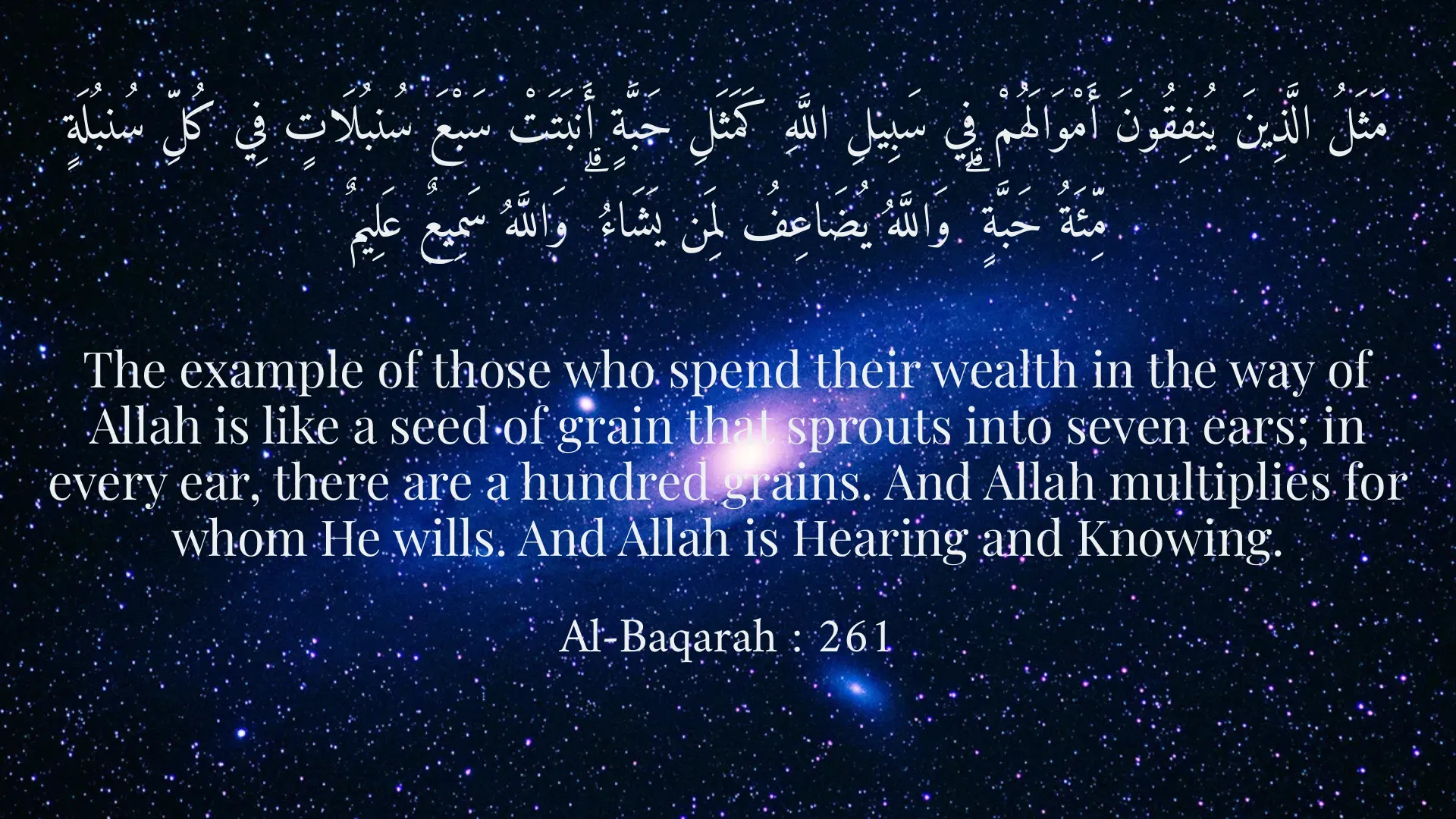
In the Holy Quran, Allah explicitly expresses His love for those who are generous and charitable, weaving the concept of generosity into the very fabric of righteous living. Generosity can be defined as the quality of being kind, understanding, and giving; an essence that Allah holds in high regard. In numerous verses, Allah emphasizes that acts of charity and generosity not only benefit the recipient but also serve to enrich the giver's spiritual journey and overall life experience. The Quran presents a beautiful picture of this symbiotic relationship between giving and receiving, and how these acts reflect an individual's standing before Allah. In Surah Al-Ma'idah, verse 13, it is stated: 'And as for the punishment, it will be a result of what their own hands have earned; and in this matter, it should be known that the reward of the good-doers is nothing but goodness and reward.' This verse highlights the principle of justice that governs our actions; the consequences we face in this world and the hereafter are directly correlated with our deeds. For those who embody generosity and engage in charitable acts, their reward is assured — a firm promise from Allah. This serves as motivation for believers to practice goodness, reinforcing the notion that being charitable is not just a desirable trait but a vital characteristic of the righteous. Generosity is fundamentally about creating connections — both among people and between humans and the Divine. It fosters a sense of community, where individuals come together in mutual support and shared responsibilities. Whenever one extends their hand to help those in need, they contribute to the nurturing of communal bonds that strengthen the fabric of society. The collective experience of giving, of being generous, helps reduce feelings of isolation and loneliness, enabling people to build a loving and supportive environment. Moreover, Allah promises manifold rewards for those who act generously. In Surah Al-Baqarah, verse 261, we find a profound metaphor: 'The example of those who spend their wealth in the way of Allah is like a seed of grain that sprouts into seven ears; in every ear there are a hundred grains.' This illustrates the remarkable and exponential return on investment that comes from generosity. The imagery invokes the idea that every act of charity bears fruit far beyond the initial giving. Just as a seed grows and multiplies, so too will the rewards for the generous follower of Allah. This principle reinforces faith in divine benevolence and emphasizes that Allah, in His infinite mercy, appreciates every humble offering and magnifies its significance in the grand scheme of existence. In essence, spending in the way of Allah yields rewards that can manifest not only as material wealth but as spiritual fulfillment and peace of mind. Believers should approach charitable acts with the understanding that they will not only help others but will also elevate their own spiritual status and bring them closer to Allah. Moreover, the Quran reiterates the motivation behind charity in Surah Al-Baqarah, verse 273, where Allah admonishes: 'Indeed, charity is for the poor and the needy...' Here, we are reminded that the act of charity should stem from compassion and love for humanity — not merely an obligation but a heartfelt desire to alleviate the burdens of those less fortunate. Such charity is a means of bridging the gap between the rich and the poor, reinforcing the importance of empathy in building a harmonious society. To truly comprehend the Quranic view on generosity, it is crucial to understand the transformative power it possesses. Generosity is a means of purifying one's wealth and heart. The act of giving – whether through financial support, time, or emotional encouragement – serves to cleanse the soul of greed and selfishness, promoting a more abundant inner life. In a world where materialism often overshadows moral values, the Quran seeks to remind us of the importance of generosity as a virtue that enriches character and lives. It emphasizes that the pursuit of wealth should not be a solitary endeavor but rather one that includes the well-being of all members of society. The Quran constantly urges us to look beyond our own comfort and success, shifting our focus to the welfare of those around us. Moreover, the impact of generosity is not confined to the earthly realm. The Quran suggests that charitable acts hold significance in the hereafter as well. By practicing generosity, believers are essentially creating a charitable legacy that continues to yield rewards even after their death. The standing of a person in the afterlife can be significantly influenced by their actions in this world, and helping others is among the noblest deeds prioritized in divine judgment. The lessons of generosity contained in the Quran are multi-faceted, reflecting on not just the act of giving but the accompanying intentions and mindset. Allah encourages believers to engage in charitable deeds sincerely, as a pathway toward greater spiritual growth and divine favor. Thus, a generous heart not only embodies the values espoused by the Quran but also acts as a beacon of love and mercy in the world. In conclusion, through the lens of the Quran, generosity emerges as an essential characteristic of the faithful — a trait that not only underscores one's moral standing but also solidifies one's relationship with Allah. It reinforces the notion that each act of kindness impacts not just the giver and receiver but also the fabric of society itself. As we navigate personal and communal struggles, may we find solace and strength in the teachings of the Quran about generosity, understanding it not merely as a duty but as a divine pathway to love, kindness, and closeness to Allah.
Related Verses
مَثَلُ الَّذِينَ يُنفِقُونَ أَمْوَالَهُمْ فِي سَبِيلِ اللَّهِ كَمَثَلِ حَبَّةٍ أَنبَتَتْ سَبْعَ سُنبُلَاتٍ فِي كُلِّ سُنبُلَةٍ مِّئَةُ حَبَّةٍ ۗ وَاللَّهُ يُضَاعِفُ لِمَن يَشَاءُ ۗ وَاللَّهُ سَمِيعٌ عَلِيمٌ
The example of those who spend their wealth in the way of Allah is like a seed of grain that sprouts into seven ears; in every ear, there are a hundred grains. And Allah multiplies for whom He wills. And Allah is Hearing and Knowing.
Al-Baqarah : 261
فَأَمَّا الَّذِينَ كَسَبُواْ السَّيِّئَاتِ فَجَزَاؤُهُمْ سَيِّئَةٌ مِّثْلُهَا ۖ وَأَمَّا الَّذِينَ آمَنُوا وَعَمِلُوا الصَّالِحَاتِ فَلَهُمْ جَنَّـاتُ النَّعِيمِ
But those who earned bad deeds will have a recompense equivalent to it; and those who believed and did righteous deeds will have gardens of bliss.
Al-Ma'idah : 13
إِنَّمَا الصَّدَقَاتُ لِلْفُقَرَاءِ وَالْمَسَاكِينِ وَالَّذِينَ يُقَاتِلُونَ فِي سَبِيلِ اللَّهِ وَالْمُعْتَرفِينَ بِمَا عَلَيْهِمْ مَشَارَةٌ فِي السَّنَة.
Charity is only for the poor and the needy and those who fight in the cause of Allah and those who are recognized for what they possess in the year.
Al-Baqarah : 273
Short Story
One day, a kind man was walking down the street when he came across a poor individual. Remembering the verses of the Quran, he decided to help him. He joyfully not only gave him some money but also addressed his needs. As a result, he found more joy in his life each day, realizing that his generosity brought him blessings and peace.