Quranic Answer
The Quran serves as the chief religious text for Muslims, and within its verses, it extensively discusses matters of morality, spirituality, and the consequences of human actions. Among these discussions, the themes of divine rewards, in both the earthly life and the hereafter, are profoundly emphasized. This essay seeks to explore these themes further, demonstrating how they shape the beliefs and actions of believers and provide context for their moral and ethical choices. One striking example of divine rewards can be found in Surah Al-Baqarah, verse 261, where Allah employs a powerful metaphor to illustrate the exponential benefits of charitable giving. The verse states that 'the example of those who spend their wealth in the way of Allah is like that of a seed that sprouts seven ears; in every ear, there are a hundred grains.' This representation captures the essence of investment in righteousness. It signifies that engaging in acts of kindness, particularly giving in charity, leads to abundant returns far beyond the initial offering. In essence, the Quran reassures believers that their contributions not only yield spiritual rewards in the afterlife but also engender blessings and prosperity in their earthly experience. Moving further into the text, we come across Surah Al-Imran, verse 133, which exhorts believers to 'hasten to the forgiveness from your Lord and a Paradise whose width is like the heavens and the earth.' This verse serves as an invitation for individuals to pursue excellence in their actions and strive for righteousness. Here, Allah paints an image of paradise that is as vast as the cosmos, an infinite realm promising everlasting joy and fulfillment for those who act in accordance with His guidance. This powerful imagery effectively motivates Muslims to cultivate a strong moral compass in life, leading them toward good deeds that align with divine expectations. The duality of rewards—spiritual and worldly—encourages responsiveness to Allah's call and a proactive stance toward goodness. Moreover, in Surah Al-An'am, verse 160, we find a critical reminder of accountability: 'And whoever comes with a sin will not be recompensed except for the like of it.' This emphasizes that every action has a corresponding reaction, thereby instilling the belief in both the consequences of good and evil deeds. This serves as an essential moral lesson, providing a framework within which Muslims are encouraged to conduct their lives. The inherent duality of this message—that good has its rewards and evil bears its penalties—compels individuals to reflect on their actions and the long-term outcomes of their choices. The Quran does not merely dwell on the possibility of rewards; it simultaneously establishes a firm footing for ethical behavior by affirming that every good deed engenders further good, while sinful actions inevitably attract unfavorable consequences. This prompts believers to engage in self-assessment, seeking to align their actions with the principles outlined in the sacred text. As we contemplate the virtues espoused in these verses, it becomes evident that Allah's messages extend beyond mere guidelines. They craft a holistic model of an ethical life—one where the pursuit of goodness is intertwined with the anticipation of divine rewards. The idea that charitable donations can yield tangible benefits reinforces an important principle that goodness generates abundance, both spiritually and materially. This perspective elevates the act of giving to a divine investment that benefits both the individual and the community. Furthermore, the Quranic principle of accountability, articulated in Surah Al-An'am, strengthens the argument for social cohesion and collective responsibility. Through the conscious acts of charity and righteousness, believers can contribute to societal stability and harmony, making the world a better place. Ultimately, the insights provided in the Quran encourage individuals to take proactive steps toward fostering not only spiritual growth but also communal well-being. In understanding these themes, we can witness how the Quran reflects a universal truth about human existence: that our actions matter. In a world where people often seek validation through material gain or fleeting pleasures, the Quran reassures believers of a higher purpose that transcends everyday life. It invites them to consider the impact of their actions on both a personal and communal level, emphasizing growth through goodness. To summarize, the concepts of rewards in the Quran, as manifested in the examples presented from various verses, highlight a significant correlation between actions and consequences. The emphasis on charity not only suggests a pathway to divine favor but also nurtures a bountiful spiritual garden in this world. Believers are encouraged to aspire towards righteousness, pursue worthwhile deeds, and maintain awareness of their accountability in both their earthly and heavenly lives. God indeed promises a life enriched with reward and blessings for those willing to hearken to His call, solidifying the belief that a life steeped in good deeds is both fulfilling and fruitful, both now and in the hereafter.
Related Verses
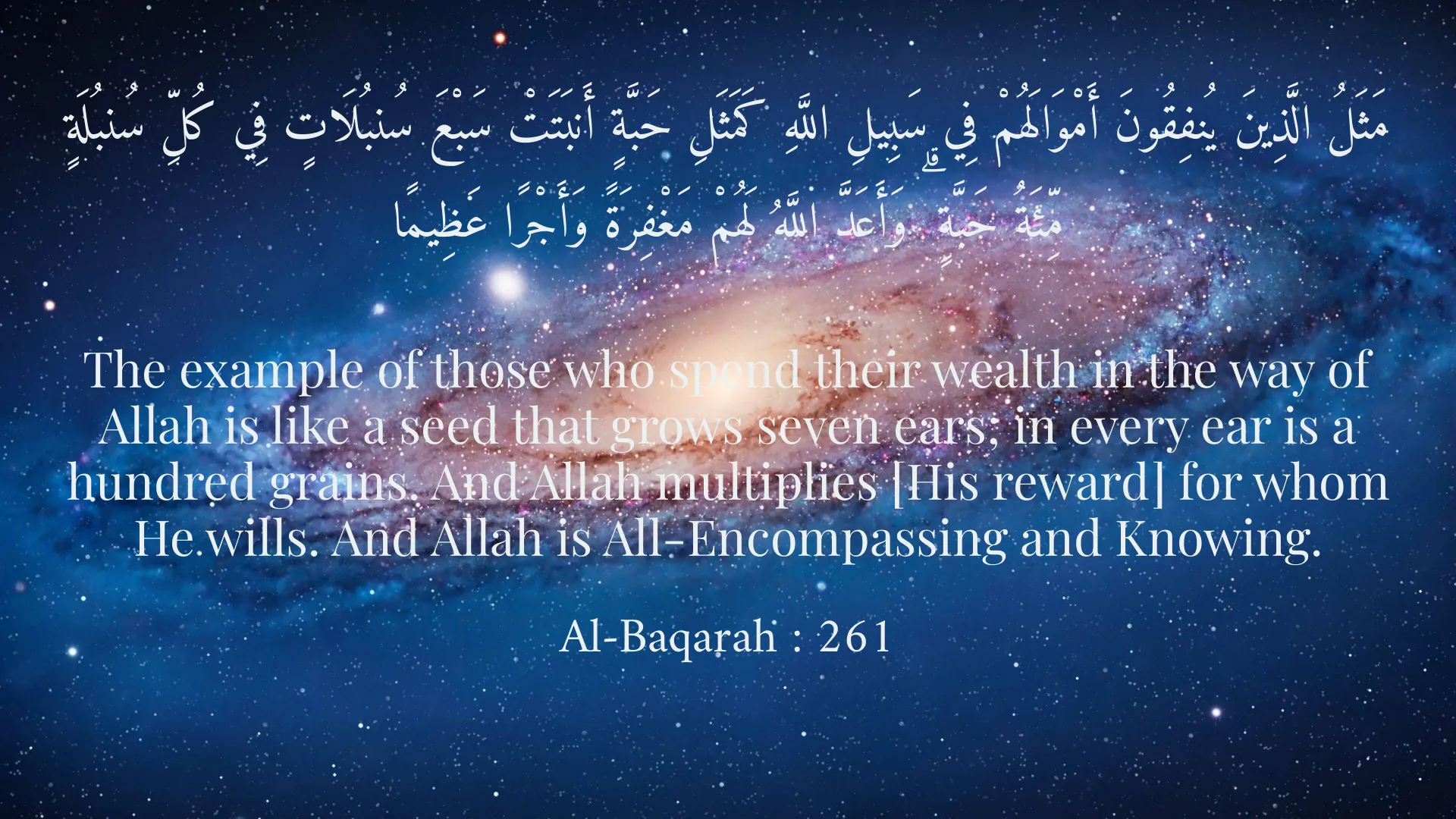
مَثَلُ الَّذِينَ يُنفِقُونَ أَمْوَالَهُمْ فِي سَبِيلِ اللَّهِ كَمَثَلِ حَبَّةٍ أَنبَتَتْ سَبْعَ سُنبُلَاتٍ فِي كُلِّ سُنبُلَةٍ مِّئَةُ حَبَّةٍ ۗ وَأَعَدَّ اللَّهُ لَهُمْ مَغْفِرَةً وَأَجْرًا عَظِيمًا
The example of those who spend their wealth in the way of Allah is like a seed that grows seven ears; in every ear is a hundred grains. And Allah multiplies [His reward] for whom He wills. And Allah is All-Encompassing and Knowing.
Al-Baqarah : 261
وَسَارِعُوا إِلَى مَغْفِرَةٍ مِّن رَّبِّكُمْ وَجَنَّةٍ عَرْضُهَا كَعَرْضِ السَّمَاء وَالْأَرْضِ أُعِدَّتْ لِلْمُتَّقِينَ
And race towards forgiveness from your Lord and a garden as vast as the heavens and the earth, prepared for the righteous.
Al-Imran : 133
وَمَن جَاءَ بِالسَّيِّئَةِ فَلَا يُجْزَى إِلَّا مِثْلَهَا
And whoever comes with a sin will not be recompensed except for the like of it.
Al-An'am : 160
Short Story
One day, a friend went to visit another friend and saw him reading the Quran. He asked, 'Why do you pay so much attention to reading the Quran?' His friend replied, 'Because I know that every verse I read brings reward for me and grants me peace. In this world, I must do good deeds and see the reward of that in this life too.' This sentence made his friend realize the significance of good deeds in both this world and the hereafter.