Quranic Answer
In the luminous teachings of the Holy Quran, the matter of intention (niyyah) and purpose in performing good deeds holds a profoundly fundamental and elevated position. The Quran explicitly states that outward goodness, without a pure and divine intention, cannot fully possess true value or spiritual reward in the sight of Allah. This is a pivotal principle in the philosophy of action within Islam, asserting that every action, whether an act of worship or a social endeavor, must first be nourished by a pure and sincere intention to be accepted by the Divine Presence and to bear eternal fruits. The Quran repeatedly emphasizes the importance of "ikhlas" (sincerity); ikhlas means that all of a person's actions and acts of worship are performed solely and exclusively for the pleasure of Allah, without any trace of hypocrisy (riya'), showing off, seeking fame, or acquiring worldly gain. This emphasis on intention extends not only to acts of worship such as prayer, fasting, and pilgrimage, but also to all aspects of a believer's life. Even mundane, everyday tasks, if performed with a pure intention for God and seeking closeness to Him, can transform into acts of worship and carry spiritual reward. For instance, if an individual strives to earn a lawful living for their family, and performs this task with the intention of obeying God's command and fulfilling family rights, this livelihood endeavor becomes an act of worship. However, if the same effort is made solely for accumulating wealth and boasting, it becomes devoid of spiritual value. This illustrates how intention acts as a transformative factor, capable of altering the very nature of actions. For example, in Surah Al-Bayyinah, verse 5, Allah Almighty explicitly states: "And they were not commanded except to worship Allah, [being] sincere to Him in religion, inclining to truth, and to establish prayer and to give zakat. And that is the correct religion." This verse clearly indicates that the foundation of religion and servitude is sincerity in intention. This means that even performing prayers and giving zakat, which are pillars of the religion, only attain their full value when accompanied by a pure intention for Allah. If someone prays so that others may perceive them as devout, or gives zakat to gain public recognition, from the Quran's perspective, their action becomes empty of its spirit and essence, and its eternal reward is forfeited, leaving behind only a performative act that will bring regret to its doer on the Day of Judgment. The Quran also warns in numerous verses about the detrimental consequences of hypocrisy (riya') and impure intentions. Riya' refers to performing good deeds for the sake of being seen and admired by people, rather than for the pleasure of Allah. This great spiritual affliction can nullify all good deeds. In Surah Al-Baqarah, verse 264, regarding charity given for showing off, it is stated: "O you who have believed, do not invalidate your charities with reminders [of it] or [other] injury, like one who spends his wealth [only] to be seen by the people and does not believe in Allah and the Last Day. His example is like that of a smooth rock with [a layer of] dust on it; then a heavy rain strikes it, leaving it bare. They are unable [to keep] anything of what they earned. And Allah does not guide the disbelieving people." This verse provides a very vivid illustration of how hypocritical actions become worthless; it is like dust settling on a smooth rock, which is then washed away by heavy rain, leaving no trace. This means that even if a good deed has been outwardly performed, if the intention is not pure, Allah will not accept it, and there will be no reward for it in the Hereafter. This Quranic example clearly demonstrates that the outward appearance of a good deed alone is insufficient; its inner essence and intention determine its ultimate value. One of the primary reasons for this Quranic emphasis on intention is that Islam is a religion that focuses not only on the outward manifestation of actions but also on the inner disposition and motivation of the human being. Human actions are reflections of their intentions, and their true value lies in their intentions. Without a pure intention, an action, no matter how grand or impressive, remains merely a physical movement or a social display, devoid of its spiritual dimension and connection to the Creator. This principle teaches individuals to constantly examine their hearts and motivations, ensuring that their actions are not merely for gaining people's approval or fleeting worldly benefits, but for the pleasure of Allah and for earning eternal rewards. The true worth of any action resides in the sincerity of the doer's intention. Allah Almighty, who is aware of everything and knows "what is in the breasts," looks at the depth of intentions and the purity of hearts, rather than just the outward appearance of deeds. Furthermore, in Surah Hud, verse 15, it is stated: "Whoever desires the life of this world and its adornments - We fully repay them for their deeds therein, and they are not deprived of it. Those are the ones for whom there is nothing in the Hereafter but the Fire, and what they did therein has become worthless, and what they used to do is vain." This verse indicates that if the primary goal of performing good deeds is solely to attain worldly benefits (such as fame, respect, wealth), Allah will grant them their worldly reward, but in the Hereafter, there will be nothing for them except the Fire, and their deeds will become nullified and worthless. This is a serious warning that worldly intentions strip good deeds of their eternal value and eliminate the principal reward that is with Allah. In conclusion, from the perspective of the Holy Quran, good and sincere intention is not only a condition for perfection but also a fundamental condition for the acceptance of deeds. An action performed with a pure intention, no matter how small, is great in the sight of Allah and carries immense reward. However, an action performed without good intention or with an impure intention, no matter how grand or conspicuous, will bring nothing but regret and emptiness on the Day of Judgment. This rule serves as a profound moral and spiritual lesson for believers to always keep their hearts pure and make their actions a reflection of their divine intentions. This principle reminds us that the true value of an action lies in the degree of sincerity and truthfulness of intention, not in its volume or outward appearance. It is for this reason that Prophet Muhammad (peace be upon him) said: "Indeed, actions are by intentions," a hadith that originates from and affirms this Quranic concept. This principle ensures that anyone, regardless of their material capabilities or resources, can attain the greatest rewards from their Lord through their pure intention, and no one will be deprived of recompense due to a lack of wealth or power, as long as their heart and intention are for the sake of Allah.
Related Verses
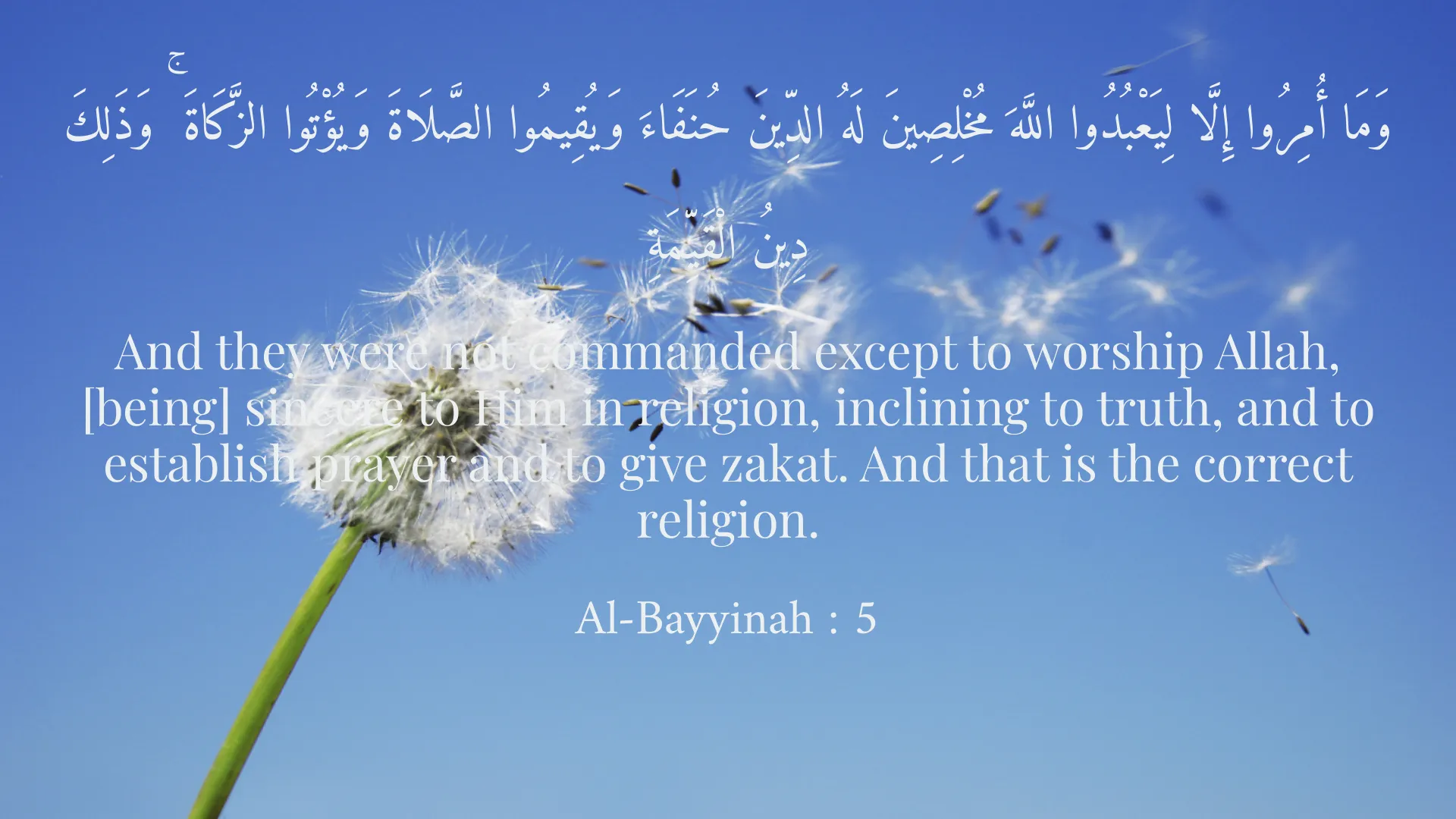
وَمَا أُمِرُوا إِلَّا لِيَعْبُدُوا اللَّهَ مُخْلِصِينَ لَهُ الدِّينَ حُنَفَاءَ وَيُقِيمُوا الصَّلَاةَ وَيُؤْتُوا الزَّكَاةَ ۚ وَذَلِكَ دِينُ الْقَيِّمَةِ
And they were not commanded except to worship Allah, [being] sincere to Him in religion, inclining to truth, and to establish prayer and to give zakat. And that is the correct religion.
Al-Bayyinah : 5
يَا أَيُّهَا الَّذِينَ آمَنُوا لَا تُبْطِلُوا صَدَقَاتِكُم بِالْمَنِّ وَالْأَذَىٰ كَالَّذِي يُنفِقُ مَالَهُ رِئَاءَ النَّاسِ وَلَا يُؤْمِنُ بِاللَّهِ وَالْيَوْمِ الْآخِرِ ۖ فَمَثَلُهُ كَمَثَلِ صَفْوَانٍ عَلَيْهِ تُرَابٌ فَأَصَابَهُ وَابِلٌ فَتَرَكَهُ صَلْدًا ۖ لَّا يَقْدِرُونَ عَلَىٰ شَيْءٍ مِّمَّا كَسَبُوا ۗ وَاللَّهُ لَا يَهْدِي الْقَوْمَ الْكَافِرِينَ
O you who have believed, do not invalidate your charities with reminders [of it] or [other] injury, like one who spends his wealth [only] to be seen by the people and does not believe in Allah and the Last Day. His example is like that of a smooth rock with [a layer of] dust on it; then a heavy rain strikes it, leaving it bare. They are unable [to keep] anything of what they earned. And Allah does not guide the disbelieving people.
Al-Baqarah : 264
مَن كَانَ يُرِيدُ الْحَيَاةَ الدُّنْيَا وَزِينَتَهَا نُوَفِّ إِلَيْهِمْ أَعْمَالَهُمْ فِيهَا وَهُمْ فِيهَا لَا يُبْخَسُونَ
Whoever desires the life of this world and its adornments - We fully repay them for their deeds therein, and they are not deprived of it.
Hud : 15
Short Story
There lived a wealthy merchant in a town, renowned for his grand feasts and abundant charity. He would always give alms publicly, ensuring everyone witnessed his generosity. One day, a hungry pauper arrived at his feast. The merchant, eager to impress his guests, theatrically presented him with a large, fresh loaf of bread. The pauper took the bread, thanked him profusely, and departed. A little further down the road, the pauper encountered a humble dervish, sitting quietly. The dervish possessed only a small, dry piece of bread. Upon seeing the pauper's fresh loaf, the dervish smiled kindly and remarked, "May your bread be blessed, for it originated from a hand that sought praise." Puzzled, the pauper inquired, "But surely, a gift is a gift?" The dervish replied, "My dear friend, in the eyes of God, the true value of an action lies not in its magnitude or its public display, but in the sincerity of the heart from which it springs. That merchant gave for the gaze of men, whereas a mere sip of water offered by a thirsty soul to another, with pure intention for God, holds more weight than all the feasts given for show. Remember Saadi's words: 'A little sincerity is better than much hypocrisy.'"