Quranic Answer
In the Holy Quran, the concept of kindness and goodness to others is not just a mere suggestion, but a fundamental principle that resonates throughout its teachings. From the very beginning, believers are encouraged to embody compassion and to extend their hands in helping those in need without anticipation of any rewards or acknowledgments. One of the most poignant illustrations of this directive can be found in Surah Al-Insan, verses 8 to 9, where it is beautifully articulated: "And they give food, despite their desire for it, to the needy, the orphan, and the captive. [Saying], 'We feed you only for the sake of Allah. We wish not from you reward or gratitude.'" This passage serves as a profound reminder that the essence of charitable acts is rooted in our intentions and our devotion to Allah’s pleasure. The Quran emphasizes that acts of kindness should stem from a place of selflessness and that our primary motivation should be to honor our Creator by fulfilling our religious and moral obligations to one another. In this light, engaging in good deeds transcends the ordinary; it morphs into an act of worship, a means of enhancing one's faith, and a path that draws us closer to God. The Quran points out that being kind and generous is not only a way to please Allah but also a way to cultivate a harmonious society. Despite the natural inclination of human beings to seek validation and appreciation, Allah calls upon us to rise above these desires and to act purely for His sake. Furthermore, in Surah Al-Imran, verse 92, Allah makes a profound statement regarding righteousness: "You will never attain righteousness until you spend from that which you love." This verse underscores the significance of genuine intentions in our acts of kindness and generosity, urging believers to contribute from their personal resources, such as time, money, and love, without the hope of receiving anything in return. It is through these selfless acts that one can truly achieve a deeper sense of piety and moral integrity. Islamic teachings continually remind us that kindness administered with selfless intentions not only fosters love and friendship within a community but also lays the groundwork for tranquility and inner peace. When individuals approach their fellow humans with compassion and empathy, they create an environment where mutual respect and understanding can flourish. In essence, the act of giving, whether it be material goods, emotional support, or spiritual guidance, becomes a building block for a stronger, more cohesive society. The implications of these teaching extend beyond the individual, as kindness begets kindness. When one person acts benevolently, it often inspires others to do the same, creating a ripple effect of goodwill. This cycle reinforces the Quranic teaching that when we engage in acts of love and support for one another, we reflect the beautiful traits of Allah, who is often described in the Quran as "The Most Kind" and "The Most Merciful." The more we embrace and practice kindness, the more we emulate these admirable attributes. Moreover, the community-oriented aspect of kindness brings forth an even deeper understanding of human relationships. In a world often marred by conflict, division, and competition, the Quran proposes a model in which kindness acts as a unifying force. By engaging with others through a lens of empathy and support, barriers imposed by societal divisions — be it wealth, status, or ethnicity — can begin to diminish. We are reminded that every individual, regardless of their circumstances, is deserving of compassion. This inclusive perspective fosters a sense of belonging and mutual responsibility. The Quran also warns against the dangers of selfishness and the heavy toll it poses not only on individuals but also on the broader community. Living in a state of self-centeredness can lead to isolation and a disconnect from the collective spirit that binds humanity. Therefore, the teachings of the Quran encourage believers to cultivate a spirit of collective concern for one another, urging them to look beyond their own needs and to consider the well-being of those around them. In today's world, the significance of kindness cannot be overstated. As we navigate the complexities of modern life, the timeless wisdom imparted in the Quran becomes ever more pertinent. Acts of kindness can bridge divides created by social media, enhance relationships, and create environments where individuals feel safe and supported. In essence, kindness is a strength — a powerful tool that facilitates healing and reconstruction in times of distress. As members of a global community, we are called not only to reflect on the teachings of the Quran but to embody them fully in our interactions with others. Lastly, it is essential to understand that the cultivation of kindness is a continuous journey, one that requires conscious effort and dedication. As believers, acknowledging our shortcomings is the first step towards improvement. By integrating kindness into our daily lives, we didactically engrain it within our hearts, thus paving the way for a world that thrives on love, understanding, and respect for one another. A world empowered by the values taught in the Quran can indeed nurture a brighter future for generations to come and create a legacy of kindness that resonates through time, rooted firmly in the love of Allah. In conclusion, the emphasis placed on kindness in the Holy Quran is a multifaceted aspect of Islamic teachings that extends well beyond mere social etiquette. It encompasses a profound spiritual journey geared toward the betterment of both individual souls and collective communities. By committing ourselves to practices of kindness done for the sake of Allah, we embrace a path that not only transforms our hearts but also shapes the world around us into a beacon of hope, compassion, and peace.
Related Verses
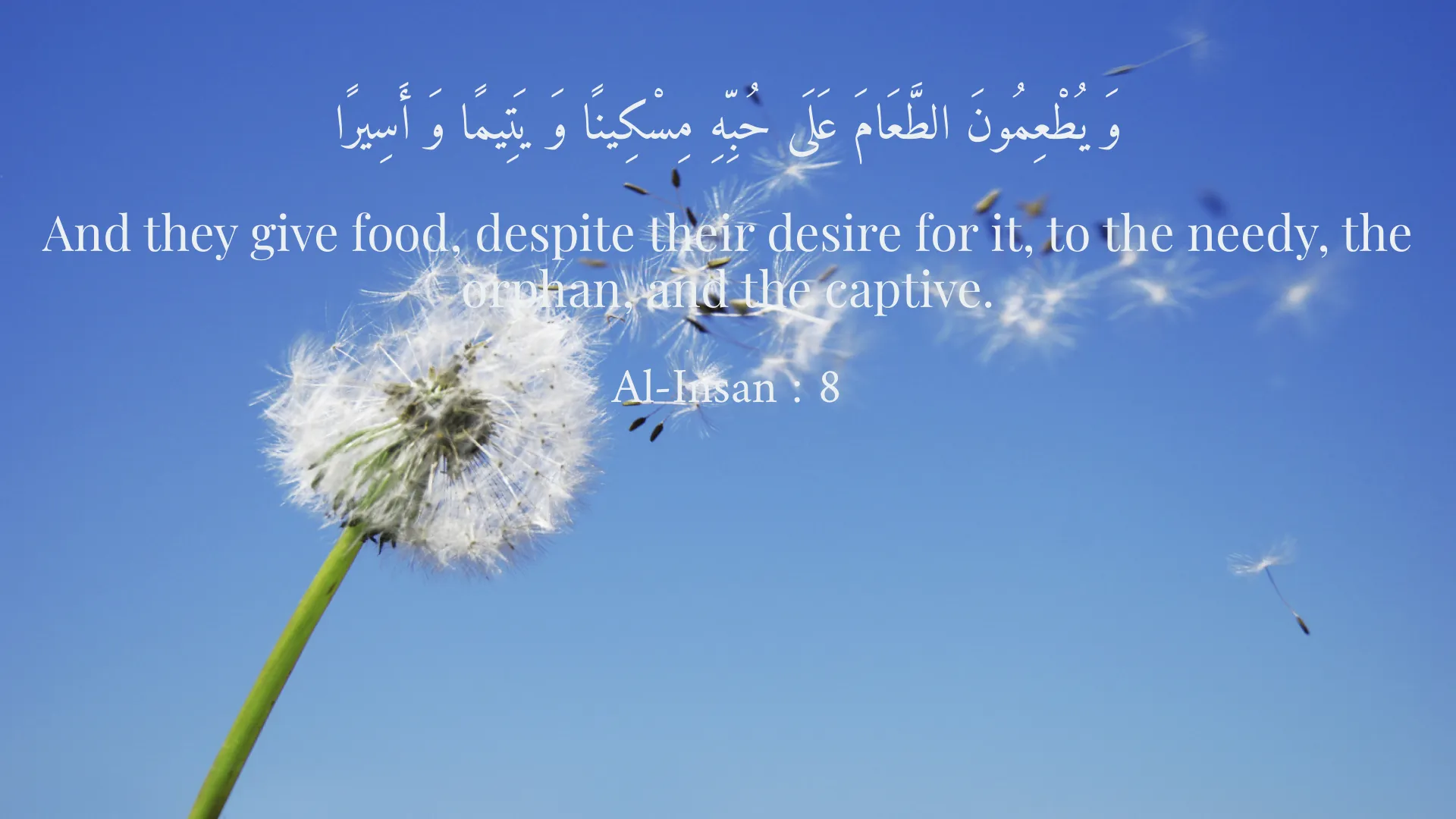
وَ يُطْعِمُونَ الطَّعَامَ عَلَى حُبِّهِ مِسْكِينًا وَ يَتِيمًا وَ أَسِيرًا
And they give food, despite their desire for it, to the needy, the orphan, and the captive.
Al-Insan : 8
إِنَّمَا نُطْعِمُكُمْ لِوَجْهِ اللَّهِ لَا نُرِيدُ مِنكُمْ جَزَاءً وَلَا شُكُورًا
We feed you only for the sake of Allah. We wish not from you reward or gratitude.
Al-Insan : 9
لن تنالوا البرّ حتى تنفقوا مما تحبون
You will never attain righteousness until you spend from that which you love.
Al-Imran : 92
Short Story
Once upon a time, in a not-so-distant world, there was a man named Hasan living in his busy life. One day, he decided to help someone in need without expecting anything in return. He prepared food and gave it to that person, and he felt an incredible sense of peace in his heart. From that day on, Hasan realized that the joy of helping others was a reward in itself.