Quranic Answer
In the contemporary world, the concept of modesty and moral integrity is often overshadowed by the rampant liberalization of societal norms. Despite the evolving attitudes towards relationships and interactions between genders, the teachings contained within the Holy Quran continue to offer profound insight into the importance of maintaining one's gaze, especially in relation to non-mahrams. The Quran not only highlights the physical act of looking but also emphasizes the spiritual implications that accompany our gaze. This essay will elaborate on the significance of lowering one's gaze as prescribed in the Quran, its impact on the individual’s soul, and the relevance of these teachings in today's society. The Quran, which serves as the ultimate guide for Muslims, provides explicit instructions that form the foundation of an Islamic lifestyle. In Surah An-Nur, verse 30, Allah commands the believers to 'Tell the believing men to reduce [some] of their vision and guard their private parts.' This commandment is rooted in the understanding that the power of the gaze can influence one's thoughts and actions. The act of looking provocatively at non-mahrams can trigger a variety of emotional responses, including desire, lust, and even jealousy. By lowering their gaze, individuals not only obey a divine injunction but also take proactive steps to protect their spiritual wellbeing. The relationship between the gaze and sin is intricately connected; the Quran emphasizes that even the initial glance may lead down a path of temptation. Furthermore, the instruction is not monolithic as it extends to women as well. In verse 31 of the same Surah, women are also commanded to lower their gaze and guard their modesty. This tells us that the principle of modesty is crucial for both genders, reinforcing the idea that it is a shared responsibility. By promoting mutual respect and dignity, these teachings aim to cultivate an environment where spiritual integrity is upheld. When both men and women practice modesty in their interactions, there is a reduction in societal temptations, making it easier for individuals to maintain their chastity and moral purity. In the context of contemporary society, one might argue that the Quran's teachings on gaze are outdated or too stringent. However, it is essential to view these instructions not as restrictive but rather as protective measures for the soul. The incessant exposure to images and social media that objectify individuals can lead to a distorted sense of relationships and attraction. The message conveyed through the Holy Quran is, therefore, not merely about refraining from the act of looking but about fostering a community that treasures spiritual beauty above physical appearances. The relentless pursuit of aesthetics often results in discontent and a lack of fulfillment, as these interactions are devoid of substance. In contrast, a pure gaze that seeks spiritual beauty nurtures the soul and fosters a connection with Allah, which is paramount for personal growth and fulfillment. Moreover, the teachings on lowering the gaze play a critical role in preventing the onset of negative emotions such as anger and lust. In a society where these emotions can easily spiral out of control, the wisdom found within the Holy Quran provides a remedy. Research has shown that unchecked desires can lead to destructive behavior, not only harming oneself but also affecting the broader community. The Quran's guidance helps individuals cultivate self-discipline and control, which are fundamental in achieving a peaceful and stable life. By consciously making an effort to lower one’s gaze, individuals can develop a deeper sense of humility and self-awareness, which are essential virtues in Islam. Additionally, it is important to recognize the social implications of adhering to these teachings. A society that collectively embraces the principles of modesty and respect can significantly mitigate issues such as harassment and objectification. By lowering their gazes, individuals contribute to the establishment of a culture that respects personal boundaries, encourages dignity, and honors the essence of human connection. It is a step towards creating a society that values moral integrity over superficiality, thereby enriching the lives of its members However, maintaining purity and chastity in a world filled with distractions is a challenge. It requires commitment, awareness, and a continuous effort to align one’s actions with spiritual values. Muslims are encouraged to engage in regular prayer and reflection as a means of cultivating mindfulness regarding their actions. The importance of surrounding oneself with supportive individuals who share similar values cannot be overstated. Supportive friendships can bolster commitment to maintaining spiritual purity and foster an environment where the teachings of the Quran can thrive. In conclusion, the directive from the Holy Quran regarding the gaze at non-mahrams is steeped in wisdom and foresight. These teachings are not simply restrictions; rather, they serve as guiding principles that promote spiritual health, moral integrity, and collective respect within society. By lowering their gazes and refraining from inappropriate looks, individuals fortify their relationship with Allah and lay the foundation for a fulfilling and peaceful life. It is through the embrace of these values that Muslims can not only strengthen their faith but also contribute positively to the moral fabric of society. Ultimately, the teachings of the Quran offer timeless guidance that is as relevant today as it was over fourteen centuries ago.
Related Verses
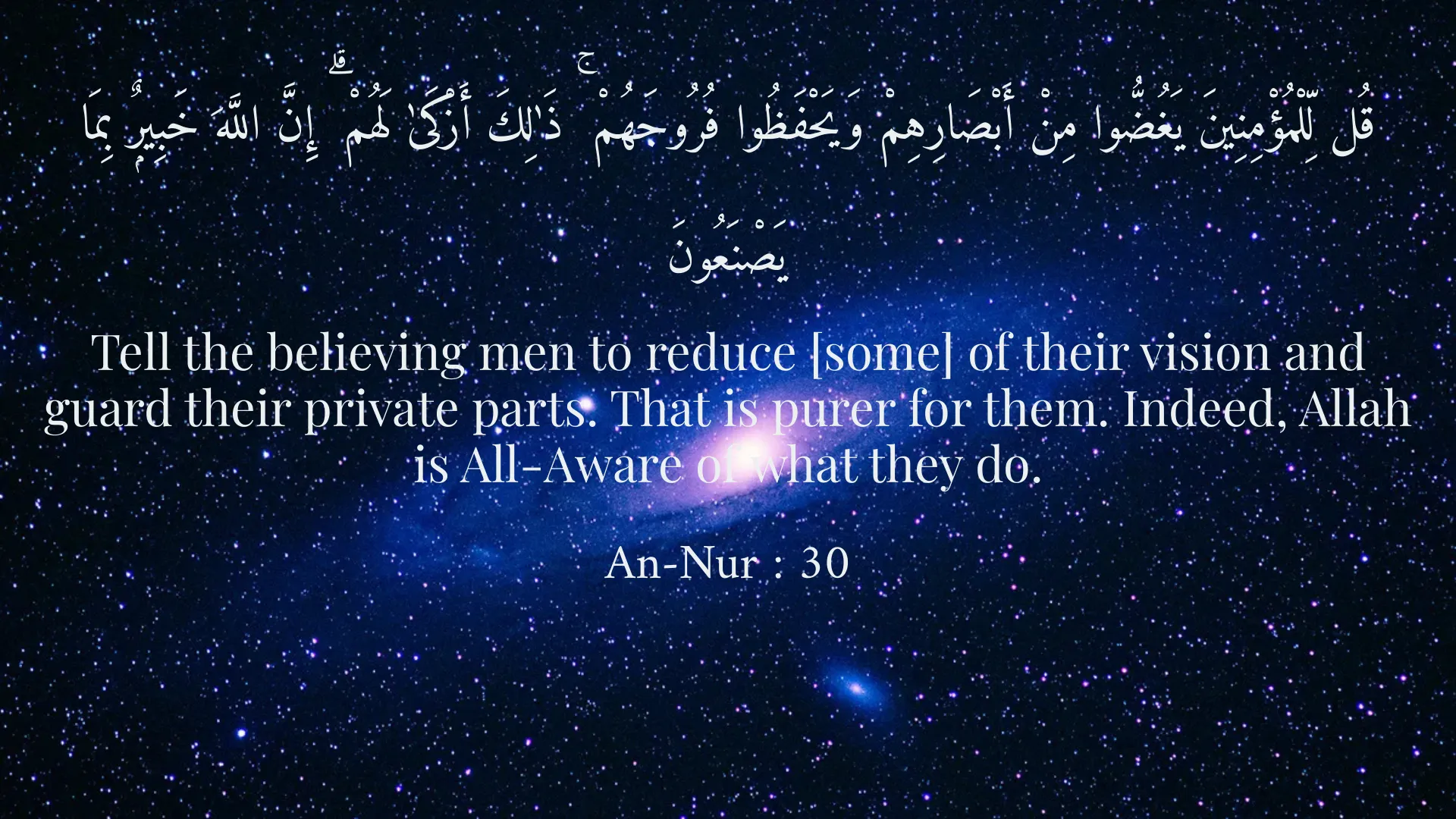
قُل لِّلْمُؤْمِنِينَ يَغُضُّوا مِنْ أَبْصَارِهِمْ وَيَحْفَظُوا فُرُوجَهُمْ ۚ ذَٰلِكَ أَزْكَىٰ لَهُمْ ۗ إِنَّ اللَّهَ خَبِيرٌۭ بِمَا يَصْنَعُونَ
Tell the believing men to reduce [some] of their vision and guard their private parts. That is purer for them. Indeed, Allah is All-Aware of what they do.
An-Nur : 30
وَقُل لِّلنِّسَاءِ يَغْضُضْنَ مِنْ أَبْصَارِهِنَّ وَيَحْفَظْنَ فُرُوجَهُنَّ وَلَا يُبْدِينَ زِينَتَهُنَّ إِلَّا مَا ظَهَرَ مِنْهَا ۖ وَلْيَضْرِبْنَ بِخُمُرِهِنَّ عَلَى جُيُوبِهِنَّ ۖ وَلَا يُبْدِينَ زِينَتَهُنَّ إِلَّا لِبُعُولَتِهِنَّ أَوْ آبَائِهِنَّ أَوْ أَبْنَائِهِنَّ ...
And tell the believing women to lower [some] of their vision and guard their private parts and not expose their adornment except that which [ordinarily] appears thereof.
An-Nur : 31
Short Story
One day, a man was strolling in a garden, admiring the colors and scents of the flowers. He knew that gazing at the beauty of non-mahrams could take him away from Allah. Therefore, he decided to only look at the flowers and the beauty of nature, distancing himself from any spiritual harm. He felt that this action not only brought peace to his soul but also drew him closer to God.