Quranic Answer
While the exact terminology of “personal boundaries” or “emotional boundaries” in their modern sociological sense may not appear verbatim in the Holy Quran, the divine scripture articulates profound and comprehensive principles that unequivocally emphasize the necessity of respecting individuals’ privacy, human dignity, and their emotional and psychological well-being. These teachings provide a robust ethical and behavioral framework that forms the bedrock of healthy and respectful relationships within the Islamic society, thereby implicitly endorsing and supporting the concept of personal and emotional boundaries. One of the most prominent examples of this respect pertains to an individual’s physical and private space. The Quran, in several verses, stresses the importance of seeking permission before entering homes. In Surah An-Noor, verses 27 and 28, Allah states: "O you who have believed, do not enter houses other than your own houses until you have asked permission and greeted their occupants. That is better for you, that you may be reminded. And if you find no one therein, then do not enter them until permission has been given you. And if it is said to you, 'Go back,' then go back; it is purer for you. And Allah is knowing of what you do." These verses not only underscore the sanctity of the home as a private space but also implicitly remind us to respect the will and choice of the homeowners. Not intruding upon others' private space without permission is a sign of etiquette and respect, preventing any encroachment on the space a person considers reserved for themselves. This is not merely a jurisprudential ruling but an ethical principle that ensures the psychological peace and security of individuals. Furthermore, the Holy Quran places significant emphasis on the importance of good speech and refraining from words that might cause distress or emotional harm. In Surah Al-Isra, verse 53, it is stated: "And tell My servants to say that which is best. Indeed, Satan induces [dissension] among them. Indeed Satan is ever, to man, a clear enemy." This verse clearly indicates that the quality of speech and avoiding harsh, offensive, or demeaning language are of paramount importance for maintaining healthy relationships and preventing animosity. Speaking kindly entails respecting the feelings of the other party and preventing any verbal transgression against their emotional boundaries. Additionally, in Surah Al-Baqarah, verse 83, Allah commands us to speak kindly to people. This command is a pervasive principle for all human interactions, signifying that words can profoundly affect individuals' spirits and minds; therefore, adherence to etiquette and good manners in speech is essential for respecting emotional boundaries. Moreover, the Quran explicitly prohibits certain social behaviors that harm individuals' privacy and emotional well-being. In Surah Al-Hujurat, verses 11 and 12, it says: "O you who have believed, let not a people ridicule [another] people; perhaps they may be better than them; nor let women ridicule [other] women; perhaps they may be better than them. And do not insult one another and do not call each other by [offensive] nicknames. Wretched is the name of disobedience after [one's] faith. And whoever does not repent — then it is those who are the wrongdoers. O you who have believed, avoid much [negative] assumption. Indeed, some assumption is sin. And do not spy [on one another] or backbite each another. Would one of you like to eat the flesh of his brother when dead? You would detest it. And fear Allah; indeed, Allah is Accepting of repentance and Merciful." These verses directly address issues such as ridicule, finding fault, using offensive nicknames, suspicion, spying, and backbiting, all of which are clear instances of violating individuals' emotional and private boundaries. Ridicule and offensive nicknames undermine human dignity and harm an individual’s feelings. Spying and suspicion violate individuals' intellectual and practical privacy, and backbiting harms their reputation in their absence, creating an atmosphere of distrust. These explicit prohibitions demonstrate how much Islam values the preservation of individuals' honor and respect, both in their presence and absence. Furthermore, in Surah Al-Baqarah, verse 256, it states: "There shall be no compulsion in [acceptance of] the religion. The right course has become clear from the error." While this verse specifically addresses religious belief, it also encompasses a broader principle that points to respecting individual choice and not imposing beliefs or lifestyles on others. This principle forms a basis for respecting intellectual independence and individual boundaries in life decisions (within the framework of Sharia, of course). Indeed, the Quran teaches Muslims that every individual is responsible for their actions and should be guided towards the right path in an atmosphere of freedom and choice, not through coercion or compulsion. In conclusion, the Holy Quran, by establishing laws and ethical teachings concerning speech, conduct, and social interactions, comprehensively contributes to the preservation of individuals' personal and emotional boundaries. These teachings not only prevent physical and material harm but also emphasize the psychological and emotional well-being of society. Adherence to these principles leads to the creation of a society built on trust, mutual respect, tranquility, and human dignity, where every individual can live peacefully alongside others while maintaining their personal space. Therefore, the concept of respecting personal and emotional boundaries is considered a fundamental pillar of Quranic ethics, rooted in the monotheistic worldview and the inherent dignity of humanity from an Islamic perspective. These divine instructions teach Muslims to consider the impact of their actions on others before proceeding and to refrain from anything that causes emotional or physical distress. These directives are revealed with the aim of building a just, compassionate, and stable society. Respecting others' boundaries is not only a sign of piety and righteousness but also strengthens social and familial bonds. A society whose members respect each other's privacy experiences fewer conflicts and disagreements, and individuals feel more secure and peaceful within it. The Quran, by emphasizing concepts such as 'good assumption,' 'avoiding backbiting,' 'not spying,' and 'not ridiculing,' specifically addresses the emotional and psychological aspects of boundaries, providing practical guidance for maintaining the mental well-being of individuals and relationships. Ultimately, these teachings help people interact with each other with compassion, understanding, and mutual respect, refraining from any infringement on the rights and feelings of others, as this respect is an embodiment of servitude to God and adherence to divine ethical values.
Related Verses
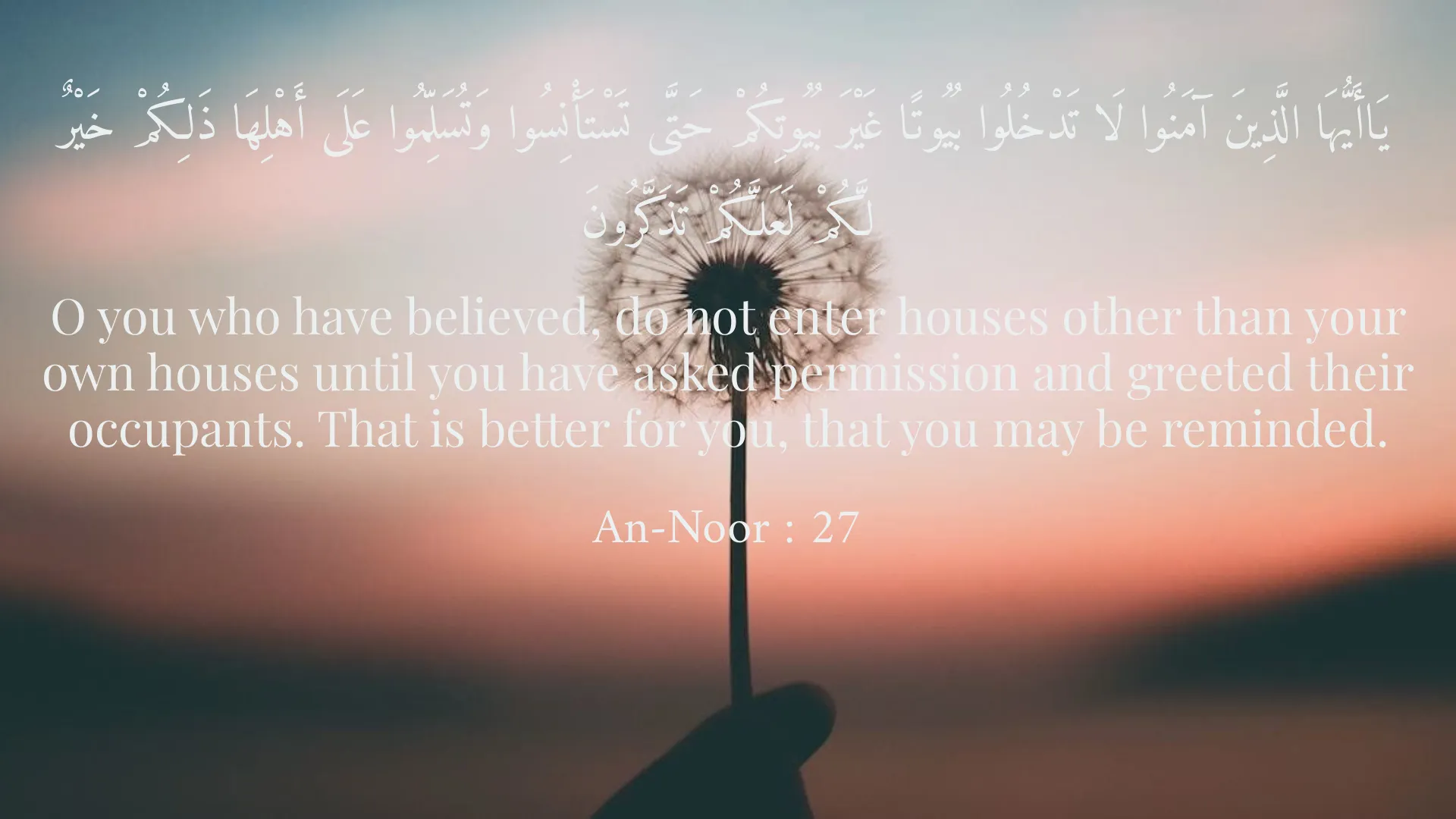
يَاأَيُّهَا الَّذِينَ آمَنُوا لَا تَدْخُلُوا بُيُوتًا غَيْرَ بُيُوتِكُمْ حَتَّى تَسْتَأْنِسُوا وَتُسَلِّمُوا عَلَى أَهْلِهَا ذَلِكُمْ خَيْرٌ لَّكُمْ لَعَلَّكُمْ تَذَكَّرُونَ
O you who have believed, do not enter houses other than your own houses until you have asked permission and greeted their occupants. That is better for you, that you may be reminded.
An-Noor : 27
يَا أَيُّهَا الَّذِينَ آمَنُوا اجْتَنِبُوا كَثِيرًا مِّنَ الظَّنِّ إِنَّ بَعْضَ الظَّنِّ إِثْمٌ وَلَا تَجَسَّسُوا وَلَا يَغْتَب بَّعْضُكُم بَعْضًا أَيُحِبُّ أَحَدُكُمْ أَن يَأْكُلَ لَحْمَ أَخِيهِ مَيْتًا فَكَرِهْتُمُوهُ وَاتَّقُوا اللَّهَ إِنَّ اللَّهَ تَوَّابٌ رَّحِيمٌ
O you who have believed, avoid much [negative] assumption. Indeed, some assumption is sin. And do not spy [on one another] or backbite each another. Would one of you like to eat the flesh of his brother when dead? You would detest it. And fear Allah; indeed, Allah is Accepting of repentance and Merciful.
Al-Hujurat : 12
وَقُل لِّعِبَادِي يَقُولُوا الَّتِي هِيَ أَحْسَنُ إِنَّ الشَّيْطَانَ يَنزَغُ بَيْنَهُمْ إِنَّ الشَّيْطَانَ كَانَ لِلْإِنسَانِ عَدُوًّا مُّبِينًا
And tell My servants to say that which is best. Indeed, Satan induces [dissension] among them. Indeed Satan is ever, to man, a clear enemy.
Al-Isra : 53
Short Story
In Saadi's Golestan, it is recounted that a king had a wise vizier who always spoke truthfully. One day, an envious courtier told the king that the vizier was speaking ill of him, saying things unworthy of a king. The king, enraged, summoned the vizier. But the vizier calmly said: "O King, if someone trespasses upon another's private sphere, overhears words not meant for them, and then repeats them, know that it is they who have trampled upon justice. I have spoken nothing but for your welfare." The king realized that the envious courtier had intruded upon his vizier's private space without permission, heard words not intended for him, and misrepresented them. The king understood that respecting people's boundaries, even in speech, is crucial because it instills peace and trust in hearts, and whoever disregards these boundaries is himself an agent of ruin.