Quranic Answer
The Holy Quran, as the central religious text of Islam, provides comprehensive guidance for personal conduct, social interactions, and moral behavior. Among the numerous topics it addresses, the themes of chastity and modesty stand out as critical virtues for believers. In a world where the boundaries of moral and ethical behavior can often become blurred, the Quran offers clear directives designed to uphold dignity, respect, and integrity within individual lives and the broader community. This article will explore the Quranic teachings regarding chastity and modesty, emphasizing their significance in fostering both personal integrity and strong societal bonds. Chastity and modesty are deeply rooted in the Islamic faith, and the Quran emphasizes the necessity for believers to pursue these virtues in their daily lives. One of the most notable references can be found in Surah An-Nur (Chapter of Light). In verse 30, Allah instructs the believing men with a clear directive: "Tell the believing men to reduce [some] of their vision and guard their private parts. That is purer for them." This instruction places a strong emphasis on the act of lowering one's gaze; it serves as both a practical measure and a spiritual exercise intended to protect one's purity. The notion of lowering one's gaze is more than a simple admonition against lustful looks; it reflects a broader awareness of the impact that visual stimuli can have on thoughts and actions. The Quran recognizes that the human eye can lead to temptation, which is why believers are urged to exercise restraint and to maintain their dignity by focusing on higher objectives rather than succumbing to fleeting desires. In many ways, this verse encapsulates the broader principles of self-control and discipline that are essential not only in spiritual life but also in establishing a harmonious society. Following this, the Quran provides guidance specifically for women in verse 31 of Surah An-Nur, where it encourages believing women to draw their cloaks over themselves and not to reveal their adornment except what is apparent. This verse holds profound implications for gender relations and societal norms within the Muslim community. By urging women to dress modestly, the Quran promotes a culture of respect, where individuals are valued for their character and contributions rather than their physical appearances. Essentially, modesty becomes a form of protection, shielding individuals from objectification and perpetuating a sense of dignity in interactions. The implications of such teachings extend beyond personal piety; they contribute to the broader fabric of social interaction. When individuals, both men and women, adhere to the values of chastity and modesty, they cultivate an environment that encourages respect, trust, and mutual honor. In this sense, the Quran positions modesty not only as a personal attribute but as a cornerstone for healthy familial and communal relationships. Moreover, in Surah Al-Mu'minun, verses 5 to 7, the Quran reinforces the importance of guarding one's private parts, stating, "And they who are to their trust and their covenant due. And they who carefully maintain their prayer. Those are the inheritors. Who will inherit al-Firdaus; they will abide therein eternally." Here, the connection between chastity and fulfilling one’s obligations serves to solidify the argument that being modest and chaste is intertwined with being a responsible and trustworthy member of the community. The verse illustrates that true believers, characterized by their chastity, develop the foundation for trust and commitment that enhances social harmony. Chastity and modesty are thus portrayed in the Quran as integral elements of not only personal moral conduct but also as essential social virtues. The emphasis on these characteristics underlines a comprehensive view of morality that encompasses not only an individual's personal life but also their interactions within their families, communities, and the larger society. By adhering to these principles, individuals contribute to a more respectful and ethically grounded society that prioritizes human dignity above fleeting physical attraction. Additionally, it is essential to acknowledge the psychological and emotional benefits associated with practicing chastity and modesty. Those who embody these values often experience greater self-esteem, inner peace, and security. By distancing themselves from the temptations of the world, they can cultivate a more profound relationship with their faith and develop a clearer sense of purpose. In conclusion, the teachings of the Quran on chastity and modesty resonate powerfully in today's context, where moral values are often challenged. By following the guidance provided in the Quran, believers can protect themselves from the moral pitfalls that may threaten their purity and dignity. This adherence not only enriches their spiritual life but also serves as a positive influence on those within their community. The consistent encouragement towards modesty and chastity reveals a profound understanding of human behavior, societal norms, and the divine intention for a respectful, dignified, and ethical life. As such, these teachings remain eternally relevant, transcending time and societal changes and providing a clear roadmap for individuals striving for piety, integrity, and harmony in their lives.
Related Verses
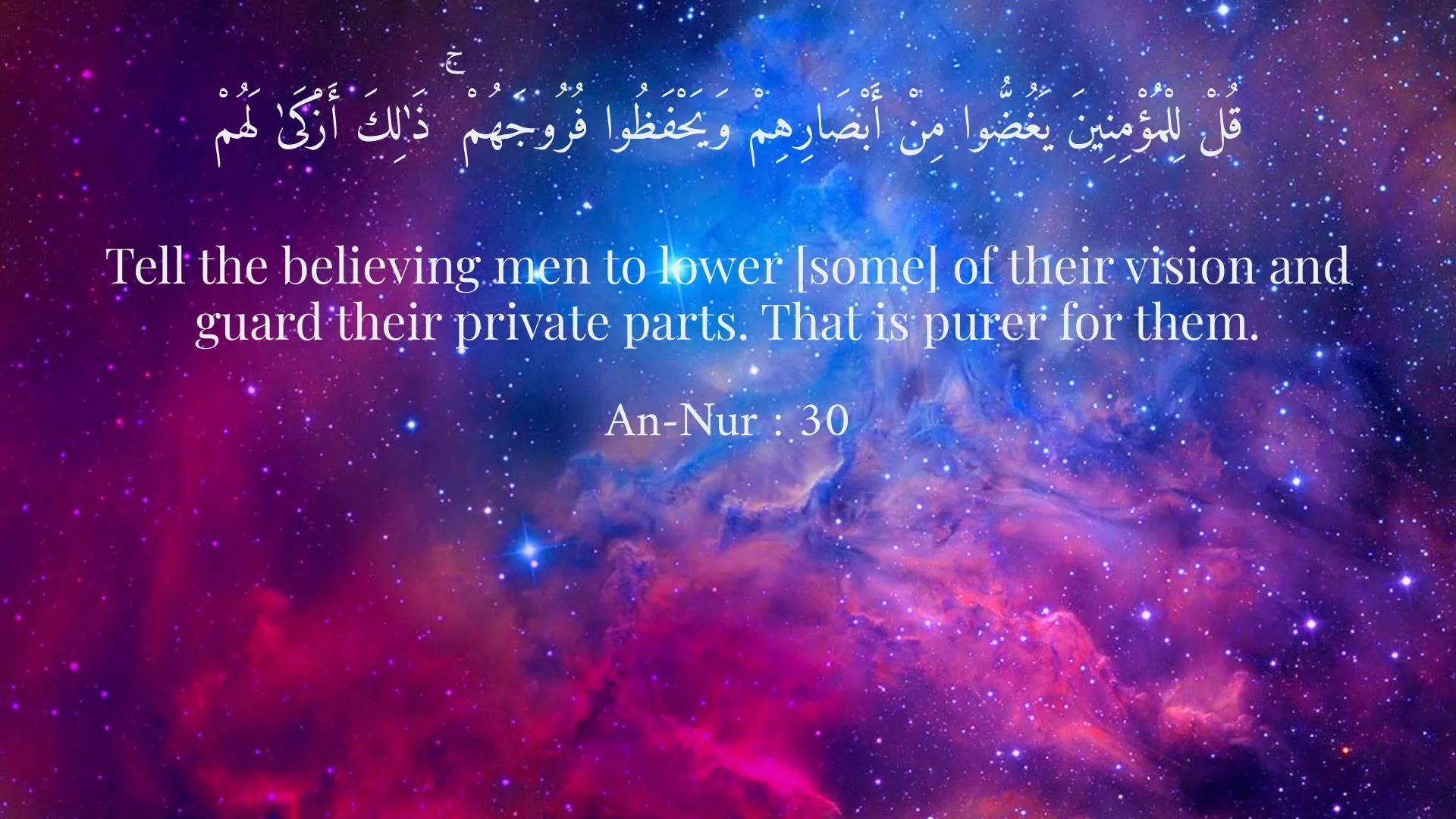
قُلْ لِلْمُؤْمِنِينَ يَغُضُّوا مِنْ أَبْصَارِهِمْ وَيَحْفَظُوا فُرُوجَهُمْ ۚ ذَٰلِكَ أَزْكَىٰ لَهُمْ
Tell the believing men to lower [some] of their vision and guard their private parts. That is purer for them.
An-Nur : 30
وَقُل لِلْمُؤْمِنَاتِ يَغْضُضْنَ مِنْ أَبْصَارِهِنَّ وَيَحْفَظْنَ فُرُوجَهُنَّ وَلَا يُبْدِينَ زِينَتَهُنَّ إِلَّا مَا ظَهَرَ مِنْهَا
And tell the believing women to lower [some] of their vision and guard their private parts and not expose their adornment except that which [ordinarily] appears thereof.
An-Nur : 31
وَالَّذِينَ هُمْ لِفُرُوجِهِمْ حَافِظُونَ
And they who carefully guard their private parts.
Al-Mu’minun : 5
Short Story
Once upon a time, in a faraway land, there lived a young man named Adel. Adel was aware of the Quranic verses and often pondered about chastity and modesty. He decided to lead a better life by controlling his gaze and maintaining his chastity. After a while, Adel noticed that his soul felt more at peace and his heart was lighter. He connected with his honesty and continued his journey, encouraging others to uphold modesty as well.