Quranic Answer
The Holy Quran, as a divine guide, presents a timeless set of principles and values for human life across all ages. Although the concepts of 'internet' or 'publishing content online' did not exist at the time of its revelation, its luminous verses clearly emphasize the necessity of deep thought, contemplation, and accountability in speech and action. These principles inherently extend to the digital realm and the dissemination of content within it. Indeed, Quranic teachings lay robust foundations for digital ethics, providing timeless guidance for responsible communication that is profoundly applicable in today's online world. One of the most fundamental Quranic principles directly related to the necessity of thinking before publishing content is the principle of 'tabayyun' (verification) and 'tahqeeq' (investigation). Allah states in Surah Al-Hujurat, verse 6: "O you who have believed, if there comes to you a disobedient one with information, investigate, lest you harm a people out of ignorance and become over what you have done regretful." This verse explicitly emphasizes the importance of scrutinizing and verifying the accuracy of news and information before accepting or spreading it. In the age of the internet, where information spreads at an astonishing speed and distinguishing truth from falsehood is challenging, this divine command gains double importance. Publishing false news or a rumor without verification can cause irreparable damage to individuals' reputations, social relationships, public trust, and even societal security. This verse teaches us that the responsibility for the content we publish rests with us, and its consequences will also be borne by us. Every post, every tweet, and every share in the online space can act as a 'piece of information' that, if published without investigation and thought, will lead to dire consequences. This responsibility includes checking sources, assessing the credibility of information, and avoiding becoming a tool for spreading ignorance and falsehood. Another principle emphasized in the Quran is human accountability for every word and action that emanates from them. Allah says in Surah Qaf, verse 18: "He does not utter a word except that with him is an observer prepared [to record it]." This verse clearly states that all our words and deeds are recorded and will be accounted for one day. In the digital space, where a single post or comment can influence thousands or millions of people and remain in digital memory forever, this Quranic warning should be a constant reminder for every user. Every word we type, every image we share, and every opinion we write, is effectively a 'word uttered' that the 'observer prepared' records. Thinking before publishing means understanding this heavy responsibility and weighing the worldly and otherworldly consequences of the content; from personal reputations to promoting correct or incorrect values. This contemplation must precede every 'click' and every 'share' to ensure that what we publish aligns with truth and public good. The Quran also strictly prohibits any form of gossip, backbiting, slander, and defamation. In Surah Al-Hujurat, verse 12, it states: "O you who have believed, avoid much [negative] assumption. Indeed, some assumption is sin. And do not spy or backbite each other. Would one of you like to eat the flesh of his brother when dead? You would detest it. And fear Allah; indeed, Allah is Accepting of repentance and Merciful." This verse not only prohibits backbiting but also forbids suspicion and spying. In the online sphere, the potential for misusing personal information, spreading baseless rumors, and character assassination is very high. Therefore, thinking before publishing includes reflecting on the intention and content of one's words, lest one inadvertently or deliberately commits sins like backbiting, slander, or defamation, which are considered major sins. The repercussions of these actions in the digital space are even wider and more permanent, as published content spreads rapidly and without geographical limits, and its removal is nearly impossible. Furthermore, the Quran instructs people to use good and pleasant speech and to speak nothing but the truth. In Surah Al-Baqarah, verse 83, it says: "...and speak to people good [words]..." This command not only refers to the tone and language of speech but also to its content. The content we publish must be constructive, beneficial, hopeful, and free from any ugliness or corruption. In the digital space, which is an ideal platform for spreading thoughts and ideas, this responsibility is magnified. Publishing constructive and positive content can contribute to the intellectual, cultural, and spiritual growth of society, while publishing negative, discouraging, or divisive content can harm mental well-being and social cohesion. This includes respecting diverse viewpoints, avoiding insults and degradation, and promoting healthy and constructive discourse. Moreover, the Quran warns us not to follow or promote anything of which we have no knowledge. In Surah Al-Isra, verse 36, it states: "And do not pursue that of which you have no knowledge. Indeed, the hearing, the sight and the heart – all of those will be questioned about that." This verse also emphasizes the importance of investigation and contemplation before accepting and disseminating information. In today's world, where fake news and misinformation spread like wildfire, not pursuing what we have no knowledge of means not publishing content whose veracity we are unsure of. This responsibility includes checking sources, assessing the credibility of information, and avoiding becoming a tool for spreading ignorance and falsehood. In summary, while the Quran does not directly refer to the internet, the ethical and behavioral principles related to speech and communication elucidated in its verses comprehensively and thoroughly affirm the necessity of deep reflection before publishing any content in the digital space. This reflection must include contemplation of the accuracy of the information, the intention behind publishing it, its potential consequences for individuals and society, and its compliance with moral and religious values. The Quran calls upon believers to use their tools of communication and speech responsibly, consciously, and with full insight, so that they may be successful in this world and dignified in the hereafter. This is precisely the kind of thought and deliberation that should precede every 'click' and every 'share', forming the key to building a healthy and ethical digital society.
Related Verses
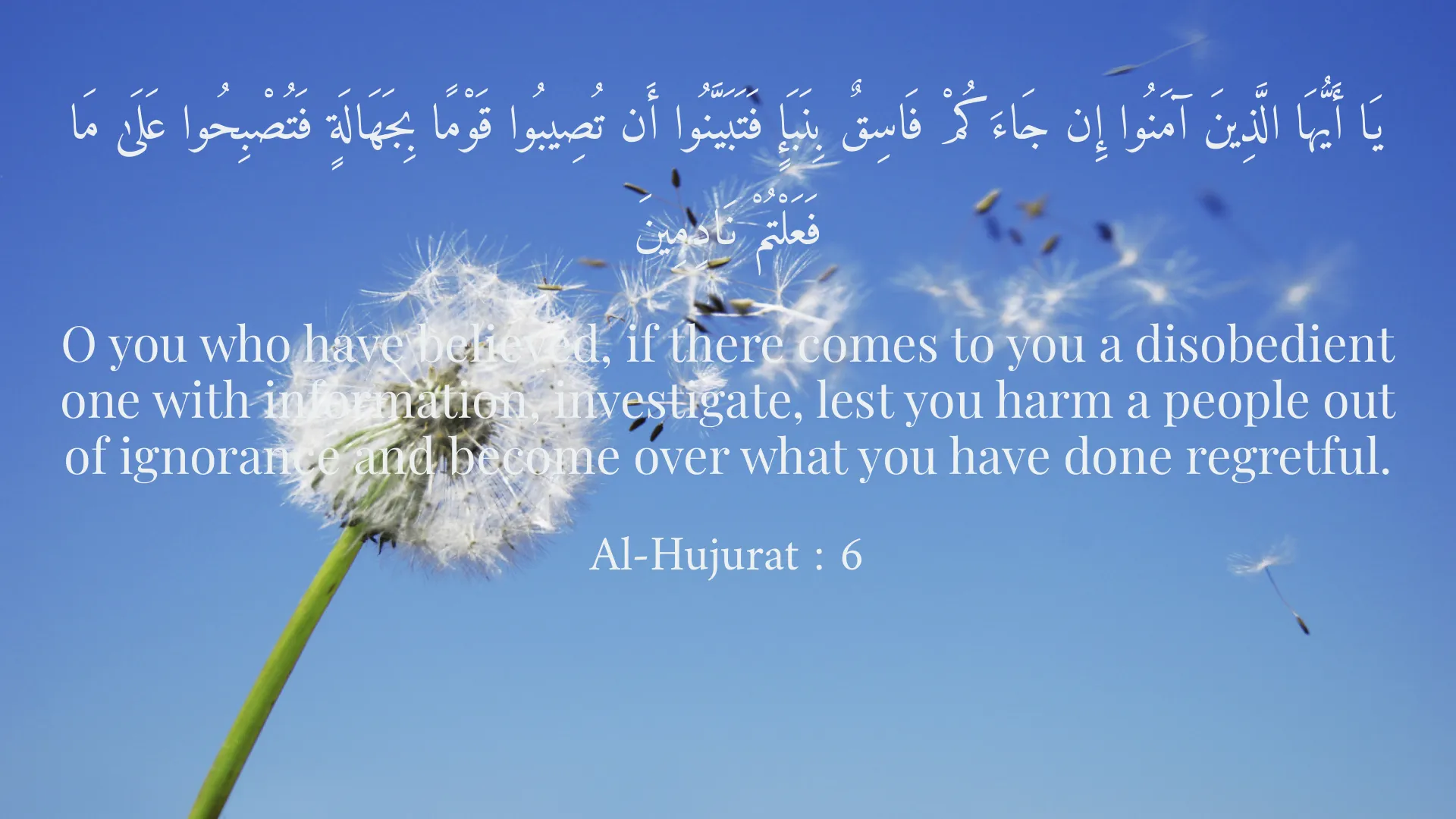
يَا أَيُّهَا الَّذِينَ آمَنُوا إِن جَاءَكُمْ فَاسِقٌ بِنَبَإٍ فَتَبَيَّنُوا أَن تُصِيبُوا قَوْمًا بِجَهَالَةٍ فَتُصْبِحُوا عَلَىٰ مَا فَعَلْتُمْ نَادِمِينَ
O you who have believed, if there comes to you a disobedient one with information, investigate, lest you harm a people out of ignorance and become over what you have done regretful.
Al-Hujurat : 6
مَا يَلْفِظُ مِن قَوْلٍ إِلَّا لَدَيْهِ رَقِيبٌ عَتِيدٌ
He does not utter a word except that with him is an observer prepared [to record it].
Qaf : 18
وَلَا تَقْفُ مَا لَيْسَ لَكَ بِهِ عِلْمٌ ۚ إِنَّ السَّمْعَ وَالْبَصَرَ وَالْفُؤَادَ كُلُّ أُولَٰئِكَ كَانَ عَنْهُ مَسْئُولًا
And do not pursue that of which you have no knowledge. Indeed, the hearing, the sight and the heart – all of those will be questioned about that.
Al-Isra : 36
يَا أَيُّهَا الَّذِينَ آمَنُوا اجْتَنِبُوا كَثِيرًا مِّنَ الظَّنِّ إِنَّ بَعْضَ الظَّنِّ إِثْمٌ ۖ وَلَا تَجَسَّسُوا وَلَا يَغْتَب بَّعْضُكُم بَعْضًا ۚ أَيُحِبُّ أَحَدُكُمْ أَن يَأْكُلَ لَحْمَ أَخِيهِ مَيْتًا فَكَرِهْتُمُوهُ ۚ وَاتَّقُوا اللَّهَ ۚ إِنَّ اللَّهَ تَوَّابٌ رَّحِيمٌ
O you who have believed, avoid much [negative] assumption. Indeed, some assumption is sin. And do not spy or backbite each other. Would one of you like to eat the flesh of his brother when dead? You would detest it. And fear Allah; indeed, Allah is Accepting of repentance and Merciful.
Al-Hujurat : 12
Short Story
One day, a man hastily uttered words which, upon reaching others, caused great discord. A wise elder advised him, saying: 'O son! A word is like an arrow; once released from the bow, its retrieval is impossible. Before you utter a word, weigh it in your heart: does it carry the scent of a rose or the prickle of a thorn? How many words are spoken in an instant, yet fuel the flames of discord for years and wound hearts.' The man took heed of this counsel, and thereafter, whenever he intended to speak or publish a message, he first weighed his words on the scales of wisdom and ethics, lest they cause regret and harm.