Quranic Answer
Let's approach this important question with warmth and precision. Although the term 'environment' as we understand it today is not explicitly mentioned in the Holy Quran, a deeper contemplation of its divine verses reveals that the Quran, through its fundamental principles and teachings, provides a robust framework for the preservation and protection of nature and the environment. These teachings are not merely ethical recommendations but are integral to the human purpose and duty towards the Creator and creation. In fact, the Quranic view of nature is not utilitarian or purely materialistic; rather, it regards nature as signs (Ayat) of God’s power, wisdom, and beauty, deserving of respect, care, and gratitude. One of the most central concepts in this regard is the concept of 'Khilafah' or vicegerency of humans on Earth. In Surah Al-Baqarah, verse 30, Allah states: "And [mention, O Muhammad], when your Lord said to the angels, 'Indeed, I will make upon the earth a successive authority…'" This verse clearly indicates that humans are appointed as God's vicegerents and representatives on Earth. This vicegerency does not imply absolute dominion and destruction, but rather responsibility, care, and development. Humans are responsible for maintaining the delicate balance of ecosystems, managing natural resources in a sustainable manner, and ensuring the health and survival of the environment for future generations. This responsibility is a great trust placed upon them, for which they will be held accountable. Therefore, any destructive act towards nature is not only an injustice to oneself and others but also a betrayal of this divine trust. Another principle repeatedly emphasized in the Quran is 'Mizan' or balance and proportion. Allah created the universe with 'Mizan' and precise order. In Surah Ar-Rahman, verses 7 to 9, it states: "And the heaven He raised and set the balance, that you may not transgress [in] the balance. And establish weight in justice and do not make the balance deficient." These verses not only emphasize justice in human relations but implicitly refer to the preservation of natural balance and the avoidance of any extremism or neglect that would disturb the order of creation. Deforestation, pollution of water and air, excessive hunting and fishing, and any unsustainable extraction of natural resources are all examples of 'transgressing the balance,' which the Quran strongly forbids. Humans must always be careful not to disrupt the natural balance of the world through their actions, as this balance is the foundation of life and tranquility. The Quran also strongly condemns 'Fasad' or corruption on Earth. In Surah Al-A'raf, verse 56, it is stated: "And cause not corruption upon the earth after its reformation." This verse is a serious warning. After Allah has prepared the Earth with a perfect order and an environment full of blessings for human life, any destructive act, creation of pollution, or disruption of the natural system falls under the category of 'Fasad fil-Ard' (corruption on Earth). This corruption includes the destruction of natural resources, pollution of water, soil, and air, and any action that harms the health of ecosystems. The Quran explicitly states that Allah does not love those who cause corruption. This indicates that Islam's view on the environment is not merely an ethical recommendation but a religious obligation, the neglect of which entails severe consequences, both in this world and the hereafter. 'Fasad' on Earth is considered one of the greatest sins, as it not only infringes upon the rights of the present generation but also jeopardizes the future of coming generations. Furthermore, the concept of 'Israf' or extravagance and waste is also forbidden in the Quran. In Surah Al-An'am, verse 141, and Surah Al-A'raf, verse 31, it states: "...and do not be extravagant. Indeed, He does not like those who commit extravagance." These verses emphasize optimal consumption and avoiding the wastage of resources. Whether in water consumption, energy use, or the exploitation of other natural resources, Muslims are obligated to avoid extravagance and excess. This principle forms the basis of sustainable resource management and responsible consumption. In today's world, facing challenges of water scarcity, energy crises, and excessive consumerism, this Quranic teaching becomes even more crucial. Finally, the Holy Quran introduces nature as 'Ayat' or signs of God's existence, greatness, and power. Observing mountains, seas, stars, rain, and plants all helps humans to realize the Creator's magnificence. This perspective creates a deep respect for nature. When humans see nature as a manifestation of divine attributes, they consider any harm or destruction of it not only an injustice to creation but also an offense to the Creator. Prophet Muhammad (peace be upon him) also advised in numerous hadiths on preserving trees, avoiding water and air pollution, and respecting animal rights. These teachings provide a comprehensive ethical and practical framework for environmental protection. Therefore, it can be concluded that the Holy Quran, with its key concepts of 'Khilafah' (human responsibility), 'Mizan' (maintaining balance), 'prohibition of Fasad' (avoiding destruction), and 'prohibition of Israf' (optimal consumption), offers a profound and practical philosophy for environmental protection. This framework requires the Muslim individual to be mindful of their surroundings in all aspects of life, not only to prevent its destruction but also to strive for its development and preservation. This duty is not merely for material benefits, but primarily for obeying divine command and expressing gratitude for His endless blessings. This perspective leads humanity towards a sustainable and harmonious life with nature, where human well-being is aligned with the health of ecosystems and not in conflict with it.
Related Verses
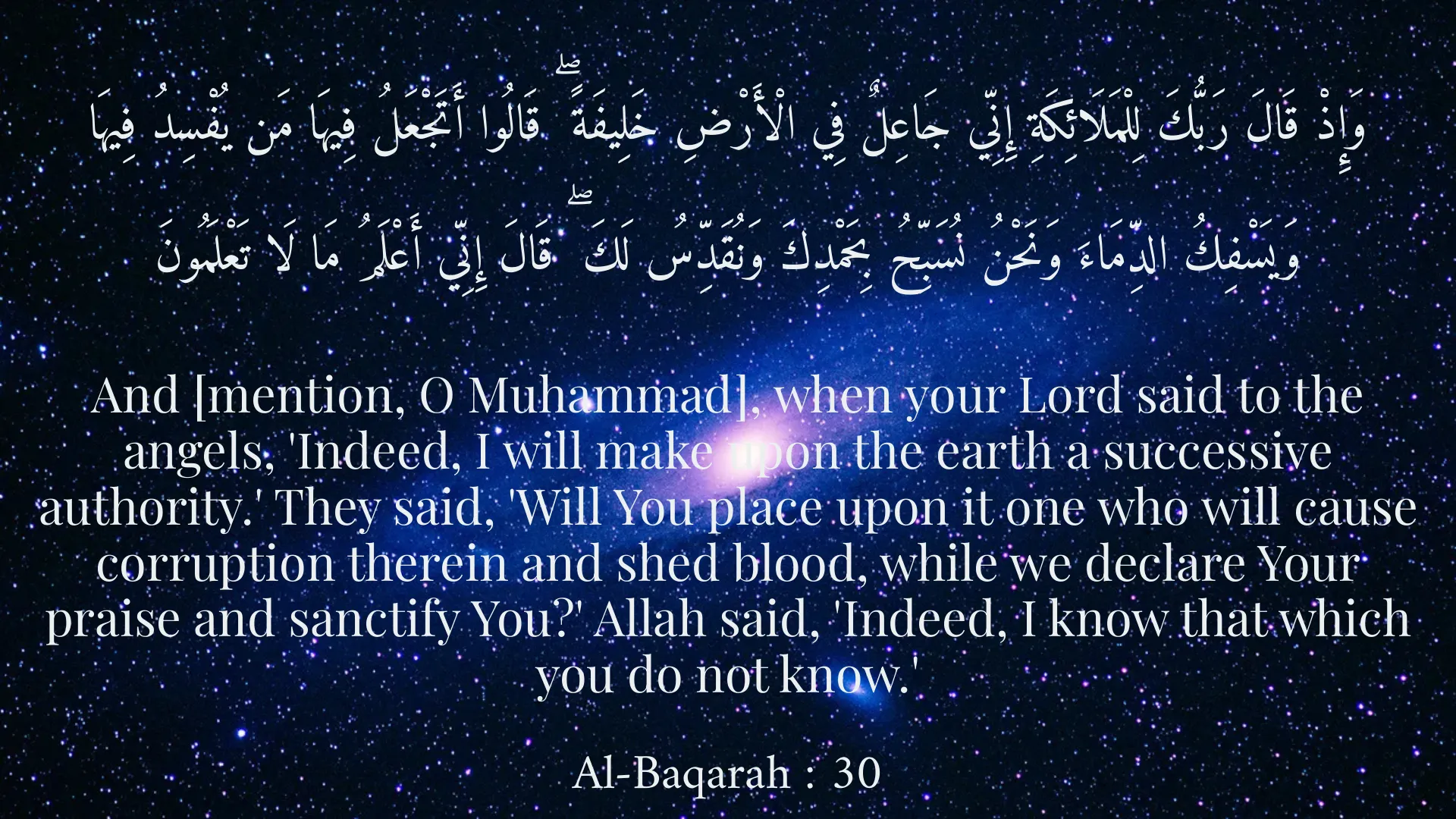
وَإِذْ قَالَ رَبُّكَ لِلْمَلَائِكَةِ إِنِّي جَاعِلٌ فِي الْأَرْضِ خَلِيفَةً ۖ قَالُوا أَتَجْعَلُ فِيهَا مَن يُفْسِدُ فِيهَا وَيَسْفِكُ الدِّمَاءَ وَنَحْنُ نُسَبِّحُ بِحَمْدِكَ وَنُقَدِّسُ لَكَ ۖ قَالَ إِنِّي أَعْلَمُ مَا لَا تَعْلَمُونَ
And [mention, O Muhammad], when your Lord said to the angels, 'Indeed, I will make upon the earth a successive authority.' They said, 'Will You place upon it one who will cause corruption therein and shed blood, while we declare Your praise and sanctify You?' Allah said, 'Indeed, I know that which you do not know.'
Al-Baqarah : 30
وَلَا تُفْسِدُوا فِي الْأَرْضِ بَعْدَ إِصْلَاحِهَا وَادْعُوهُ خَوْفًا وَطَمَعًا ۚ إِنَّ رَحْمَتَ اللَّهِ قَرِيبٌ مِّنَ الْمُحْسِنِينَ
And cause not corruption upon the earth after its reformation. And invoke Him in fear and aspiration. Indeed, the mercy of Allah is near to the doers of good.
Al-A'raf : 56
وَالسَّمَاءَ رَفَعَهَا وَوَضَعَ الْمِيزَانَ
And the heaven He raised and set the balance,
Ar-Rahman : 7
أَلَّا تَطْغَوْا فِي الْمِيزَانِ
That you may not transgress [in] the balance.
Ar-Rahman : 8
وَأَقِيمُوا الْوَزْنَ بِالْقِسْطِ وَلَا تُخْسِرُوا الْمِيزَانَ
And establish weight in justice and do not make the balance deficient.
Ar-Rahman : 9
Short Story
It is said that in ancient times, there was a king who outwardly desired prosperity, but in practice, his hands reached out to the land, destroying every ancient tree and every flowing stream for his fleeting gains. A wise and elderly scholar from that land approached the king and said: "O King, know that this world is not a house that belongs to you, but rather a garden inherited from your ancestors, which you must carefully preserve to pass on to your children. Every tree you fell is as if you break a branch from the tree of your children's hope, and every water source you spoil, you dry up the spring of their lives. Do you not know that God created the world with balance, and transgressing that balance brings naught but corruption and harm? Trees are the pillars of the sky and the purity of the air, and water, the lifeblood of the earth. If you destroy these, what legacy will you leave for tomorrow?" The king, thoughtful from his words, paused for a moment and realized that true prosperity lies in preserving nature, not in destroying it. From then on, instead of devastation, he began to plant and protect, leaving behind a good name; for he knew that "Human beings are members of a whole, in creation of one essence and soul."