Quranic Answer
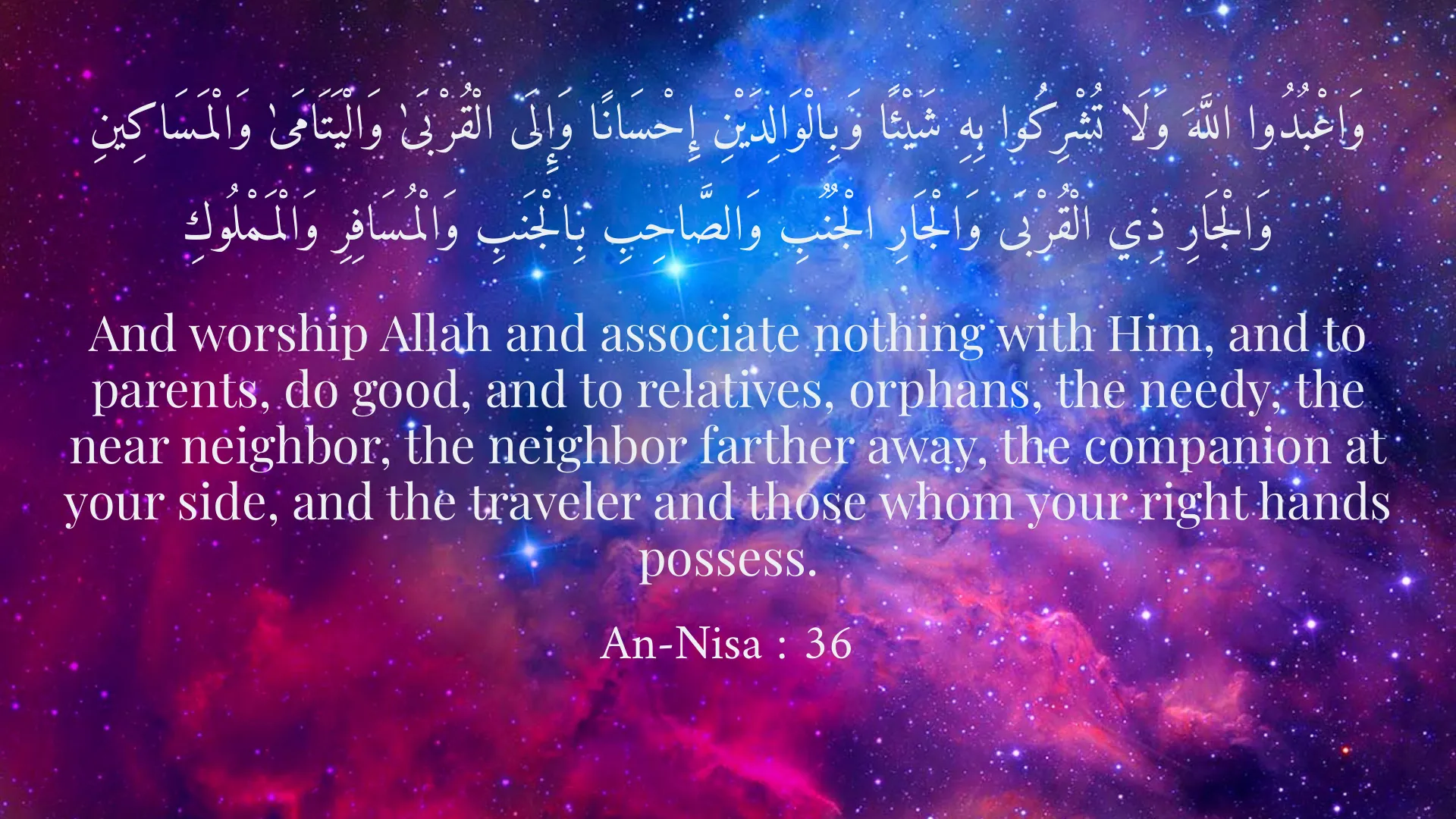
The Holy Quran, revered by Muslims as the word of God, serves as a comprehensive guide for various aspects of life, including interpersonal relationships. Although it does not explicitly delineate the rights of neighbors, it implicitly underscores the importance of human interactions and the moral imperatives associated with them. The principles of kindness, respect, and social responsibility are interwoven throughout the Quran, encouraging individuals to uphold these values not only towards their families but also toward society at large. This article explores the significance of neighborly rights in Islam, diving deeper into Quranic verses and the teachings of Prophet Muhammad (peace be upon him) in order to construct an understanding of how these principles translate into social behavior and contribute to communal harmony. One of the most striking verses that reflects the fundamental characteristics of neighborliness can be found in Surah An-Nisa, verse 36: 'And worship Allah and associate nothing with Him, and to parents, do good, and to relatives, orphans, the needy, the near neighbor, the neighbor farther away, the companion at your side, and the traveler and those whom your right hands possess.' This verse, rich in layers, establishes a hierarchy of responsibilities and interconnections in human relationships. Notably, neighbors are mentioned in close proximity to familial ties and obligations, illustrating their critical role in everyday life and society. In listing neighbors first among those entitled to good treatment, this verse indicates that Islam does not merely acknowledge the existence of neighbors but emphasizes the need to uphold their rights and deliver kindness towards them. The notion that one's immediate surroundings—places of residence and work—are deserving of respect is crucial for cultivating a sense of community. The Prophet Muhammad (peace be upon him) further elaborates on this principle through his teachings and personal conduct. He emphasized neighborly rights in myriad instances, demonstrating their practical importance. Notably, he stated, 'Jibril kept advising me about neighbors until I thought that he would make them heirs.' This profound statement reflects the Prophet's dedication to ensuring that the rights of neighbors are prioritized in Islamic ethics. The implication is clear: neighbors hold significant value in the fabric of society and are to be treated with utmost care, respect, and responsibility. The significance of neighborly rights extends beyond mere obligation; it creates an environment where communal ties flourish. When Muslims act in accordance with these teachings, it cultivates strong and healthy relationships that benefit not just individuals but the entire society. In Islamic culture, many traditions and customs enhance neighborly relations, such as mutual visits, sharing meals, and providing assistance in times of need. This practice enriches lives, alleviates suffering, and enhances social bonds. Thus, neighborly rights can be viewed as an integral part of Islamic ideology that promotes peace, compassion, and community cohesion. From a sociological perspective, the implications of adhering to neighborly rights resonate on a broader scale. When individuals respect and honor their neighbors, it serves as a basis for social interaction, thereby facilitating trust and cooperation within communities. In a world where social isolation and urban alienation are rampant, the call to care for neighbors stands as a remedy to these issues. Active engagement and positive relationships with those living nearby can counterbalance the effects of contemporary challenges such as loneliness and disconnection. Moreover, the act of fostering good neighborly relations functions as a preventive measure against potential conflicts. Oftentimes, friction arises within communities due to misunderstandings or a lack of communication. By building strong connections with one’s neighbors, misunderstandings can be addressed more swiftly, and conflicts can be resolved amicably. In this way, the teachings of Islam regarding neighborly rights contribute not only to personal character development but also to the stability and harmony of society as a whole. Historically, various Islamic scholars and community leaders have stressed the importance of these rights. The life of Prophet Muhammad (peace be upon him) serves as a primary example, wherein he fostered a community in Medina that exemplified cooperative and harmonious living. The bonds he nurtured with his neighbors became a model for future generations, teaching that caring for one's neighbors and engaging positively within the community is fundamental to experiencing a fulfilled life. In addition to encouraging individuals to treat their neighbors with kindness and respect, Islam prescribes specific rights that neighbors are entitled to. These include ensuring their safety, providing assistance when needed, and generally promoting a spirit of benevolence. This moral framework engenders an atmosphere where individuals can rely on one another, creating a strong support system that is vital for community living. In an era marked by individualism, these teachings promote a return to communal ethics and shared values, thereby enhancing societal welfare. Furthermore, some interpretations of Islamic texts suggest that the rights of neighbors extend to non-Muslims, highlighting the inclusive nature of the teachings. This speaks to the idea of universal human dignity and respect, encouraging individuals to extend their goodwill regardless of faith, ethnicity, or background. By doing so, they contribute to a broader understanding of compassion and empathy, which emerges as a foundation for peaceful coexistence in a diverse world. To conclude, the focus on neighborly rights, both in the Quran and through the actions of Prophet Muhammad (peace be upon him), emphasizes the significance of cultivating relationships that are rooted in respect, kindness, and responsibility. These values serve as a framework for individual character development and broader social cohesion. By adhering to these principles, Muslims not only honor their faith but also contribute to building harmonious and sustainable relationships that ultimately benefit their communities. In an era where social bonds often weaken, a renewed commitment to neighborly rights can serve as a guiding light, enabling individuals to experience the richness of community life that Islam envisions.
Related Verses
وَاعْبُدُوا اللَّهَ وَلَا تُشْرِكُوا بِهِ شَيْئًا وَبِالْوَالِدَيْنِ إِحْسَانًا وَإِلَى الْقُرْبَىٰ وَالْيَتَامَىٰ وَالْمَسَاكِينِ وَالْجَارِ ذِي الْقُرْبَى وَالْجَارِ الْجُنُبِ وَالصَّاحِبِ بِالْجَنبِ وَالْمُسَافِرِ وَالْمَمْلُوكِ
And worship Allah and associate nothing with Him, and to parents, do good, and to relatives, orphans, the needy, the near neighbor, the neighbor farther away, the companion at your side, and the traveler and those whom your right hands possess.
An-Nisa : 36
Short Story
One day in a neighborhood, two neighbors were in conflict. One of them decided to follow the advice of the Quran and treat his neighbor kindly. He took a bag of dates to his neighbor's house and respectfully apologized to him. The neighbor welcomed him with a smile, and they became good friends again. This change in behavior brought peace to everyone in the neighborhood.