Quranic Answer
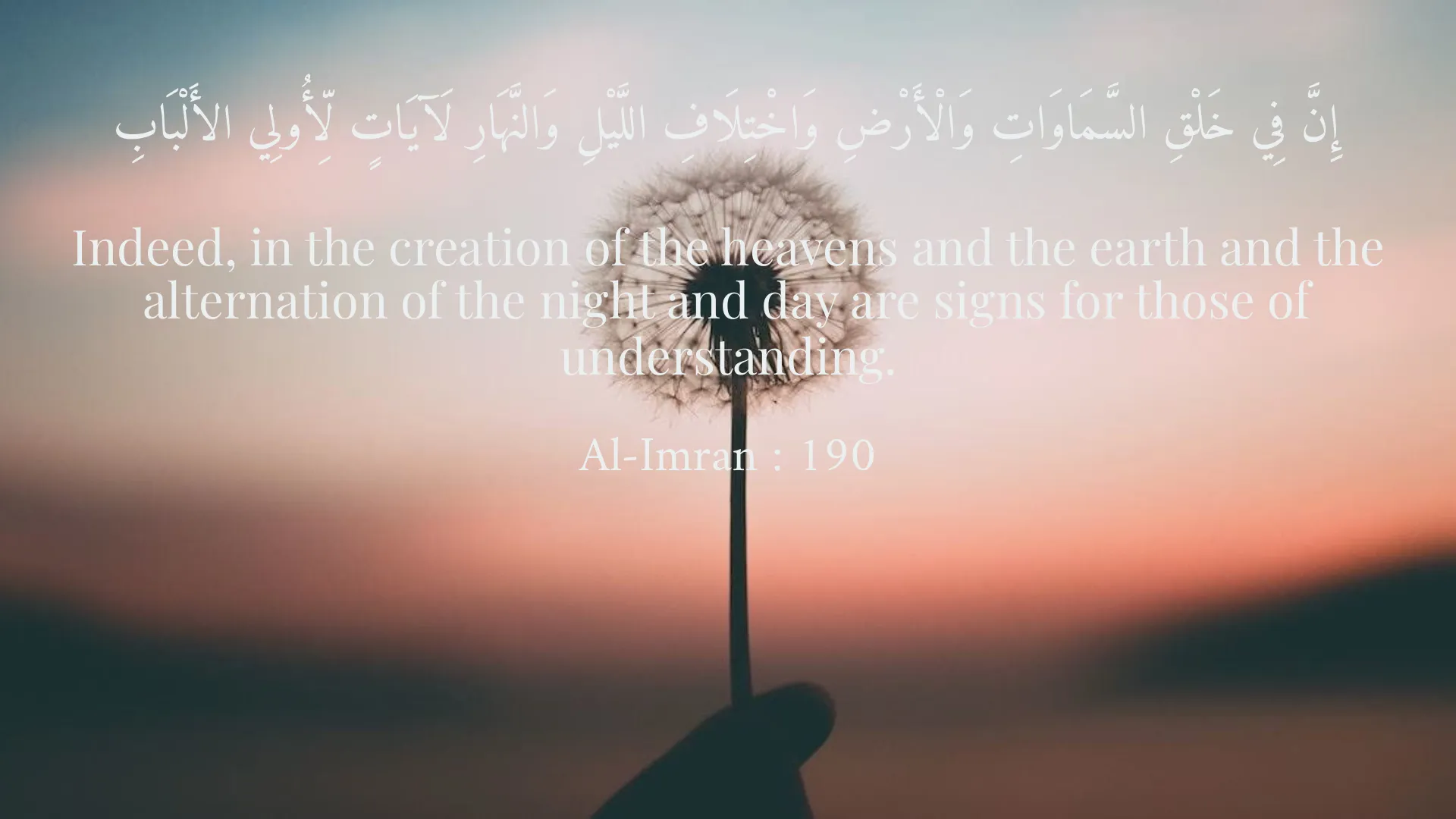
The Holy Quran, the sacred text of Islam, encapsulates profound insights and wisdom regarding the universe and the creation of humanity. One of the recurring themes within its verses is the imperative for contemplation and reflection on creation. This call for introspection serves not only as an invitation for believers to appreciate the beauty of the world around them but also as a pathway for deepening one’s understanding of Allah, the Creator. In Surah Al-Imran, verse 190, it is stated: 'Indeed, in the creation of the heavens and the earth and the alternation of the night and day are signs for those of understanding.' This significant verse reveals the idea that the intricate designs and patterns observed in nature serve as signs or signs of divine artistry meant for reflection. Hence, each aspect of creation is a prompt to look deeper, to inquire about the realities behind what is perceived, and to recognize the greatness of Allah. This invitation to reflect is not confined to abstractions; rather, it is presented in a context that is deeply personal and relatable to the human experience. For example, in Surah Al-Mu’minun, verses 12 to 14, the stages of human creation are illustrated with striking imagery. The verses indicate that humans originate from a mere drop of fluid, transform into a clinging clot, and eventually evolve into a slightly formed creature. By detailing these stages, the Quran not only highlights the remarkable process of creation but also encourages individuals to ponder their own origins and development. This contemplation evokes gratitude and humility, reinforcing the notion that humans are intricately woven into the fabric of creation and that their very existence is a sign of Allah’s power and wisdom. Moreover, such reflections extend beyond self-contemplation to encompass a broader understanding of existence. The Quran invites humans to consider the vastness of creation, such as the celestial bodies, the earth, and the rhythms of nature. When individuals immerse themselves in contemplation, they begin to recognize the complex interconnections within the natural world, which in turn serves as a mirror to the multifaceted nature of the Creator. The beauty of a sunrise, the vastness of the ocean, and the delicate balance of ecosystems all become manifestations of divine wisdom, urging humanity to seek and admire the signs that point towards Allah. Surah Ar-Ra’d, verse 16 further reinforces this concept with a poignant rhetorical question: 'Who is the creator of the heavens and the earth? Is He not the One who is above all they associate with Him?' This verse challenges individuals to reassess their beliefs regarding divinity and creation, urging them to recognize the exclusivity of Allah as the sole Creator. It invites a moment of reflection about the many entities that people often revere or associate with divinity, calling attention to the fact that only the Creator of the heavens and the earth is deserving of true worship. This understanding is crucial as it underscores the importance of worshipping Allah in the context of His magnificence as the originator of all existence. The Quranic perspective on contemplation does not end with mere acknowledgment of signs; rather, it leads to action. The awareness gained through reflection compels individuals to nurture a relationship with the Creator, fostering worship that is rooted in understanding and reverence. Such worship is not a superficial practice limited to rituals, but rather an engagement with the heart and mind aimed at fulfilling the purpose of existence. As believers invest time in meditation and reflection upon the signs of creation, they cultivate spiritual consciousness, guiding them towards a deeper, more fulfilling faith. Furthermore, the importance of contemplation is not limited to individual growth; it extends to the community. A society that encourages reflection will likely be more compassionate, understanding, and responsible, as individuals become more aware of their interconnectedness with each other and with the environment. The virtues of empathy, kindness, and stewardship emerge when one realizes that humanity is part of a larger creation designed by a benevolent Creator. Therefore, fostering a culture of reflection can lead to societal harmony as individuals strive to embody the principles of justice, equity, and respect for all forms of life. Despite its significance, the practice of contemplation is often overshadowed in a fast-paced world consumed by distractions and superficial pursuits. Technology, societal pressures, and an overwhelming influx of information can act as barriers, diverting attention from the inward journey that leads to understanding. However, the Quran offers a solution by encouraging those who seek truth to carve out time for introspection and to reconnect with the natural world. By stepping away from distractions and immersing oneself in the beauty of creation — whether through a serene walk in nature or by observing the stars at night — individuals can rekindle their sense of wonder and appreciation for the divine. In conclusion, the Holy Quran profoundly emphasizes the importance of contemplation and reflection on creation as an essential component of faith. Through various verses, it not only invites individuals to ponder the signs of Allah's grandeur within the natural world and their own selves but also highlights the intrinsic connection between creation and the Creator. This journey of reflection leads to a deeper understanding of Allah, nurtures worship grounded in knowledge, and fosters a compassionate community appreciative of the interconnectedness of all existence. In embracing the Quran's call to reflect, believers embark on a path that enriches their lives and propels them toward a more profound relationship with the divine.
Related Verses
إِنَّ فِي خَلْقِ السَّمَاوَاتِ وَالْأَرْضِ وَاخْتِلَافِ اللَّيْلِ وَالنَّهَارِ لَآيَاتٍ لِّأُولِي الأَلْبَابِ
Indeed, in the creation of the heavens and the earth and the alternation of the night and day are signs for those of understanding.
Al-Imran : 190
وَلَقَدْ خَلَقْنَا الْإِنْسَانَ مِن سُلَالَةٍ مِّن طِينٍ
And indeed We created man from clay.
Al-Mu'minun : 12
أَمَّنْ خَلَقَ السَّمَاوَاتِ وَالْأَرْضَ فَأَنَا يُشْرَكُ بِاللَّهِ
Who is the creator of the heavens and the earth? Is He not the One who is above all they associate with Him?
Ar-Ra’d : 16
Short Story
Once, there was a young man named Amir who was astounded by the beauty of creation and nature. He decided to go to the mountains alone to watch the sky and the stars. There, he realized that each star tells a story and that within the heavens lie signs of Allah's might. With this contemplation of creation, Amir attained tremendous peace and decided to study more about creation and heighten his dedication to understanding Allah.