Quranic Answer
The Holy Quran, the central religious text of Islam, not only serves as a guide for spiritual and moral conduct but also emphasizes the significance of various social responsibilities. One of the key areas that the Quran addresses is the treatment of the elderly, particularly parents. The importance of respecting and caring for the elderly is prominently highlighted throughout the Quran, advocating a moral framework within which relationships between generations are built. This article will delve into the Quranic verses that stress the importance of respecting the elderly, the implications of these verses in everyday life, and how the teachings are further reinforced through the Hadiths of the Prophet Muhammad (PBUH). The relationship between parents and their children is given special significance in Islam. In Surah Al-Isra, verse 23, Allah emphasizes the divine obligation of treating parents with utmost respect as they age. The verse states: 'And your Lord has decreed that you not worship except Him, and to parents, good treatment.' This verse highlights two primary commands: the worship of Allah alone and the respectful treatment of parents. Here, we can see a clear linkage between the concept of worship and kindness towards parents, indicating that our relationship with God is deeply intertwined with our behavior towards our parents. Respecting one’s parents, especially in their old age, is portrayed not merely as a cultural value but as a theological requirement. The verse reminds us that treat them with love and respect is of utmost priority. It also warns against disrespectful words, suggesting that even the smallest acts of rudeness are to be avoided. The context of this verse is profound, as it teaches that reverence and kindness should be displayed even when parents may become difficult due to age-related issues or health problems. This concept is foundational in fostering a loving and supportive family environment. Moreover, the Quran touches upon the relationship between worshiping Allah and treating our parents well, hinting at the idea that neglecting parental care might affect one’s spiritual standing. Upon analyzing the Quranic narratives, we find a recurring notion that fulfilling our duties towards the elderly translates into earning Allah's pleasure and blessings. Consequently, it becomes evident that not only does the Quran urge us to respect our parents, but it deepens our understanding of spirituality by intertwining it with familial responsibilities. In Surah Luqman, verse 14, Allah further enjoins upon humans the duty of care for their parents, reiterating this vital responsibility. The verse states: 'And We have enjoined upon man [care] for his parents. But if they endeavor to make you associate with Me that of which you have no knowledge, do not obey them...' This verse underlines the fundamental principle that while we are obligated to treat our parents with kindness, there are boundaries when it comes to faith. If parents demand actions contrary to the worship of Allah, the Quran advises against compliance, demonstrating that the ultimate allegiance must be to God. This balance that the Quran establishes illustrates how to manage familial love with religious fidelity, promoting respectful relationships while safeguarding spiritual integrity. Considering the Quranic teachings concerning the elderly is vital in the context of societal norms. In many cultures, the elderly are often marginalized or overlooked, but Islam instructs that they should be treated with dignity and honor. The command to care for elder members of society resonates deeply, as these individuals possess a wealth of experience and wisdom. Therefore, respecting their contributions to family and society at large is integral to maintaining cultural and familial cohesion. Beyond the Quran, the Hadiths provide further insights into the importance of respecting the elderly. The Prophet Muhammad (PBUH) exemplified these teachings through his actions and utterances. He often highlighted that the respect given to the elderly, especially parents, reflects on one’s character and faith. One well-known Hadith states, 'He is not one of us who does not show mercy to our young and does not respect our elderly.' This profound statement by the Prophet reinforces the idea that respect for elders is not merely a personal choice; rather, it is a collective responsibility embraced by the Muslim community. Caring for elderly family members can sometimes be challenging due to the changes in their physical or cognitive abilities. However, the blessings derived from such care are immense. By respecting and honoring our elders, we not only uphold a vital religious commandment but also foster an environment of love, unity, and understanding within our families. Acts of kindness toward elderly parents or relatives can manifest in various forms, including verbal affection, help with daily tasks, or merely spending quality time together. The act of honoring the elderly contributes significantly to community wellbeing, creating networks of support that extend beyond immediate family units. It sets an example for younger generations, teaching them the value of compassion, patience, and dedication to family. In a world increasingly focused on rapid changes and youth-oriented dynamics, the Quran and teachings of the Prophet encourage us to create a more inclusive environment that values every stage of life, especially the wisdom and experience afforded by aging. In conclusion, the Holy Quran's insistence on the respectful treatment of the elderly is a reflection of a broader moral imperative within Islamic teachings. Verses in Surah Al-Isra and Surah Luqman poignantly call upon individuals to fulfill their duties towards parents, reinforcing an essential aspect of belief and character in Islam. The teachings of the Hadith further bolster this message, ensuring that respect for elders is instilled within the community. Taking these principles to heart fosters a culture of compassion and respect, which not only honors our parents and elderly but also strengthens the moral fabric of society, leading to a more harmonious living environment for all.
Related Verses
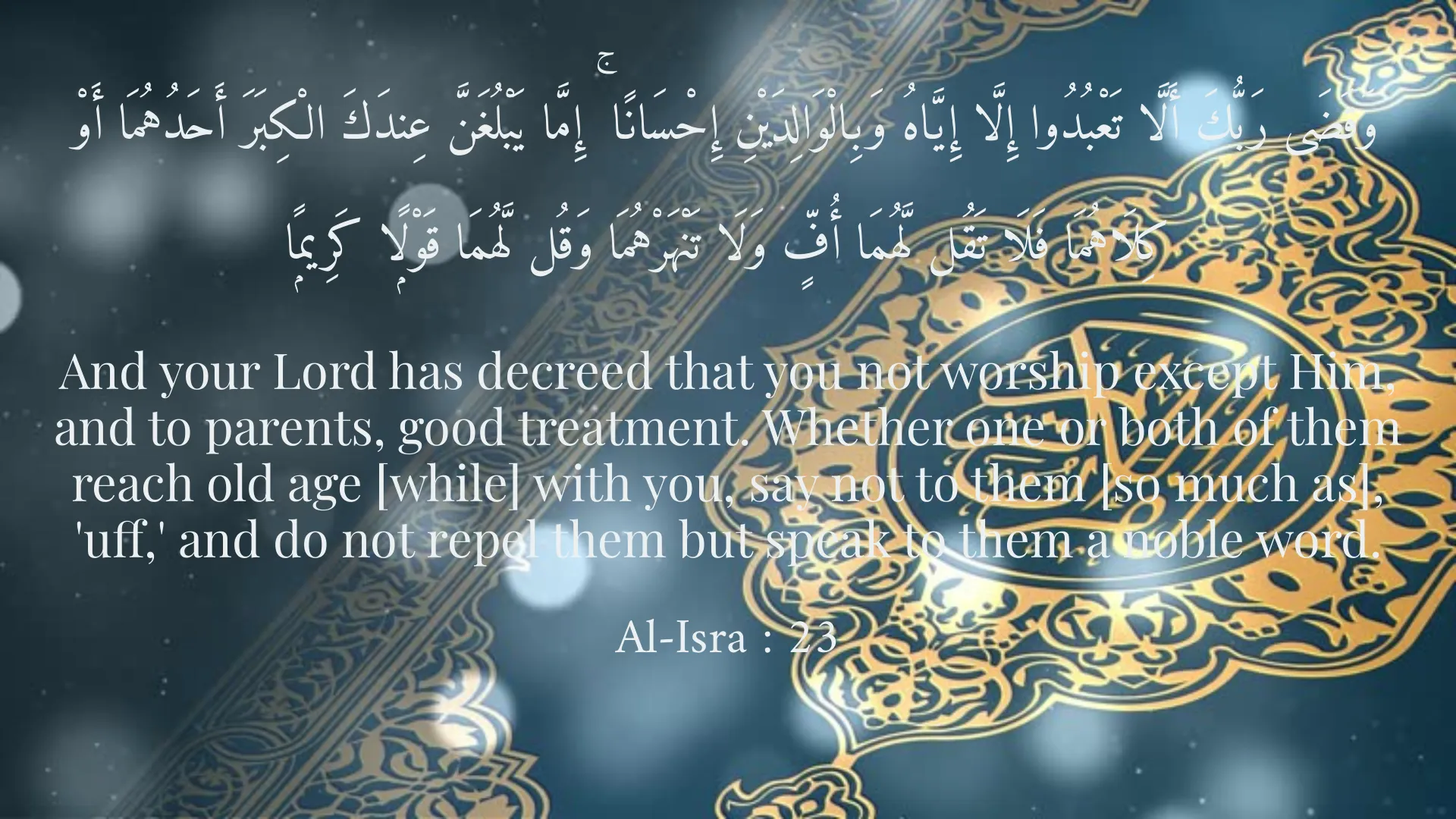
وَقَضَى رَبُّكَ أَلَّا تَعْبُدُوا إِلَّا إِيَّاهُ وَبِالْوَالِدَيْنِ إِحْسَانًا ۚ إِمَّا يَبْلُغَنَّ عِندَكَ الْكِبَرَ أَحَدُهُمَا أَوْ كِلَاهُمَا فَلَا تَقُل لَّهُمَا أُفٍّ وَلَا تَنْهَرْهُمَا وَقُل لَّهُمَا قَوْلًۭا كَرِيمًۭا
And your Lord has decreed that you not worship except Him, and to parents, good treatment. Whether one or both of them reach old age [while] with you, say not to them [so much as], 'uff,' and do not repel them but speak to them a noble word.
Al-Isra : 23
وَوَصَّيْنَا الْإِنْسَانَ بِوَالِدَيْهِ ۖ أَنِ اشْكُرْ لِي وَلِوَالِدَيْكَ إِلَيَّ الْمَصِيرُ
And We have enjoined upon man [care] for his parents. But if they endeavor to make you associate with Me that of which you have no knowledge, do not obey them.
Luqman : 14
Short Story
One day, a young man named Amir went to visit his grandmother. He always respected his parents and especially his grandmother. That day, when he arrived at his grandmother's house, he found her very ill. Amir immediately approached her bedside and started talking to her. He asked her about her youth and told her how much he loved her. This behavior brought great joy to his grandmother, making her feel valued and respected. Amir realized that respecting the elderly is not just a duty but also brings blessings and joy to life.