Quranic Answer
The question of whether the Holy Quran perceives a contradiction between empirical science and divine revelation is met with a resounding “no.” In fact, the Quran views divine revelation and scientific discovery not as opposing forces, but as two complementary wings for humanity's flight towards truth and divine knowledge. From the Quranic perspective, empirical science is not merely non-contradictory with revelation; it serves as a vital tool and a fertile ground for a deeper understanding of God's signs (Ayat) and wonders throughout the cosmos. The Quran repeatedly calls upon humanity to reflect, ponder, and use their intellect in contemplating the creation of the universe, its natural phenomena, and even their own intricate existence. These calls are, in essence, invitations to a form of scientific inquiry and meticulous observation of reality, with the ultimate goal of attaining knowledge of the Creator and deepening one's faith. One of the pivotal concepts in the Quran that illustrates this synergy is the concept of “Ayah.” An “Ayah” refers both to the verses of the Quran itself and to the signs and proofs of God found in the “Afaq” (the external world) and “Anfus” (within the human self). The Quran is replete with verses that present natural phenomena as undeniable signs of God's power, wisdom, and meticulous planning. For instance, in Surah Ar-Rum, verse 22, Allah says: “And of His signs is the creation of the heavens and the earth and the diversity of your languages and your colors. Indeed in that are signs for those of knowledge.” This verse clearly establishes a link between observing natural phenomena (the creation of the heavens and earth, linguistic and racial diversity) and the discovery of divine signs by “those of knowledge” (Al-Alameen). These “Al-Alameen” encompass not only religious scholars but anyone who diligently explores the truths of existence through scientific methodologies. By encouraging observation and contemplation of creation, the Quran, in essence, paves the way for scientific discoveries. Verses that refer to the orderly movement of stars and planets, the water cycle, the growth of plants, the life of animals, and even the complexities of human creation, all serve as invitations to reflect upon and scientifically examine these phenomena. The ultimate purpose of these investigations is not merely to acquire material knowledge but to achieve a profound understanding of the Creator and to stand in awe of His magnificent power. Empirical science reveals the “how” of the universe's operation – from the laws of physics and chemistry to intricate biological processes. These “hows” are themselves manifestations of a supreme and precise order that can only originate from an infinitely wise and powerful source. Revelation, on the other hand, tells us the “why” of the universe's existence and the ultimate “purpose” of human creation. Revelation answers questions that empirical science can never fully address: Where do we come from? Where are we going? What is the meaning of life? How should we live? These are matters pertaining to the metaphysical and ultimate dimensions of human existence and the cosmos. Here, science and revelation are not in conflict; rather, they are complementary. Science is a tool for unraveling the mysteries of nature, and revelation is a guide for comprehending the meaning of these mysteries and situating them within the purposeful framework of creation. For example, physics can explain the complex process of a raindrop's formation and the physical laws governing it. However, revelation (such as Surah An-Nur, verse 43: “Do you not see that Allah drives clouds, then gathers them together, then makes them into a heap, and you see the rain emerge from between them? And He sends down from the sky mountains [of clouds] within which is hail, and He strikes with it whom He wills and averts it from whom He wills. The flash of its lightning almost takes away the eyesight.”) not only describes the phenomenon of rain but emphasizes that all this originates from divine planning and wisdom, serving as a sign of His power and mercy. Science focuses on discovering laws, while revelation explains the origin and purpose of these laws and humanity's relationship with them. Another crucial point is the absence of any “vacuum” or limitation for science in the Quran. Unlike some other religious texts, the Quran does not close the doors of knowledge; rather, it opens them wide. Verses referring to “Ulul-Albab” (people of understanding and intellect) describe those who ponder over the creation of the heavens and earth and the alternation of night and day, thereby coming to recognize God's greatness (Surah Al-Imran, verses 190-191). These individuals are, in essence, scientists and thinkers who, through observation and analysis, arrive at a deeper comprehension of reality. The history of Islamic civilization also bears witness to this claim. During the Golden Age of Islam, Muslim scholars, inspired by Quranic injunctions, achieved remarkable advancements in various scientific fields, including medicine, astronomy, mathematics, chemistry, and physics. They saw no contradiction between faith and science; instead, they regarded science as a means to discover the Creator's magnificence and serve humanity. This approach formed the basis for many subsequent scientific advancements in the Western world. Ultimately, any apparent contradiction between science and revelation usually stems from one of the following: a misinterpretation of the religious text, an incomplete or nascent understanding of scientific findings (which may be corrected with further scientific progress), or an attempt to impose specific philosophical biases on both domains. The Quran, as divine speech, presents truths that will always be compatible with accurate and definitive scientific discoveries, as both originate from a single source of truth – Allah Almighty. Therefore, the Quran not only sees no contradiction between empirical science and revelation but encourages and affirms them as two parallel and complementary paths to achieving a comprehensive understanding of existence and the Creator of existence.
Related Verses
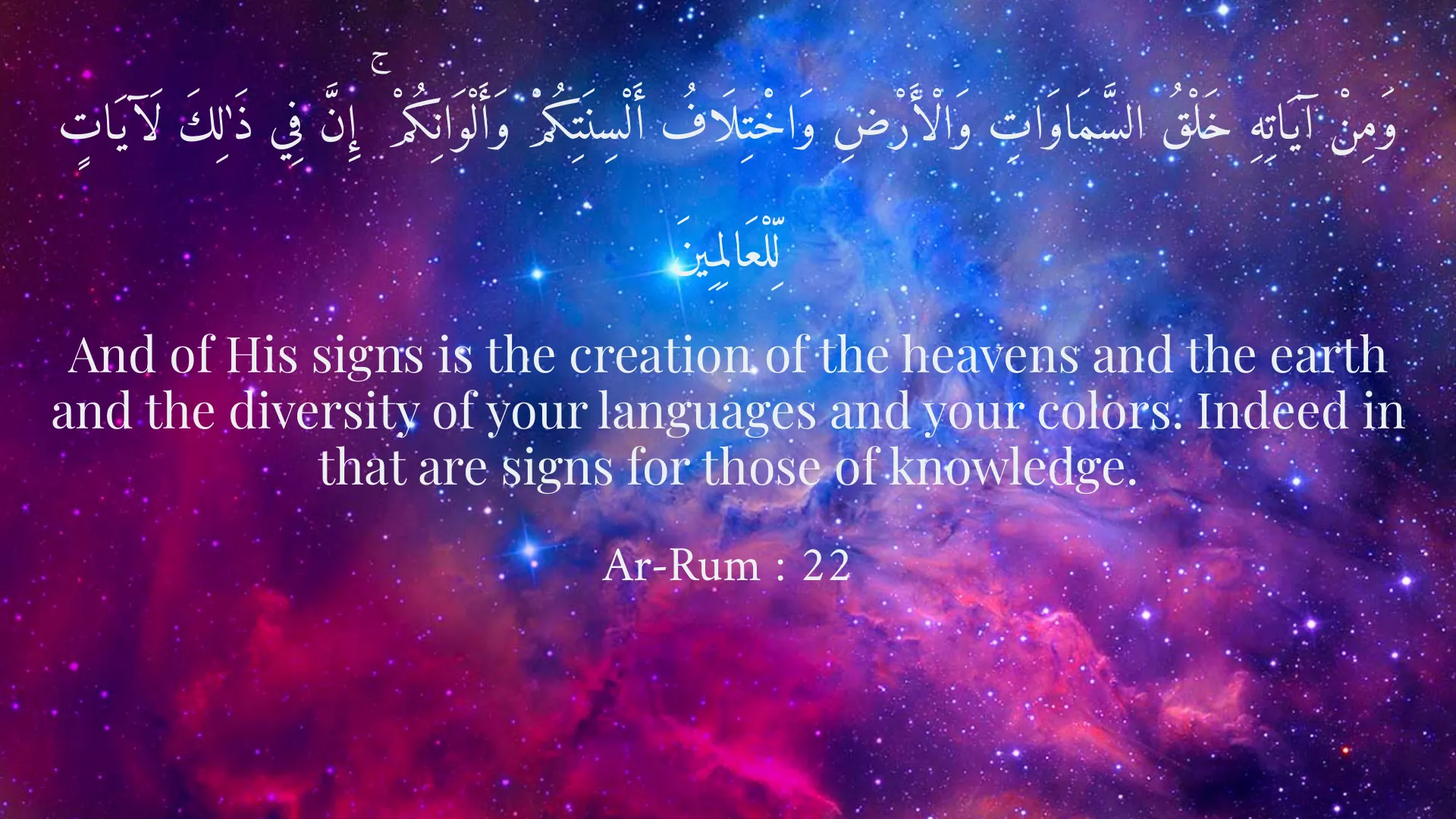
وَمِنْ آيَاتِهِ خَلْقُ السَّمَاوَاتِ وَالْأَرْضِ وَاخْتِلَافُ أَلْسِنَتِكُمْ وَأَلْوَانِكُمْ ۚ إِنَّ فِي ذَٰلِكَ لَآيَاتٍ لِّلْعَالِمِينَ
And of His signs is the creation of the heavens and the earth and the diversity of your languages and your colors. Indeed in that are signs for those of knowledge.
Ar-Rum : 22
إِنَّ فِي السَّمَاوَاتِ وَالْأَرْضِ لَآيَاتٍ لِّلْمُؤْمِنِينَ
Indeed, within the heavens and earth are signs for the believers.
Al-Jathiya : 3
وَفِي خَلْقِكُمْ وَمَا يَبُثُّ مِن دَابَّةٍ آيَاتٌ لِّقَوْمٍ يُوقِنُونَ
And in your creation and what He disperses of living creatures are signs for a people who are certain [in faith].
Al-Jathiya : 4
سَنُرِيهِمْ آيَاتِنَا فِي الْآفَاقِ وَفِي أَنفُسِهِمْ حَتَّى يَتَبَيَّنَ لَهُمْ أَنَّهُ الْحَقُّ ۗ أَوَلَمْ يَكْفِ بِرَبِّكَ أَنَّهُ عَلَىٰ كُلِّ شَيْءٍ شَهِيدٌ
We will show them Our signs in the horizons and within themselves until it becomes clear to them that it is the truth. But is it not sufficient concerning your Lord that He is, over all things, a Witness?
Fussilat : 53
Short Story
They say that a seeker of knowledge once traveled far and wide, collecting scrolls and listening to scholars. He prided himself on his vast learning. One day, he came upon an old sage sitting by a flowing river, gazing at the water. The seeker, eager to display his knowledge, began to recount the myriad theories of the river's origin, its chemical composition, and the physics of its flow. The sage listened patiently, then gently smiled. 'My son,' he said, 'you have learned much about the river's body. But have you considered its spirit? Have you seen the thirsty bird quenching its thirst, the fields it nourishes, the life it sustains? Have you pondered the wisdom of its constant flow, a testament to the Creator's enduring power, or its gentle murmur, a hymn of praise? True knowledge is not merely dissecting the parts, but understanding the magnificent whole and the purpose woven within it.' The seeker realized that his pursuit of 'how' had overshadowed the profound 'why' and the spiritual insight that observation, combined with contemplation, could yield.