Quranic Answer
Yes, absolutely, the Holy Quran addresses our responsibility towards future generations extensively and with great emphasis. This topic is one of the fundamental pillars of the Quranic worldview, reflected directly and indirectly in numerous verses. This responsibility not only encompasses the preservation and transmission of material heritage but also extends to much deeper spiritual, ethical, social, and environmental dimensions. The foundation of this perspective lies in the concepts of "Khalifah" (Stewardship/Vicegerency) and "Amanah" (Trust), with which Allah Almighty has honored humanity on Earth. Firstly, it is essential to highlight the concept of Khalifah and Divine Trust. In Surah Al-Baqarah, verse 30, Allah states: "And [mention, O Muhammad], when your Lord said to the angels, 'Indeed, I will make upon the earth a successive authority (Khalifa).'" This foundational verse introduces humanity as Allah’s vicegerent and representative on Earth. This vicegerency does not imply absolute ownership but rather trusteeship, guardianship, and accountability for resources, creation, and all existence. This responsibility includes the just and wise management of Earth's resources, not merely for the present generation, but crucially, for future ones as well. The Earth and everything within it are a trust (Amanah) in our hands, which we must preserve in the best possible way and pass on to subsequent generations, rather than destroying or plundering it. This concept forms the basis of all sustainable development and long-term thinking in Islam, encouraging a perspective that extends beyond immediate gratification to consider lasting impacts on society and the environment, obliging humanity to a responsible outlook towards nature and the future. Secondly, responsibility for preserving the environment and natural resources is paramount. The Quran vehemently opposes any form of corruption or mischief on Earth. Surah Al-A'raf, verse 56, declares: "And do not cause corruption on the earth after its reformation." This prohibition of corruption includes environmental degradation, pollution of water and air, destruction of forests, and wasteful consumption of resources. These actions not only disrupt current life but also jeopardize the future of coming generations. It is our responsibility to hand over a healthy and thriving Earth to our successors. The utilization of resources must be characterized by moderation and avoidance of extravagance (Israf), as Allah states in Surah Al-Isra, verse 27: "Indeed, the wasteful are brothers of the devils." This verse signifies that extravagance is not merely an individual sin but carries destructive social and generational consequences, squandering resources that rightfully belong to future inhabitants. Therefore, sustainable management of resources and the preservation of ecosystems are vital duties we owe to future generations, ensuring their access to clean air, water, and fertile land, and this includes any decision-making regarding the exploitation of non-renewable resources and the proper management of renewable ones. Another crucial aspect is social and economic justice. The Quran places immense emphasis on establishing justice and fairness in society. Severe economic inequalities, oppression, and corrupt structures will inevitably leave a bitter legacy for future generations. In Surah An-Nisa, verse 9, Allah specifically addresses this: "And let those [guard against that] who would fear for their offspring if they left them weak [thereby]; so let them fear Allah and speak words of appropriate counsel." This verse explicitly outlines our responsibility concerning the future condition of our children and succeeding generations. This responsibility entails creating a just society with equal opportunities and robust infrastructures so that our children can thrive and achieve prosperity. This necessitates combating corruption, establishing efficient educational and healthcare systems, and ensuring the equitable distribution of wealth. We must reflect on whether the society we bequeath to future generations will be one where rights and justice prevail, or one riddled with systemic problems, and whether we have provided adequate social and and economic infrastructure for their well-being and progress. One of the most significant dimensions of our responsibility is the upbringing of righteous and knowledgeable generations. The Quran stresses the importance of having and raising pure and upright offspring. Many prayers of the prophets in the Quran, such as Prophet Ibrahim's (Abraham's) prayer for righteous progeny, underscore the importance of this matter. In Surah Al-Furqan, verse 74, righteous servants of Allah pray: "And those who say, 'Our Lord, grant us from among our wives and offspring comfort to our eyes and make us an example for the righteous.'" This prayer is not solely for individual happiness but seeks a generation that is not only righteous themselves but also exemplary in piety and a model for others. Proper upbringing of children, imparting knowledge, ethics, and religious values to them, is an investment in the future of society. A generation raised with divine values can carry the divine message forward, building an advanced and elevated society. This includes transmitting beneficial knowledge, wisdom, and experiences so that future generations are not forced to repeat past mistakes, but can rather build upon the achievements of their predecessors, continuing the path of development and elevation. Furthermore, the transmission of intellectual and spiritual heritage constitutes a significant part of this responsibility. The Quran encourages us to reflect, reason, and acquire knowledge. The heritage to be passed on to future generations is not merely material wealth but encompasses moral values, religious teachings, beneficial sciences, and wisdom. We are obligated to select the best from past heritage, enrich it with our achievements, and pass it on in a more complete form to succeeding generations. This includes preserving and promoting Quranic teachings and the Sunnah (traditions) of the Prophet Muhammad (peace be upon him) so that the light of guidance remains eternally illuminated. This transmission of knowledge and values ensures cultural and religious continuity and provides a fertile ground for the intellectual and spiritual growth of future generations. In conclusion, our responsibility towards future generations is a multifaceted and comprehensive duty stemming from the profound teachings of the Quran. This responsibility involves preserving the Earth and its resources, establishing justice and equity, raising righteous and knowledgeable children, and transmitting intellectual and spiritual heritage. The ultimate goal is to build a society where Allah's pleasure is attained, and future generations can flourish in a healthy, just, and spiritual environment. This vision compels us to think long-term and act responsibly, not just for the present, but for a brighter future for all humanity, playing our part in this path. This is a continuous commitment that leaves its effects from birth until the end of life, and even beyond, through ongoing charity (Sadaqah Jariyah). The Quran consistently reminds us that we are merely transient custodians and must care for the trust bestowed upon us in the best possible way, to be worthy of this vicegerency. This responsibility signifies the completeness and comprehensiveness of Islam, encompassing all dimensions of individual and collective life, and providing us with a vision that transcends the present moment, a vision rooted in divine principles of justice, benevolence, and sustainability, granting future generations the right to a dignified and prosperous life.
Related Verses
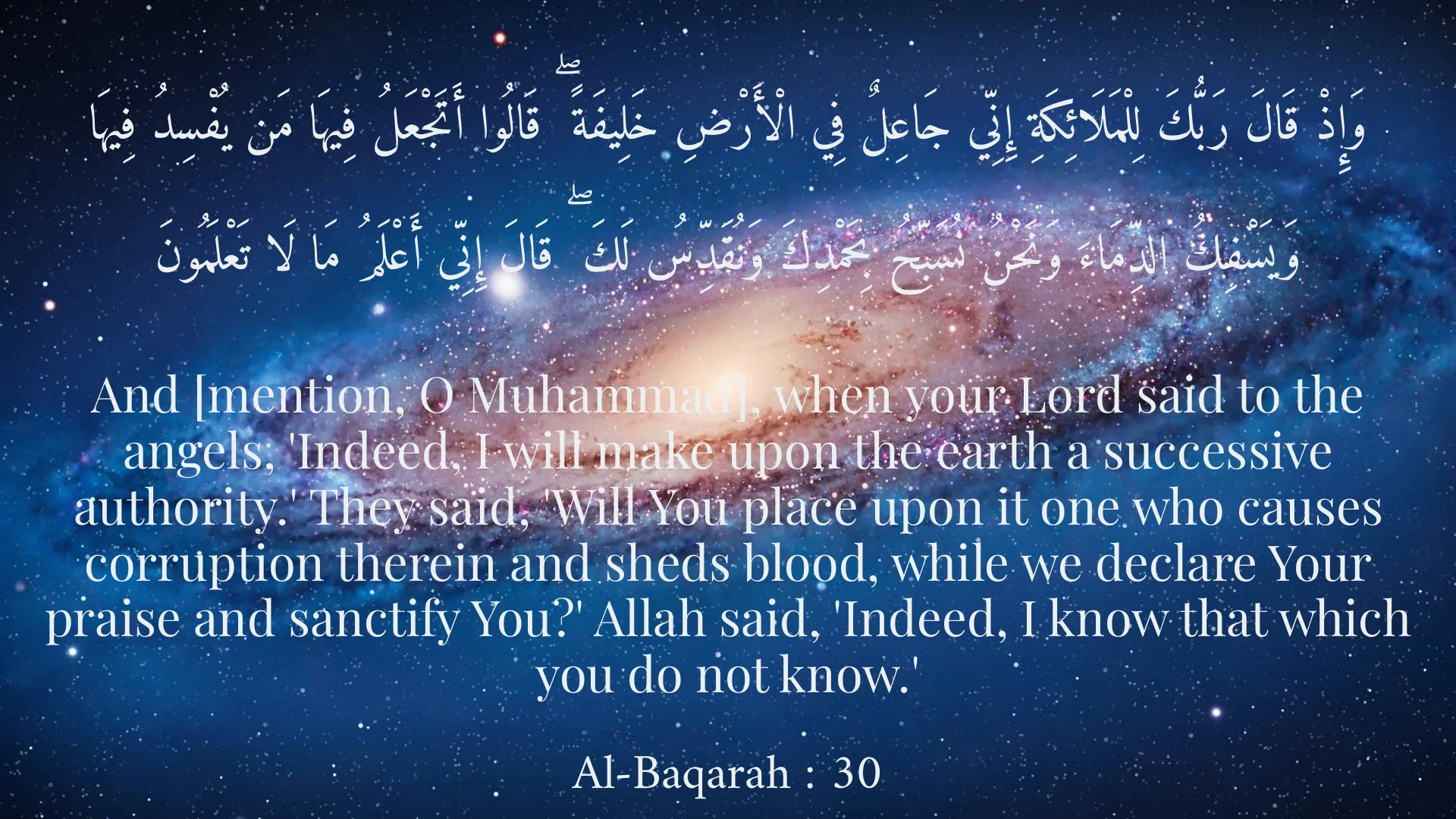
وَإِذْ قَالَ رَبُّكَ لِلْمَلَائِكَةِ إِنِّي جَاعِلٌ فِي الْأَرْضِ خَلِيفَةً ۖ قَالُوا أَتَجْعَلُ فِيهَا مَن يُفْسِدُ فِيهَا وَيَسْفِكُ الدِّمَاءَ وَنَحْنُ نُسَبِّحُ بِحَمْدِكَ وَنُقَدِّسُ لَكَ ۖ قَالَ إِنِّي أَعْلَمُ مَا لَا تَعْلَمُونَ
And [mention, O Muhammad], when your Lord said to the angels, 'Indeed, I will make upon the earth a successive authority.' They said, 'Will You place upon it one who causes corruption therein and sheds blood, while we declare Your praise and sanctify You?' Allah said, 'Indeed, I know that which you do not know.'
Al-Baqarah : 30
وَلَا تُفْسِدُوا فِي الْأَرْضِ بَعْدَ إِصْلَاحِهَا وَادْعُوهُ خَوْفًا وَطَمَعًا ۚ إِنَّ رَحْمَتَ اللَّهِ قَرِيبٌ مِّنَ الْمُحْسِنِينَ
And cause not corruption upon the earth after its reformation. And invoke Him in fear and hope. Indeed, the mercy of Allah is near to the doers of good.
Al-A'raf : 56
وَلْيَخْشَ الَّذِينَ لَوْ تَرَكُوا مِنْ خَلْفِهِمْ ذُرِّيَّةً ضِعَافًا خَافُوا عَلَيْهِمْ فَلْيَتَّقُوا اللَّهَ وَلْيَقُولُوا قَوْلًا سَدِيدًا
And let those [guard against that] who would fear for their offspring if they left them weak [thereby]; so let them fear Allah and speak words of appropriate counsel.
An-Nisa : 9
وَالَّذِينَ يَقُولُونَ رَبَّنَا هَبْ لَنَا مِنْ أَزْوَاجِنَا وَذُرِّيَّاتِنَا قُرَّةَ أَعْيُنٍ وَاجْعَلْنَا لِلْمُتَّقِينَ إِمَامًا
And those who say, 'Our Lord, grant us from among our wives and offspring comfort to our eyes and make us an example for the righteous.'
Al-Furqan : 74
Short Story
One of Saadi's beautiful stories from Bustan narrates an old man planting a sapling with his trembling hands. King Noshirvan, passing by, asked in surprise, 'O old man, with your advanced age, why are you planting a tree that will bear fruit in ten years, by which time you may not be here?' The old man replied with a kind smile, 'O King, others planted, and we ate; we too plant so that others may eat.' This heartwarming story reminds us that our responsibility extends beyond our lifetime, and we should strive with generosity and foresight for the comfort and benefit of future generations.