Quranic Answer
The Holy Quran, revered as the divine book of Islam, embodies a wealth of wisdom and guidance that addresses numerous facets of human existence and the essence of the world. Among these facets, one particularly significant aspect is the exploration of beauty—both worldly and spiritual—which is woven throughout its verses. This article delves into the multifaceted nature of beauty as depicted in the Quran, examining how it reflects the intricacies of human emotions and desires while simultaneously guiding believers towards a profound understanding of their existence. Beauty, in many cultures, is often perceived as a superficial quality, defined by aesthetics and external appearances. However, the Quran challenges this limited perspective by presenting beauty as a deeper concept intertwined with human nature, morality, and spirituality. The Quran acknowledges the innate human attraction to beauty and desire, as illustrated in Surah Al-Imran, verse 14. In this verse, Allah states: "Beautified for people is the love of that which they desire - of women and sons, heaped-up sums of gold and silver, fine branded horses, and tilled land. That is the enjoyment of worldly life, but Allah has with Him the best return." Here, the Quran illustrates the allure of worldly pleasures, highlighting that individuals are naturally drawn to various forms of beauty that are a part of their existence. The inclusion of material beauty in this text does not diminish its significance but rather recognizes that these desires are part of the human experience. Allah has created a world filled with beauty, and the love for these pleasures is an integral aspect of life. However, the verse concludes with an important reminder: although worldly beauties can provide temporary enjoyment, the ultimate return lies with Allah, suggesting that a focus solely on physical attributes and material wealth is both limiting and ultimately unsatisfactory. This leads to a deeper understanding of beauty that permeates the Quran—one that transcends mere physical attributes and speaks to the essence of spiritual beauty. In Surah Ar-Rahman, verse 13, Allah poignantly asks: "So which of the favors of your Lord would you deny?" This rhetorical question acts as a powerful reminder of the boundless beauty present in creation itself—the natural world, the intricacies of human relationships, and the blessings bestowed upon humanity. Through these verses, the Quran invites believers to engage with both the tangible beauty of the world around them and the transcendent, spiritual beauty that lies within themselves and their connection with the Divine. The Quran's exploration of beauty is not a mere celebration of the external; rather, it serves as a reminder of the importance of the inner, moral, and spiritual beauty that shapes a person's character and guides them toward righteousness. Spiritual beauty emphasizes virtues such as compassion, humility, kindness, and integrity. These qualities reflect the inner beauty that is often overshadowed by societal emphasis on external appearances. The Quran promotes the notion that true beauty is found in one's actions and intentions, urging believers to cultivate goodness in their hearts in order to manifest true beauty in their lives. Moreover, beauty as understood in the Quran also reflects a broader philosophical meaning whereby the appreciation of beauty translates into the recognition of Allah's signs. In various verses, the Quran encourages believers to contemplate the wonders of creation, the stars, the mountains, the oceans, and the intricacies of life itself as manifestations of Allah's power and creativity. This understanding invites a holistic appreciation of beauty that nurtures a connection to the Creator, reaffirming the idea that every beautiful aspect of life is ultimately a reminder of the divine. Beyond this, the Quran imbues the notion of beauty with a societal dimension. The engagement with beauty is not solely an individual affair—it extends into the community and relationships among people. The values of beauty in the Quran promote social harmony and empathy, guiding individuals to appreciate one another beyond external appearances. In this regard, beauty becomes a catalyst for building and nurturing relationships based on respect and understanding rather than superficial judgments. The interplay of beauty and morality in the Quran also brings forth a critical outlook on the transient nature of worldly beauty. Humans are often reminded that the pursuit of external beauty, wealth, and superficial pleasures may lead to a superficial existence that lacks deeper fulfillment. The Quran consistently juxtaposes this pursuit with the eternal aspects of beauty that can be attained through piety, charity, and positive contributions to society. The Quran stresses that the evaluation of beauty must encompass one's character and impact on others, rather than a mere examination of physical attributes. In conclusion, the concept of beauty in the Quran is rich, multifaceted, and deeply intertwined with human existence and spirituality. The divine text serves as a guide, inviting believers to appreciate the aesthetic allure of the world while nurturing and cultivating the inner virtues that constitute true beauty. Through both direct and indirect references, the Quran calls upon humanity to look beyond the surface and seek deeper fulfillment in the exploration of their desires and the beauty that lies within. In embracing both the external and internal facets of beauty, individuals can find a pathway to perfection and virtue, ultimately guiding their lives toward a more meaningful, spiritually enriched existence.
Related Verses
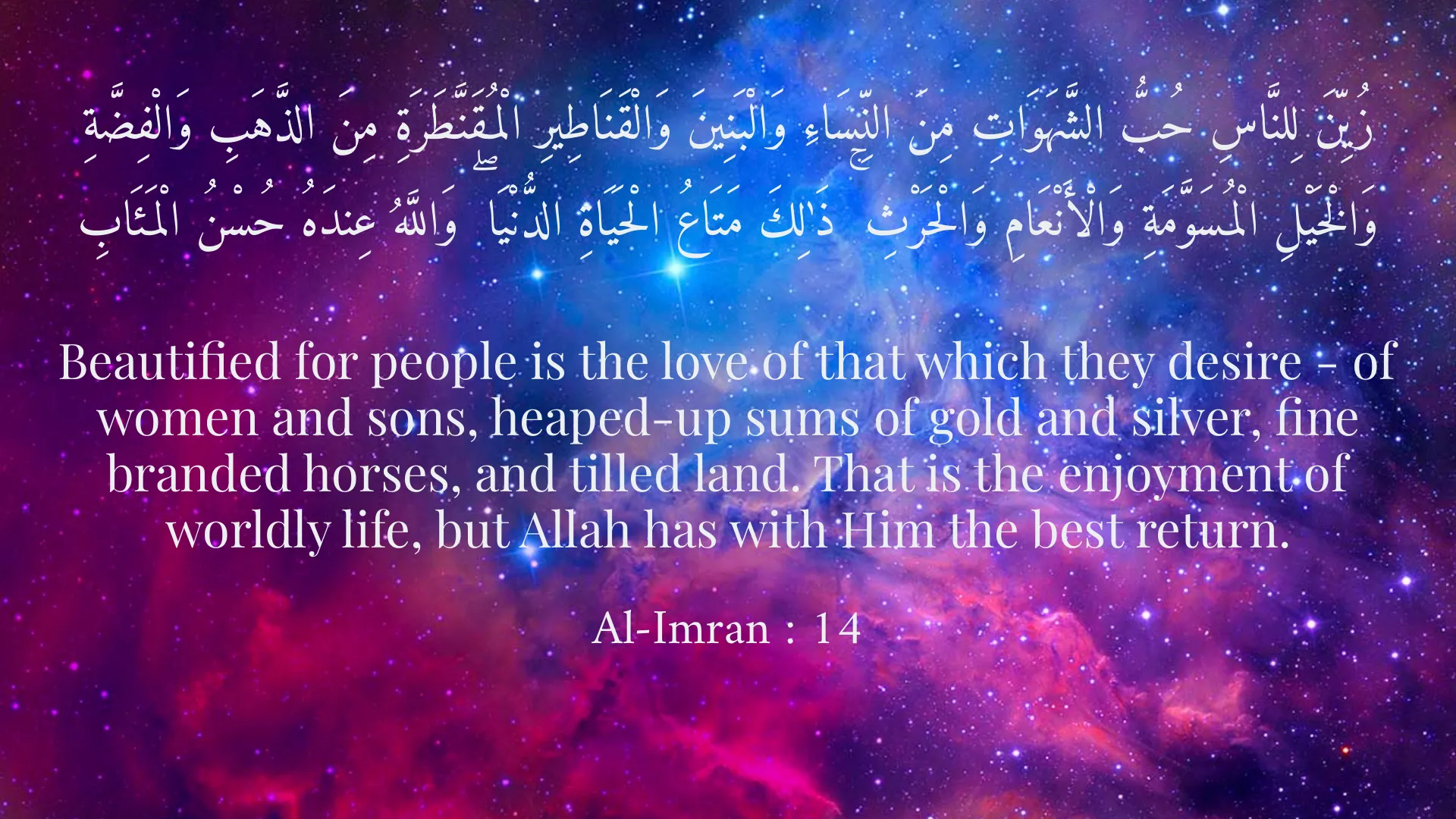
زُيِّنَ لِلنَّاسِ حُبُّ الشَّهَوَاتِ مِنَ النِّسَاءِ وَالْبَنِينَ وَالْقَنَاطِيرِ الْمُقَنَّطَرَةِ مِنَ الذَّهَبِ وَالْفِضَّةِ وَالْخَيْلِ الْمُسَوَّمَةِ وَالْأَنْعَامِ وَالْحَرْثِ ۚ ذَٰلِكَ مَتَاعُ الْحَيَاةِ الدُّنْيَا ۖ وَاللَّهُ عِندَهُ حُسْنُ الْمَئَابِ
Beautified for people is the love of that which they desire - of women and sons, heaped-up sums of gold and silver, fine branded horses, and tilled land. That is the enjoyment of worldly life, but Allah has with Him the best return.
Al-Imran : 14
فَبِأَيِّ آلَاءِ رَبِّكُمَا تُكَذِّبَانِ
So which of the favors of your Lord would you deny?
Ar-Rahman : 13
Short Story
Once upon a time, there lived a man named Hasan who was always interested in the beauties of nature and art. He tried to see beauty in everything he looked at. One day, as he passed by a beautiful garden, he admired the flowers and trees with joy. Suddenly, a verse from the Quran came to his mind: 'So which of the favors of your Lord would you deny?' Hasan said to himself, 'These beauties are all from God's kindness,' and returned home with gratitude. He decided to not only appreciate outer beauty but also pay attention to the inner beauty of himself and others.