Quranic Answer
### The Importance of Justice in Islam: A Deep Dive into Quranic Teachings Justice is a central theme in many philosophies and religions worldwide, but in Islam, it is regarded as one of the fundamental pillars of faith. The Holy Quran, as the immutable word of God, places a significant emphasis on the principles of justice, equality, and fairness. Throughout its verses, the Quran highlights justice as a core virtue that all Muslims must strive to embody and uphold. This article aims to explore the concept of justice in the Holy Quran, examining its significance, implications for individual behavior, and the broader societal consequences when justice is genuinely practiced within the Muslim community. #### Quranic Verses on Justice In the Holy Quran, several verses explicitly address the necessity of justice. One of the most notable is found in Surah An-Nisa, verse 135: 'O you who have believed, be persistently standing firm in justice, witnesses in justice, even if it be against yourselves or your parents and relatives.' This profound verse underscores the impartial nature of justice, reminding individuals that their commitments should not be clouded by personal biases or emotional ties. Here, Allah urges believers to prioritize justice, no matter the potential ramifications on their relationships. Similarly, Surah Al-Ma'idah, verse 8 reinforces this principle by stating, 'O you who have believed, be persistently standing firm in justice, witnesses for Allah, even if it be against yourselves or your parents and relatives.' This directive conveys a clear message: justice is not only a personal responsibility but also a collective obligation to uphold the truth in every aspect of one's life. The Quran acknowledges that human relationships can complicate individuals' ability to be just, emphasizing that the pursuit of fairness transcends personal feelings and affiliations. #### Justice Beyond Legalities Justice, according to the Quran, transcends mere legalistic applications and formal judgments. It extends into the moral fabric of individual behaviors and interactions within society. Islam teaches that true justice encompasses both the letter of the law and the spirit of moral integrity. Muslims are encouraged to internalize the principles of justice, making them integral to their character and interactions with others. When individuals embody justice in their everyday lives, it not only fosters trust and respect among community members but also cultivates a harmonious society. The Quran positions justice as a cornerstone for social relationships, fundamental to achieving peace and stability. The emphasis on just behavior ensures that all community members are treated fairly, mitigating conflicts and preventing oppression. #### Justice as a Social Value In Islamic teachings, justice is not merely an individual endeavor but a collective responsibility. The Quran encourages social justice, advocating for those who are oppressed and marginalized. In Surah Al-Hadid, verse 25, Allah states, 'We sent Our messengers with clear signs and sent down with them the Scripture and the balance that the people may maintain [therein] justice.' This highlights the significance of social structures and governance that prioritize equitable treatment for all. When justice permeates a society, the positive ramifications can be profound. A just society protects the rights of its citizens, ensures accountability for actions, and promotes an environment in which people feel valued. Justice in the Quran serves as the foundation for social contracts and governance, ensuring that the vulnerable are uplifted and safeguarded. #### Upholding Justice in Personal Relationships One of the remarkable aspects of justice in the Holy Quran is its application within personal and familial relationships. The instruction to stand firm in justice, even against one's interests or those they love, demonstrates the profound depth of this principle. The challenge to prioritize justice often arises in personal contexts – situations involving family members, friends, or even community leaders. The Quran implicitly calls for accountability, urging believers to reflect on their biases and preconceived notions. Upholding justice in such situations fosters trust and respect within families and communities. In doing so, believers contribute to a culture where integrity is valued, and individuals feel empowered to advocate for their rights and the rights of others. #### The Spiritual Dimension of Justice In Islam, justice is not solely a societal or legal issue; it also possesses spiritual dimensions. Upholding justice is regarded as an act of worship, a means of drawing closer to Allah. It reflects an individual's commitment to His commandments and showcases a person’s dedication to moral rectitude. The Quran portrays justice as a characteristic of piety, aligning it with the pursuit of righteousness. Moreover, when justice is fully embraced by individuals and societies at large, it cultivates a more equitable world that pleases Allah. The intertwining of justice with spiritual fulfillment underscores its significance in Islamic beliefs, promoting a holistic approach where justice is both a civic duty and a pathway to divine rewards. #### Conclusion Justice stands tall as one of the highest values in Islamic teachings. The Quran repeatedly emphasizes its importance in both individual actions and social frameworks. To uphold justice, Muslims must look beyond formal laws and regulations, internalizing these values in their hearts. The teachings of the Quran profoundly call upon believers to realize their role in advocating for justice and fairness, impacting not just their immediate surroundings but the global community as well. By creating environments where justice prevails, Muslims can pave the way for a future characterized by equity, respect, and accountability, as ordained by their Creator. In this light, justice is a transformative force that, when embraced by individuals, can lead societies toward true peace and prosperity.
Related Verses
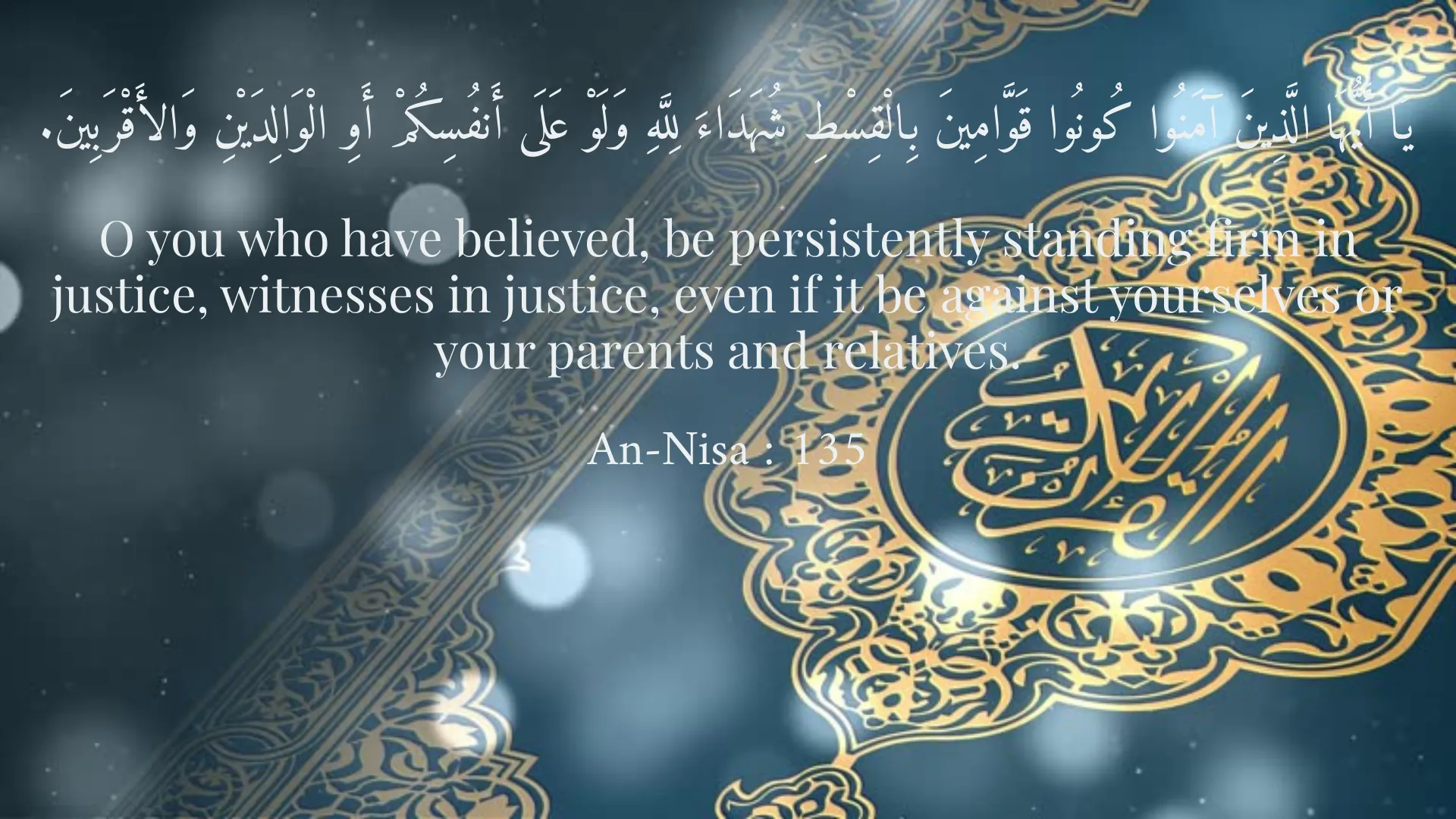
يَا أَيُّهَا الَّذِينَ آمَنُوا كُونُوا قَوَّامِينَ بِالْقِسْطِ شُهَدَاءَ لِلَّهِ وَلَوْ عَلَى أَنفُسِكُمْ أَوِ الْوَالِدَيْنِ وَالأَقْرَبِينَ.
O you who have believed, be persistently standing firm in justice, witnesses in justice, even if it be against yourselves or your parents and relatives.
An-Nisa : 135
يَا أَيُّهَا الَّذِينَ آمَنُوا كُونُوا قَوَّامِينَ لِلَّهِ شُهَدَاءَ بِالْقِسْطِ وَلَا يَجْرِمَنَّكُمْ شَنَانُ قَوْمٍ عَلَى أَلَّا تَعْدِلُوا.
O you who have believed, be persistently standing firm in justice, witnesses for Allah, even if it be against yourselves or your parents and relatives.
Al-Ma'idah : 8
Short Story
One day, Adel, an upright and thoughtful man, decided to ponder the concept of justice while sitting in the park. He recalled verse 135 of Surah An-Nisa, which clarified the meaning of justice for him. After reflecting on this verse, he decided to uphold justice in all his dealings and encourage his friends and loved ones to adhere to this principle in life.