Quranic Answer
While the Holy Quran does not contain an explicit verse directly stating, 'Beware of being deceived by outward beauty,' its profound teachings and numerous warnings implicitly and comprehensively caution humanity against being deluded by any transient and fleeting worldly adornment, including physical beauty. These warnings fundamentally shift focus from superficial appearances to the essence of matters, inviting humans to cultivate deeper insights beyond the external shell. The Quran vehemently emphasizes the paramount importance of piety (taqwa), faith, righteous deeds, and moral and spiritual values, all of which are internal and enduring, in contrast to anything that is merely outward, ephemeral, and superficial. One of the central concepts in the Quran is the emphasis on 'taqwa' as the primary criterion for human honor and nobility. Allah states in Surah Al-Hujurat, verse 13: 'O mankind, indeed We have created you from male and female and made you peoples and tribes that you may know one another. Indeed, the most noble of you in the sight of Allah is the most righteous of you. Indeed, Allah is Knowing and Acquainted.' This verse clearly articulates that the measure of human worth is neither race, lineage, wealth, nor physical beauty, but rather piety, avoidance of sin, and closeness to Allah. Physical beauty, however great it may be, is a divine gift. However, if it leads to arrogance, pride, self-admiration, or becomes a tool for deception and sin, it loses its value in the sight of Allah and can even prove detrimental to the individual. Individuals who rely solely on their physical attractiveness and neglect moral and spiritual virtues are, in essence, clinging to a mirage that will sooner or later dissipate. This deception can hinder individuals from developing deeper aspects of their being, such as knowledge, wisdom, kindness, and patience, trapping them in the most superficial layers of life. The Quran consistently calls believers to deep reflection and not to be content with appearances, for the truth of matters lies behind the veil of the apparent. The Quran repeatedly highlights the transient and fleeting nature of worldly life, contrasting it with the eternal life of the Hereafter. In Surah Al-Kahf, verse 46, we read: 'Wealth and children are the adornment of [this] worldly life; but the enduring good deeds are better with your Lord for reward and better for [one’s] hope.' In this verse, 'wealth and children' are described as 'the adornment of this worldly life' (zinat al-hayat al-dunya). Physical beauty is also part of this adornment and fleeting grandeur. The Quran’s purpose here is not to negate beauty or wealth entirely, but to warn against excessive attachment and being deceived by these temporary allurements, especially if they divert one from the ultimate purpose of creation and life. If a person values themselves or others solely based on outward beauty, they are essentially attached to a superficial and unstable dimension of existence, neglecting the deeper and more enduring aspects of being. This neglect can lead to poor decisions in life, such as choosing a spouse or friend based purely on looks, disregarding moral and spiritual qualities that are the bedrock of true happiness. This Quranic perspective guides individuals toward more sustainable and meaningful evaluations. Furthermore, the Quran explicitly warns against being 'deluded by the life of this world.' In Surah Luqman, verse 33, it states: 'O mankind, fear your Lord and fear a Day when no father will avail his son, nor will a son avail his father at all. Indeed, the promise of Allah is truth, so let not the worldly life delude you and be not deceived by the Deceiver concerning Allah.' The word 'taghurrannakum' (let it not delude you), derived from 'ghurur' meaning deception or delusion, generally encompasses anything that distracts a person from the truth and leads them towards falsehood. Physical beauty can certainly be one such deceptive factor, especially if it causes an individual to become arrogant, use it for immoral purposes, or forget true values. Satan, the ultimate 'Ghurur' (Deceiver), constantly strives to mislead humanity with false and superficial worldly attractions, diverting them from the righteous path. While physical beauty itself is not a sin, it can become a tool in the hands of Satan to lead individuals towards self-admiration, lust, unfair comparisons, or even greater sins. This is particularly crucial in modern societies that place increasing importance on appearances; where individuals might abandon moral and spiritual values or resort to unhealthy means to maintain or display their outward beauty. This part of the Quranic teachings reminds us of the necessity for insight and discernment between reality and mirage. The overarching message of the Quran is that what truly matters in the sight of Allah and for the reckoning in the Hereafter are good deeds, sincere faith, purity of heart, and piety, not one's physical appearance, wealth, or social status. Outward beauty is something that perishes and turns to dust in the grave, but a person's deeds and intentions remain with them in the eternal abode. This does not mean that Islam rejects beauty and adornment; on the contrary, it encourages cleanliness and neatness, as Allah is beautiful and loves beauty. The Prophet Muhammad (peace be upon him) said: 'Indeed, Allah is beautiful and loves beauty.' However, this adornment must be balanced and should never lead to deception, arrogance, or negligence of life's fundamental truths. For example, when choosing a spouse, the Quran advises believers to pay special attention to religiosity and good character, in addition to outward criteria, because beauty without ethics is not sustainable and does not guarantee a happy marital life. Marriages based solely on physical beauty often face significant challenges because they lack strong spiritual and ethical foundations. This emphasis on the inner self should be considered not only in choosing a spouse but in all our social and individual interactions. In conclusion, the Quran's warning regarding the deception of outward beauty is part of its broader caution against being misled by all worldly allurements and neglecting the primary purpose of creation. The Quran calls us to insight and depth, urging us not to be enslaved by fleeting appearances but to seek the essence of existence, enduring values, and the pleasure of our Lord. This perspective is crucial not only individually but also socially; a society that prioritizes only appearances drifts away from justice, ethics, and spirituality and leans towards superficiality and excessive materialism. Therefore, physical beauty itself is not inherently bad; rather, how it is used, the degree of attachment to it, and its effect on one's heart and actions determine its value and role in the path of human perfection. This Quranic insight is a path to liberation from the bondage of appearances and to achieving true tranquility and eternal bliss, helping individuals find their true path and attain desired perfection in a dazzling world.
Related Verses
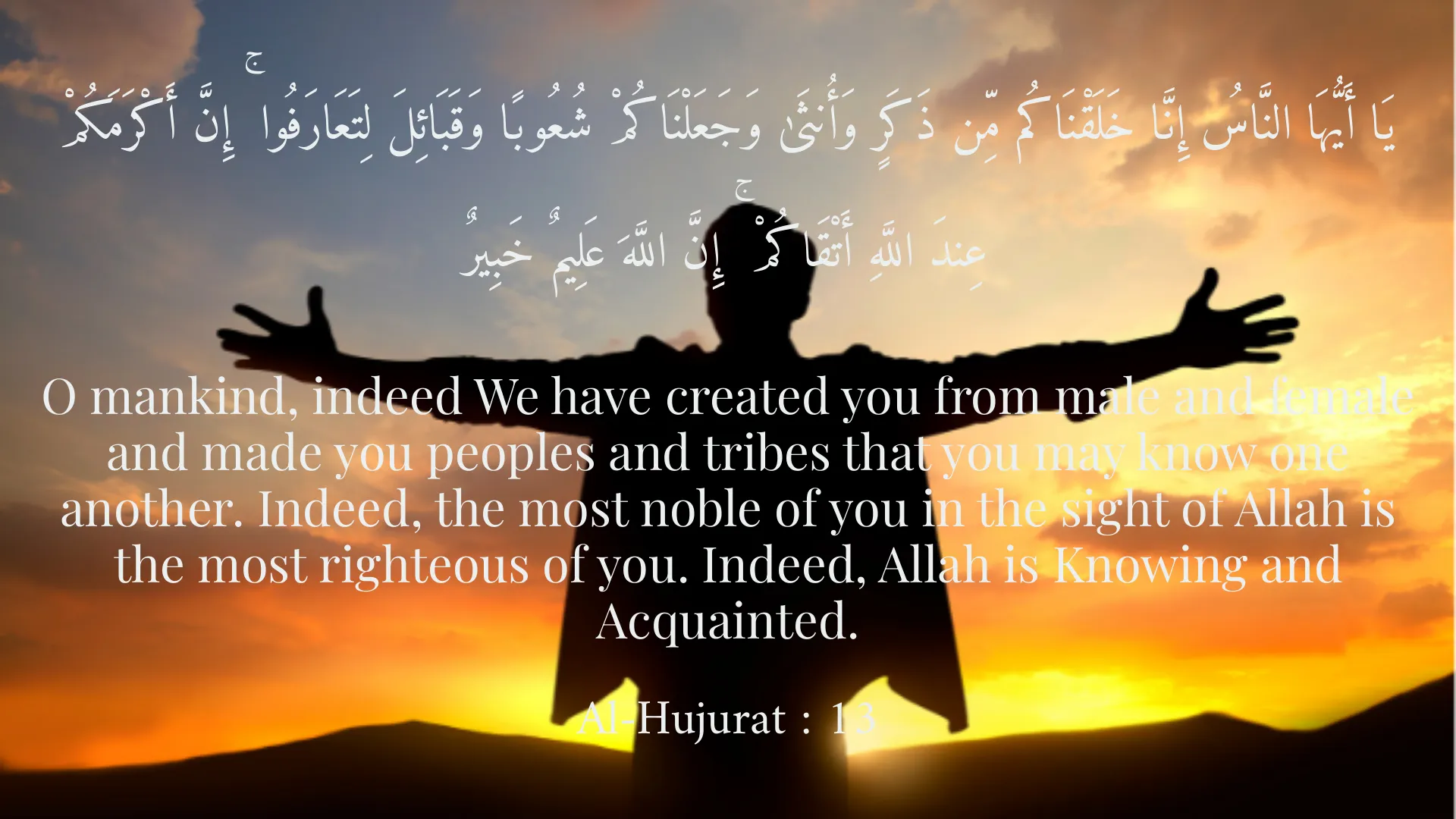
يَا أَيُّهَا النَّاسُ إِنَّا خَلَقْنَاكُم مِّن ذَكَرٍ وَأُنثَىٰ وَجَعَلْنَاكُمْ شُعُوبًا وَقَبَائِلَ لِتَعَارَفُوا ۚ إِنَّ أَكْرَمَكُمْ عِندَ اللَّهِ أَتْقَاكُمْ ۚ إِنَّ اللَّهَ عَلِيمٌ خَبِيرٌ
O mankind, indeed We have created you from male and female and made you peoples and tribes that you may know one another. Indeed, the most noble of you in the sight of Allah is the most righteous of you. Indeed, Allah is Knowing and Acquainted.
Al-Hujurat : 13
الْمَالُ وَالْبَنُونَ زِينَةُ الْحَيَاةِ الدُّنْيَا ۖ وَالْبَاقِيَاتُ الصَّالِحَاتُ خَيْرٌ عِندَ رَبِّكَ ثَوَابًا وَخَيْرٌ أَمَلًا
Wealth and children are the adornment of [this] worldly life; but the enduring good deeds are better with your Lord for reward and better for [one's] hope.
Al-Kahf : 46
يَا أَيُّهَا النَّاسُ اتَّقُوا رَبَّكُمْ وَاخْشَوْا يَوْمًا لَّا يَجْزِي وَالِدٌ عَن وَلَدِهِ وَلَا مَوْلُودٌ هُوَ جَازٍ عَن وَالِدِهِ شَيْئًا ۚ إِنَّ وَعْدَ اللَّهِ حَقٌّ ۖ فَلَا تَغُرَّنَّكُمُ الْحَيَاةُ الدُّنْيَا وَلَا يَغُرَّنَّكُم بِاللَّهِ الْغَرُورُ
O mankind, fear your Lord and fear a Day when no father will avail his son, nor will a son avail his father at all. Indeed, the promise of Allah is truth, so let not the worldly life delude you and be not deceived by the Deceiver concerning Allah.
Luqman : 33
Short Story
One of Sa'di's stories from Gulistan beautifully illustrates the importance of inner essence over outward appearance. It is narrated that a king was passing through a city. Among the people, his attention was drawn to a man with a very disheveled appearance and tattered clothes, yet despite his apparent poverty, he seemed dignified and serene. The king said to his vizier, "Do you see that man? He has a very unappealing and poor appearance, but in his countenance, there is a grandeur and tranquility that I do not see in many wealthy individuals." The vizier replied, "My lord, one should not judge based on appearances; many worldly splendors are transient and hollow, and many good inner qualities are hidden beneath a simple cover." The king ordered the man to be brought before him. After conversing with him, the king realized that he was a learned scholar and a devout mystic for whom the world and its outward beauties held no value, and whose heart was filled with divine wisdom and knowledge. The king was greatly impressed by what he learned and bestowed fine garments upon him. The wise man said, "O King, you saw my outward appearance and were not deceived by it, but in truth, it was knowledge and wisdom that drew you to me, not this worn body. This shows that true value lies within, and tattered or fine clothes are merely coverings." The king took heed of his words and understood that what truly endures is a beautiful character and inner perfections, not a fleeting and transient face.