Quranic Answer
The Holy Quran is a profound guide for humanity, directing us toward behaviors and attitudes that cultivate healthy relationships among individuals. Love and kindness are emphasized throughout its verses, underscoring their importance in forging connections that are not only significant but essential to the fabric of society. This concept is vividly expressed in Surah Al-Imran, verse 159, where Allah tells His Messenger, Prophet Muhammad: 'So by mercy from Allah, [O Muhammad], you were lenient with them.' This statement encapsulates the essence of gentleness as a divine quality, reflecting the mercy that Allah bestows upon humanity. When we emulate this divine mercy in our daily interactions, it becomes a catalyst for kindness that permeates our relationships with others. The essence of kindness derived from divine mercy is further reinforced by the Quranic insistence on social responsibilities. In Surah Al-Baqarah, verse 83, Allah commands believers: 'And remember when We took the covenant from the Children of Israel, [enjoining upon them], 'Do not worship except Allah; and to parents, do good...' This verse reiterates the importance of treating others with respect and care, illustrating that kindness is not merely a personal virtue but a collective obligation. Within this framework, we are encouraged not only to develop a mindset of kindness but also to actively engage in actions that uplift those around us. The impact of kindness on social relationships is significant; when we treat others well, we create environments where love and understanding can thrive. The symbolic relationship between kindness and its positive outcomes can be observed in various aspects of life, particularly within the family structure. By practicing kindness in our interactions with family members, such as children and spouses, we contribute to building a nurturing atmosphere. Families that embrace kindness often discover a deeper sense of unity, resilience, and love—a nurturing space where all members feel valued and respected. Moreover, kindness transcends family relationships and extends to the larger community. When individuals act with compassion and respect toward their neighbors, colleagues, and acquaintances, they foster a spirit of cooperation and unity that enhances community bonds. In Surah Al-An'ām, verse 151, Allah emphasizes the importance of kindness towards relatives, stating: 'Say, 'Come, I will recite what your Lord has prohibited to you - that you not associate anything with Him, and to parents, good treatment...' This verse aknowledges that kindness begins at home and radiates outward into society, suggesting that the cycles of love and kindness can create a larger network of human relations that uplift everyone involved. To implement the teachings of the Holy Quran regarding kindness, we can adopt practical behaviors that align with these values. One effective method is through the practice of active listening. By giving our full attention to others and showing genuine interest in their thoughts and feelings, we convey a sense of respect and care that promotes understanding and builds trust. Another approach is to express gratitude openly. Acknowledging the efforts of those around us not only fosters goodwill but also reinforces positive behaviors that contribute to a cycle of kindness. Additionally, acts of service can take kindness to another level, allowing us to engage directly with those in need. Whether volunteering for charitable organizations, aiding neighbors, or simply offering a helping hand, these actions not only bring comfort to others but also enrich our own lives. The Quran encourages believers to engage in charitable acts, reflecting the understanding that helping others is an act of selflessness that enhances one's sense of purpose and community. In conclusion, the teachings of the Holy Quran provide profound insights into the importance of love and kindness in human relationships. These components are not merely suggestions but essential elements of a fulfilling life. By embracing divine mercy, displaying kindness in our daily interactions, and adhering to social responsibilities, we can establish stronger connections with those around us. This commitment to kindness not only benefits individuals but also contributes to the creation of a society characterized by compassion and love. As we work to embody the principles laid out in the Quran, we have the potential to create a world where love prevails, nurturing a cycle of kindness that enhances all facets of life. Therefore, let us heed the call of the Holy Quran and endeavor to infuse love and kindness into our lives, impacting ourselves and the wider community positively.
Related Verses
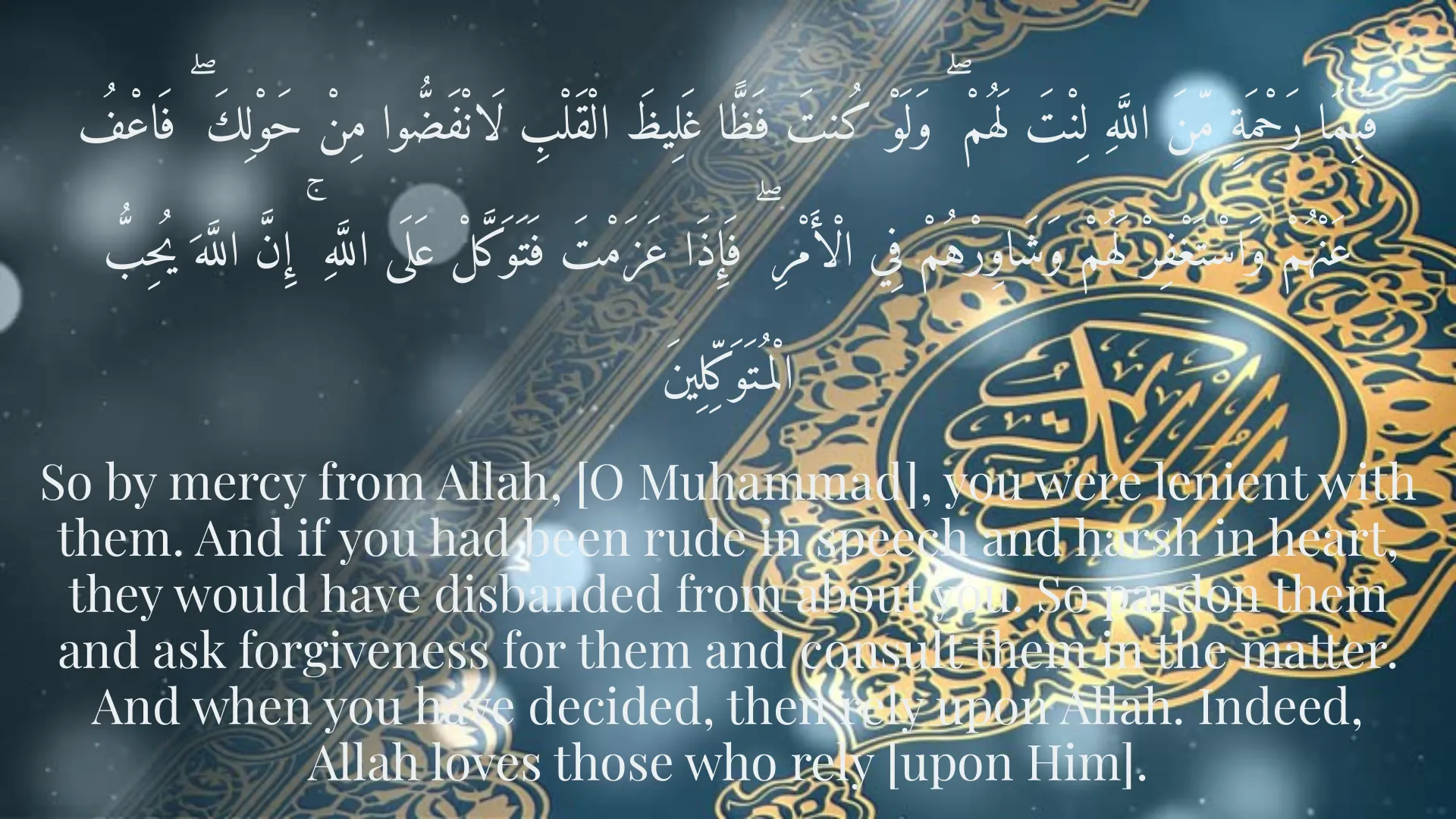
فَبِمَا رَحْمَةٍ مِّنَ اللَّهِ لِنْتَ لَهُمْ ۖ وَلَوْ كُنتَ فَظًّا غَلِيظَ الْقَلْبِ لَانْفَضُّوا مِنْ حَوْلِكَ ۖ فَاعْفُ عَنْهُمْ وَاسْتَغْفِرْ لَهُمْ وَشَاوِرْهُمْ فِي الْأَمْرِ ۖ فَإِذَا عَزَمْتَ فَتَوَكَّلْ عَلَى اللَّهِ ۚ إِنَّ اللَّهَ يُحِبُّ الْمُتَوَكِّلِينَ
So by mercy from Allah, [O Muhammad], you were lenient with them. And if you had been rude in speech and harsh in heart, they would have disbanded from about you. So pardon them and ask forgiveness for them and consult them in the matter. And when you have decided, then rely upon Allah. Indeed, Allah loves those who rely [upon Him].
Al-Imran : 159
وَإِذْ أَخَذْنَا مِيثَاقَ بَنِي إِسْرَائِيلَ لَتَعْبُدُنَّ إِلَّا اللَّهَ وَبِالْوَالِدَيْنِ إِحْسَانًا وَذِى الْقُرْبَىٰ وَالْيَتَامَىٰ وَالْمَسَاکِينِ وَقُولُوا لِلنَّاسِ حُسْنًا ۚ وَأَقِيمُوا الصَّلَاةَ وَآتُوا الزَّكَوٰةَ ۚ ثُمَّ تَوَلَّيْتُمْ إِلَّا قَلِيلًا مِّنكُمْ ۖ وَأَنتُمْ مُعْرِضُونَ
And [mention] when We took the covenant from the Children of Israel, [enjoining them], 'Do not worship except Allah; and to parents, do good and to relatives, orphans, and the needy. And speak to people good [words] and establish prayer and give zakah.' Then you turned away, except for a few of you, and you were refusing.
Al-Baqarah : 83
قُلْ تَعَالَوْا أَتْلُ مَا حَرَّمَ رَبُّكُمْ عَلَيْكُمْ أَلَّا تُشْرِكُوا بِهِ شَيْئًا وَبِالْوَالِدَيْنِ إِحْسَانًا ۖ وَلَا تَقْتُلُوا أَوْلَادَكُمْ خَشْيَةَ إِمْلاقٍ ۚ نَحْنُ نَرْزُقُهُمْ وَإِيَّاكُمْ ۚ إِنَّ قَتْلَهُمْ كَانَ خِطًّا كَبِيرًا
Say, 'Come, I will recite what your Lord has prohibited to you - that you not associate anything with Him, and to parents, good treatment. And do not kill your children for fear of poverty; We provide for them and for you. Indeed, killing them is a great sin.'
Al-An'ām : 151
Short Story
Once upon a time, there was a man named Sohrab who lived in a not-so-distant land. Sohrab was always trying to be kind to others, but sometimes in the bustle of daily life, he forgot how much kindness could change people's lives. One day, as he was walking down the street, he noticed a little girl crying. He approached her and started talking, learning that she was lost. Sohrab gently comforted her and helped her find her way back to her mother. He saw that his kindness not only brought peace to the girl but also made him feel happy and at peace. He realized that the more kind he was in his life, the happier he became, and this positive cycle continued.