Quranic Answer
In the rich and profound teachings of the Holy Quran, pride (kibr or istikbar) is identified as one of the greatest spiritual and moral afflictions that diverts humans from the path of truth and hinders their growth and elevation. The Quran repeatedly points to the detrimental consequences of pride and emphasizes the importance of humility and modesty. The roots of pride typically lie in human ignorance regarding their true existence, their place in the universe, and the absolute power of God. A proud person perceives themselves as superior to others, refuses to accept the truth, and rebels against divine commands. This trait not only tarnishes their relationship with their Creator but also leads to isolation, hatred, and hypocrisy in social interactions. For controlling pride, the Quran offers practical and fundamental strategies rooted in the remembrance of God, understanding one's true self, and accepting the status of servitude. The first step in controlling pride is to gain knowledge of Allah and recognize His boundless greatness. Whenever a person realizes the majesty of their Creator, they find themselves humble and insignificant before Him, and this realization gradually purifies their being from pride. Numerous verses in the Quran emphasize God's power, wisdom, and glory, inviting humans to reflect on the creation of the heavens and the earth, and the astonishing order of the universe. This reflection leads a person to humility before the Creator of existence. For instance, in Surah Luqman (verse 18), God warns humans not to walk with arrogance and self-conceit, and in Surah Al-Isra (verse 37), it is emphasized not to walk upon the earth with arrogance, for you can never tear the earth apart nor reach the height of the mountains; all of these are disliked and abominable. These verses clearly indicate that the source of all power and greatness is God alone, and humans possess nothing before Him. The second Quranic strategy for curbing pride is self-knowledge and reflection on one's existential nature. A person must remember that they were created from dust and will return to dust, and all blessings and abilities they possess are from divine grace and mercy, not from their inherent merit or deservingness. This constant reminder of human's intrinsic poverty and need for God creates a strong shield against pride. The Quran recounts the stories of Pharaoh and Qarun as examples of those who, due to pride, reached the peak of arrogance and ultimately met destruction. Qarun was proud of his wealth and power, and Pharaoh of his kingship and dominion. Both were ultimately annihilated in the worst possible way, serving as a lesson for future generations. These stories are a warning bell for anyone who might succumb to pride based on their temporary and material capabilities. The third strategy is practical humility and service to creation. The Quran encourages believers to do good to others, show empathy, and help the needy. Someone who serves others and sees themselves as a servant leaves no room for pride in their being. Also, associating with humble individuals and avoiding environments where pride and arrogance are prevalent is highly effective. Supplication and earnest prayer to God, seeking forgiveness and well-being, and acknowledging one's weakness and need before God are also among the actions that gradually uproot pride from a person's heart. Prophet Muhammad (peace be upon him), who was the supreme model of humility, always avoided any sign of pride and considered himself a servant of the people. The fourth strategy is to pay attention to the consequences and ultimate fate of pride in this world and the hereafter. The Holy Quran explicitly states that God does not love the arrogant and does not guide them. In Surah An-Nahl (verse 23), it is stated: "Indeed, He does not like the arrogant." And in Surah Ghafir (verse 60), God says: "And your Lord said, 'Call upon Me; I will respond to you.' Indeed, those who disdain My worship will enter Hell in humiliation." These verses serve as a serious warning for anyone caught in the trap of pride. The worldly consequences of pride also include isolation, lack of success in relationships, and missed opportunities. In contrast, humility paves the way for solving many problems and earns divine love and the affection of people. Ultimately, controlling pride is a continuous process that requires constant vigilance. A person must always guard their soul and whenever they observe signs of pride within themselves, immediately remember God and curb it through acts such as seeking forgiveness, prayer, and serving others. The goal of all this is to achieve inner peace and harmony with the divine will; a peace that is attained only through humility and true servitude, placing a person on the path of perfection and lasting felicity. Pride is like a veil that stands between a person and truth, and only by removing this veil can one attain divine light.
Related Verses
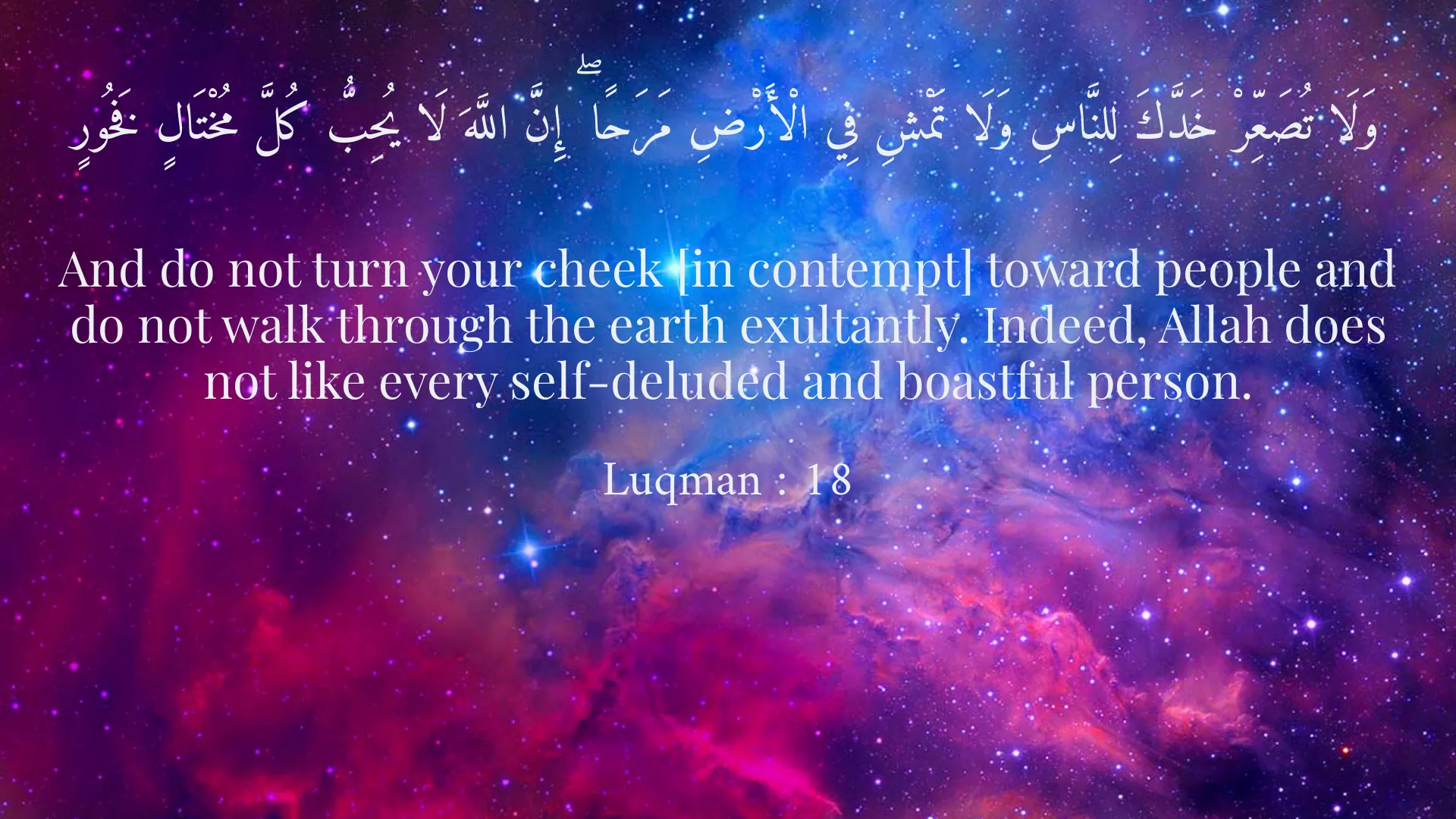
وَلَا تُصَعِّرْ خَدَّكَ لِلنَّاسِ وَلَا تَمْشِ فِي الْأَرْضِ مَرَحًا ۖ إِنَّ اللَّهَ لَا يُحِبُّ كُلَّ مُخْتَالٍ فَخُورٍ
And do not turn your cheek [in contempt] toward people and do not walk through the earth exultantly. Indeed, Allah does not like every self-deluded and boastful person.
Luqman : 18
وَلَا تَمْشِ فِي الْأَرْضِ مَرَحًا ۖ إِنَّكَ لَن تَخْرِقَ الْأَرْضَ وَلَن تَبْلُغَ الْجِبَالَ طُولًا
And do not walk upon the earth exultantly. Indeed, you will never tear the earth apart, and you will never reach the mountains in height.
Al-Isra : 37
لَا جَرَمَ أَنَّ اللَّهَ يَعْلَمُ مَا يُسِرُّونَ وَمَا يُعْلِنُونَ ۚ إِنَّهُ لَا يُحِبُّ الْمُسْتَكْبِرِينَ
Assuredly, Allah knows what they conceal and what they declare. Indeed, He does not like the arrogant.
An-Nahl : 23
وَقَالَ رَبُّكُمُ ادْعُونِي أَسْتَجِبْ لَكُمْ ۚ إِنَّ الَّذِينَ يَسْتَكْبِرُونَ عَنْ عِبَادَتِي سَيَدْخُلُونَ جَهَنَّمَ دَاخِرِينَ
And your Lord said, 'Call upon Me; I will respond to you.' Indeed, those who disdain My worship will enter Hell in humiliation.
Ghafir : 60
Short Story
It is narrated in Saadi's Golestan that a king, full of pride, sat upon his throne surrounded by numerous servants and retinues. One day, at the height of his power, he boasted to one of his courtiers, saying, 'No one in the world can attain my rank and glory.' At that very moment, a dervish was passing by the palace. He heard the king's voice and, with a gentle smile, said, 'O King! You boast so much about possessing a throne and crown, but do not forget that your throne is made of wood and stone, and your body is also made of dust. True kingship is to rule over hearts, not over bodies. Your greatness in this fleeting world is like a ripple on water, which will soon vanish. Your eternal abode and true throne is the humility you cultivate in your heart, and that is imperishable.' The king, hearing these wise words, pondered for a moment and felt ashamed of his pride. He realized that true kingship lies in humility, not in outward pomp and splendor.