Quranic Answer
Hypocrisy is a complex psychological state that has fascinated scholars, theologians, and psychologists alike for centuries. As defined in both a psychological context and within various religious frameworks, hypocrisy refers to the phenomenon where an individual consciously or unconsciously presents themselves in a way that contradicts their inner beliefs. This contradiction is particularly profound in the realm of faith, highlighting a significant disparity between an individual’s professed beliefs and their actual faith practices. In understanding hypocrisy, particularly in the context of the Islamic faith as discussed in the Holy Quran, one can discern deeper moral and ethical implications that extend far beyond mere duplicity. The Holy Quran serves as a cornerstone of guidance for believers, emphasizing the importance of sincerity in both faith and actions. One of the key messages throughout the Quran is the call for believers to embody their faith through genuine actions that reflect their beliefs. Hypocrisy, in this regard, is not merely about saying the right words but about living a life that is coherent with those words. The Quran warns against the dangers of duplicity, highlighting that when an individual neglects God and the principles of Islam internally while outwardly displaying faith and piety, they risk falling into the trap of hypocrisy. As individuals navigate social circles that may question or challenge their beliefs, the struggle between personal conviction and societal acceptance becomes evident. Hypocrisy often takes root in these tensions, leading individuals to present a facade that aligns with external expectations rather than their internal truths. For instance, a person might publicly profess their faith in Allah while privately engaging in actions that contradict Islamic teachings. This internal and external contradiction gradually fosters hypocrisy in their hearts, cultivating a mindset where self-interest and conformity to worldly desires supersede foundational beliefs. Allah addresses this issue directly in the Holy Quran, specifically in Surah Al-Baqarah, verse 8. The verse states: "And among the people are some who say, 'We believe in Allah and the Last Day,' but they are not believers." This succinct yet powerful declaration underscores the notion that many may outwardly profess their faith while their inner hearts remain disconnected from their stated beliefs. This duality not only poses a spiritual concern but also raises questions about the authenticity of relationships within faith communities, prompting believers to reflect on the sincerity of their faith and the alignment between their inner convictions and outward expressions. Diving deeper into the implications of hypocrisy, one can identify how it may stem from societal pressures, personal insecurities, or a profound misunderstanding of faith and its teachings. Individuals may feel compelled to adopt certain beliefs or practices due to peer pressure, cultural expectations, or a desire for social approval. This phenomenon exposes a crucial aspect of human psychology where the need for belonging can overshadow personal integrity. When this occurs, it can lead to a gradual moral decline, as the individual continuously compromises their values in favor of social acceptance. Moreover, the fading of genuine belief can result in an erosion of spiritual wellbeing. When individuals allow hypocrisy to govern their lives, the resulting disconnect from divine commandments can culminate in a diminished love for God. This disconnect not only affects their personal relationship with the divine but also ripples through their interactions within the community, often leading to a culture of mistrust and disillusionment among fellow believers. The progression of hypocrisy can be insidious. Initially, an individual may justify minor deviations from their beliefs, perceiving them as harmless. However, as time passes and such justifications become more frequent, a pattern of behavior emerges that forms a foundation of insincerity. This pattern often leaves individuals in a state of confusion; their faith becomes overshadowed by doubt and anxiety, creating a spiritual crisis that can be difficult to navigate. In conclusion, hypocrisy is not merely a flaw of character; it is a profound psychological state that can lead to devastating spiritual consequences. The teachings of the Holy Quran serve as a timeless reminder for believers to engage with sincerity in their faith and actions. By refusing to succumb to the pressures of societal expectation and being vigilant about the contradictions between their inner beliefs and outward expressions, individuals can mitigate the development of hypocrisy in their lives. To combat hypocrisy, it is essential for individuals to cultivate a personal relationship with God that is genuine and deeply rooted in Islamic principles. Honesty and transparency in one’s dealings, both with oneself and others, should be prioritized, as these qualities can help to bridge the gap between internal beliefs and external expressions. Furthermore, engaging with fellow believers in open discussions about challenges related to faith can foster a supportive community where individuals are encouraged to remain steadfast in their convictions. Ultimately, the journey toward overcoming hypocrisy is an ongoing process of self-discovery and spiritual awakening. As believers strive for authenticity in their faith, they contribute not only to their own spiritual health but also to the overall integrity of their faith community. The Quran’s emphasis on sincere belief and action highlights the necessity of harmony between one's internal convictions and external practices, a lesson that remains relevant in today’s complex world.
Related Verses
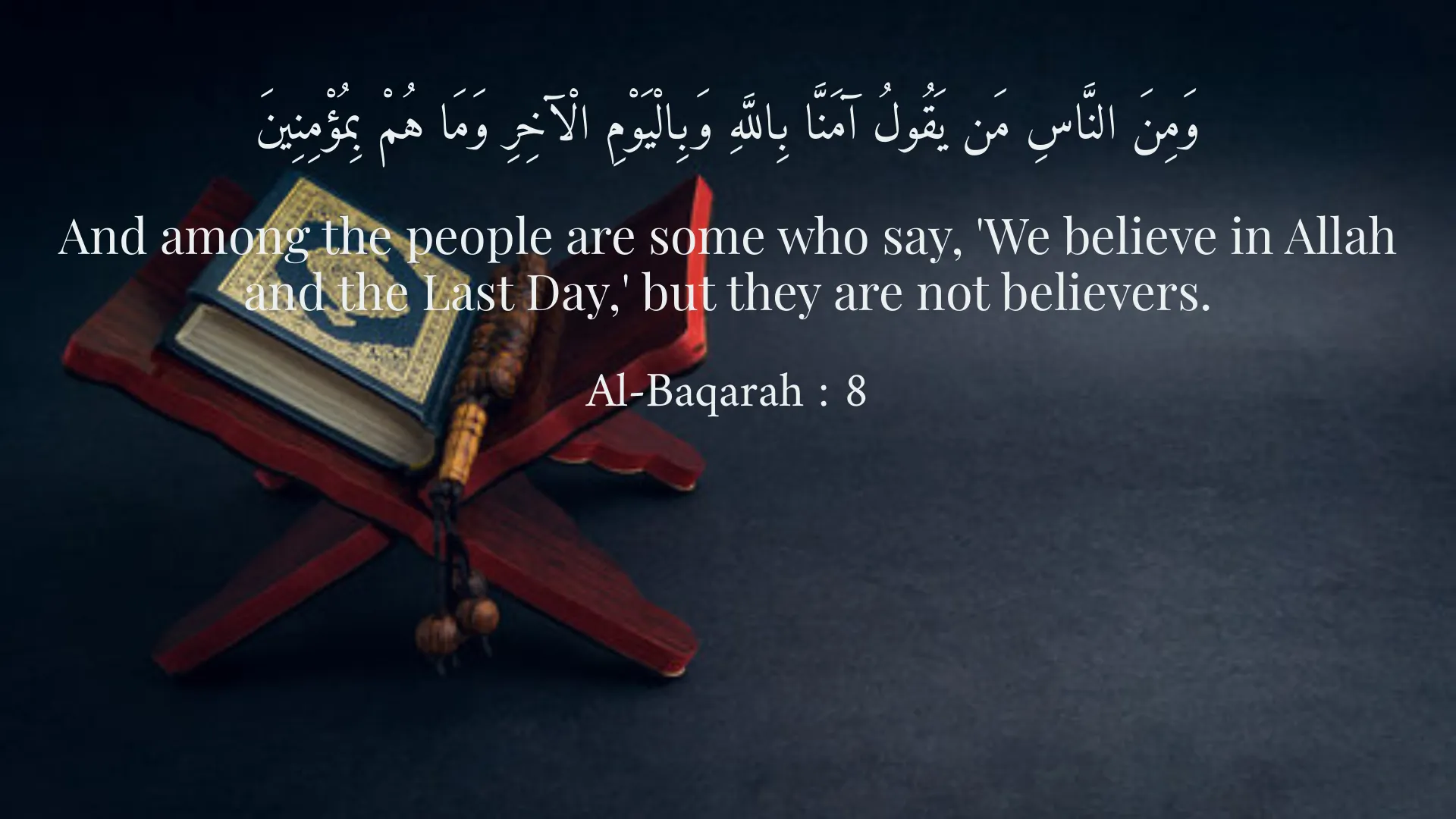
وَمِنَ النَّاسِ مَن يَقُولُ آمَنَّا بِاللَّهِ وَبِالْيَوْمِ الْآخِرِ وَمَا هُمْ بِمُؤْمِنِينَ
And among the people are some who say, 'We believe in Allah and the Last Day,' but they are not believers.
Al-Baqarah : 8
إِذَا جَاءَكَ الْمُنَافِقُونَ قَالُوا نَشْهَدُ إِنَّكَ لَرَسُولُ اللَّـهِ ۗ وَاللَّـهُ يَعْلَمُ إِنَّكَ لَرَسُولُهُ ۖ وَاللَّـهُ يَشْهَدُ إِنَّ الْمُنَافِقِينَ لَكَاذِبُونَ
When the hypocrites come to you, they say, 'We bear witness that you are indeed the Messenger of Allah.' And Allah knows that you are indeed His Messenger, and Allah bears witness that the hypocrites are indeed liars.
Al-Munafiqun : 2
Short Story
One day, a person named Hasan was contemplating how to rectify his intentions. He realized that some people appeared to be religious, but when he looked into their hearts, he found hypocrisy in them. Hasan decided to build his life on sincerity with himself and God, and in his prayers, he asked Allah to keep him away from hypocrisy. After some time, he felt a greater peace in his heart, and his relationships with others improved as well.